
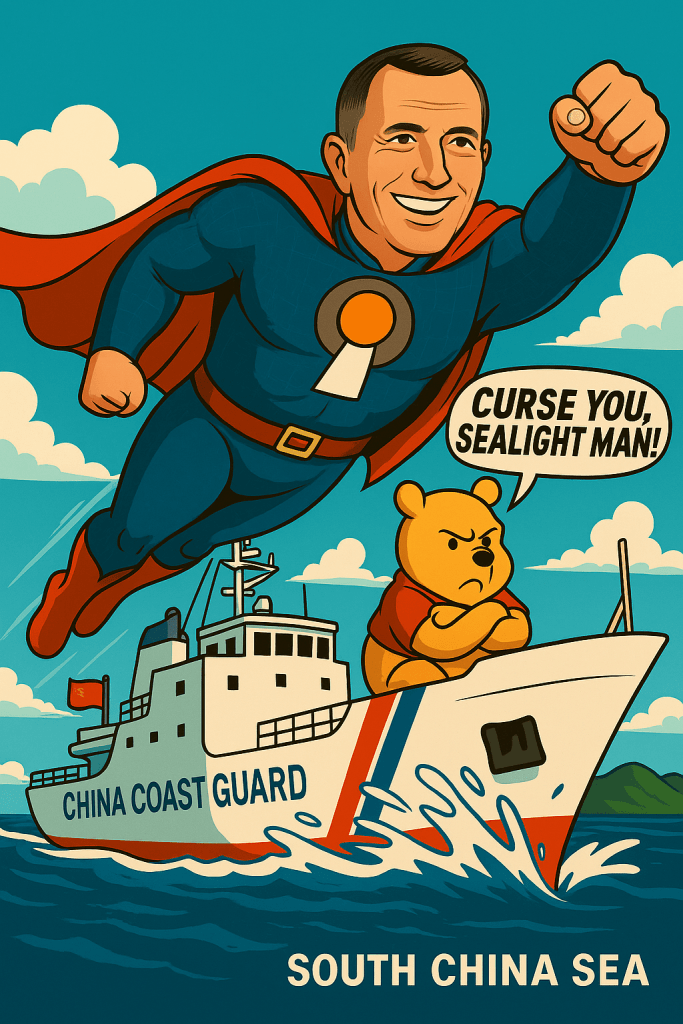
Capes, Cameras, and the Cult of Visibility

Capes, Cameras, and the Cult of Visibility: The SeaLight Crusade as White Savior Theater

By Tina Antonis

The South China Sea is more than a maritime dispute—it’s a theater of narrative warfare. While headlines focus on Chinese aggression and Philippine resistance, a quieter campaign unfolds in the background: one of satellite feeds, curated imagery, and Pentagon-backed storytelling. At the center of this effort is SeaLight, a project that claims to illuminate truth but often casts shadows of its own.

As explored in my article at Antiwar.com, SeaLight doesn’t just document—it performs. It reframes geopolitical tension through moral spectacle, positioning its creators as heroic arbiters of transparency. But when the messenger wears a cape and the funding flows from defense budgets, we must ask: is this clarity, or choreography?

Stage Left: The White Savior Enters

In the comic-strip cosmology of Ray Powell’s SeaLight project, transparency wears a cape. Clad in heroic postures and backed by satellite imagery, Powell casts himself as the guardian of maritime morality—unarmed, except with satellite feeds, theatrical flair, and strategic messaging. 

Yet beneath the cartoon and Pentagon-funded optics lies a familiar archetype: the white savior, rebranded for the South China Sea.

China Is Imperialist? Says Who?

Calling China a “maritime occupier,” Powell positions himself as a bulwark against aggression. But that moral pose collapses under scrutiny. He speaks for a country with over 800 foreign military installations and a documented history of over 250 military interventions since 1991—wars in Iraq, Afghanistan, Libya, Syria, Somalia, and dozens more, all under the banner of peace, freedom, or preemption.

By comparison, China’s post–Cold War footprint includes no sustained foreign occupations and only scattered border conflicts and peacekeeping missions. The imbalance is staggering. And Powell’s framing doesn’t just ignore it—it performs around it.

As David Vine argues in The United States of War, this vast base empire is not a passive network—it’s an architecture of perpetual war. These outposts make military engagement not an exception but a structural habit, cloaked in strategic necessity and sold as global stewardship.

Powell’s cartoon rhetoric—calling China an occupier—obscures the scale of U.S. militarism. The term “occupation” is deployed not to analyze, but to project. When adversaries hold territory, it’s a crisis; when the U.S. spans the globe with armed installations, it’s policy.

Framing Conflict: The Optics of Consent

This isn’t irony. It’s performance. Powell’s language manufactures a moral frame for confrontation—costumed in transparency, but driven by escalation. The cape is literal. The conditioning is deliberate. And the stage is set for war.

SeaLight’s mission is not just visual documentation—it’s narrative warfare. As the Japan Times openly notes, its “chief weapon is photography, applied purposefully, generously and consistently over time.” These images—enhanced, curated, and distributed across media—are not neutral. They’re constructed to shape public perception, sway international opinion, and ultimately manufacture consent for confrontation.

Assertive transparency becomes a kind of ideological scaffolding—a stage on which geopolitical tension is dramatized, simplified, and morally polarized. The goal isn’t simply to reveal conflict; it’s to condition audiences for escalation.

And when the messenger dons a superhero’s cape, the spectacle transforms into something deeper: a story of rescue, of virtue, of intervention. This is not analysis—it’s soft propaganda dressed in heroic metaphor.

Consent for war doesn’t begin with missiles. It begins with mythmaking.

Colonial Project: Inside ‘Israel’s Coalition for Regional Security’ and the Role of Arab Leaders

Twitter

Just hours after the Israeli aggression on Iran ended and Benjamin Netanyahu spoke of “a new Israeli-led Middle East,” a campaign began promoting the so-called “Israeli Coalition for Regional Security,” which reportedly includes 10 Arab leaders, notably from Egypt and Saudi Arabia.

Colonial Project: Inside ‘Israel’s Coalition for Regional Security’ and the Role of Arab Leaders

H/T: Rachel Blevins & Sarah Bils

Related:

The Abraham Shield Plan

The ‘Foreign Policy Consensus’ Is Alive and Well in Washington

The ‘Foreign Policy Consensus’ Is Alive and Well in Washington

by José Niño, Libertarian Institute

Brian Berletic, a former U.S. Marine now residing in Thailand, believes something bigger might be at play with Trump’s foreign policy agenda. The talk of foreign policy restraint vis-a-visa Russia is merely a facade. Berletic pointed out that Defense Secretary Pete Hegseth’s “division of labor” framework during his February 2025 address in Brussels will only increase tensions with Russia.

Read More »

Andriy Biletsky’s Third Corps

Note: The 3rd Assault Brigade is widely regarded as the successor to the Azov Battalion, a unit originally founded by Neo-Nazi Andriy Biletsky. The battalion, later expanded and reorganized into the Azov Regiment, underwent rebranding amid evolving military and political dynamics, eventually forming the core of the current brigade.

El Tercer Cuerpo de Andriy Biletsky (Andriy Biletsky’s Third Corps)

On March 14, Colonel Andriy Biletsky, commander of the Third Assault Brigade, announced its conversion into the Third Corps of the Armed Forces of Ukraine, a formation that will remain under his command. In a video sharing the news on Instagram, Biletsky stated:

Read More »

Hegseth visits Manila: Washington prepares for war with China + More

Hegseth visits Manila: Washington prepares for war with China

The language of Hegseth’s press conference in Manila is indicative of the openly aggressive face of US imperialism under Trump. Gone was any reference to what had been the political shibboleth of Washington in the Asia Pacific region: the defense of “freedom of navigation.” Hegseth spoke rather of “preparing for war,” using the phrase more than once. Every time Hegseth mentioned China he termed it “Communist China,” and spoke of its “aggression.” Hegseth referred to US Seventh fleet commander Admiral Samuel Paparo “and his war plans. Real war plans.”

Read More »

Trump appoints Brent Sadler, a Project 2025 contributor, to MARAD

Trump Appoints Top Naval Strategist Brent Sadler To MARAD

Sadler, a veteran naval officer and senior fellow at the Heritage Foundation (the think take behind Project 2025 but also several maritime initiatives), has been one of the few voices in Washington consistently beating the drum on maritime readiness, sealift capacity, and the critical role of the U.S. Merchant Marine in strategic competition. He’s not just another bureaucrat with a résumé. He’s a serious policy strategist who understands that America bleeds influence without hulls in the water, flags on sterns, and skilled mariners at the helm.

Read More »

Europe Hatches Plans for Ukraine Peacekeepers Without U.S.

Europe Hatches Plans for Ukraine Peacekeepers Without U.S.

Western allies are trying to hash out a bold European idea: sending 10,000 to 30,000 troops to Ukraine to help enforce any eventual peace deal with Russia.

As things stand, the chance of this force ever heading to Ukraine is a long shot, says Bence Németh, a defense expert at King’s College London. European leaders say they will only send troops if there is a lasting peace in Ukraine. Russian President Vladimir Putin has so far ruled out signing a peace deal that includes Western forces in Ukraine. 

Read More »