
Over 1,200 killed in drone strikes in Haiti in less than a year
Read More »Tag: military occupations
Why isn’t China intervening to stop the US war of aggression against Iran?
From Greenland to the Great Lakes, Secession is Our Best Hope for Escaping Tyranny
The regime change of Panama in 1989 is not a good model for dealing with Venezuela
All Elements in Place for a US Decapitation Strike on Venezuela
By Roger D. Harris and Joe Emersberger – Sep 5, 2025
President Donald Trump euphorically concluded his White House press conference on September 2 with breaking news: the US military had just blown up a small motor vessel in the middle of the Caribbean Sea. He alleged that the skiff came from Venezuela and was loaded with illicit drugs headed to the US.
All Elements in Place for a US Decapitation Strike on Venezuela
US backed ethnic cleansing of Serbs, top diplomat secretly told Croat leader
The ethnic cleansing of hundreds of thousands of Serbs by a US-backed Croatian leader was premeditated, according to newly-uncovered files revealing the operation’s planning. After the bloodshed subsided, Richard Holbrooke, a top US diplomat, assured him: “We said publicly… that we were concerned
US backed ethnic cleansing of Serbs, top diplomat secretly told Croat leader
Related:
Syrian Kurdish official rejects Turkish calls to lay down arms, says SDF seeks integration instead +
A top Syrian Kurdish official has rejected Turkish calls for the Syrian Democratic Forces (SDF) to give up their weapons as part of Ankara’s broader peace efforts with Kurdish militants, saying the situation in Syria requires integration, not the laying down of arms.
Ilham Ahmed, co-chair of the Foreign Relations Committee of the Autonomous Administration of North and East Syria (Rojava), told BBC’s Turkish service that the SDF’s continued armed presence is necessary due to ongoing security threats, particularly from Islamic State in Iraq and the Levant (ISIL) remnants and the lack of a permanent Syrian constitution.
Syrian Kurdish official rejects Turkish calls to lay down arms, says SDF seeks integration instead
The U.S. continues to back the Syrian Democratic Forces (SDF)—a coalition dominated by the YPG, which Turkey sees as indistinguishable from the PKK. Despite the PKK’s recent disarmament announcement, Washington has resuscitated funding and military coordination with the SDF—a coalition whose very name was crafted to obscure its PKK lineage. This comes even as the U.S. consolidates its military presence to a single base in Hasakah, signaling a shift from occupation to strategic entrenchment.
In 2019, as Trump was weighing a withdrawal of U.S. troops from Syria during his first term, Tulsi Gabbard brought Ilham Ahmed—the then-head of the Syrian Democratic Council, political wing of the U.S.-backed Syrian Democratic Forces in Rojava—as her guest to Trump’s second State of the Union. The message was clear: autonomy should have air support. Ahmed currently serves as Co-Chair of the Foreign Affairs Department of Rojava, also known as the Democratic Autonomous Administration of North and East Syria.
Related:
Trump should be convinced of US pullout from Syria- but… (Disarmament, dissolution of YPG)
The SDF equals the YPG/PKK/Kurds: A timeline of the PKK’s war on Türkiye
Capes, Cameras, and the Cult of Visibility
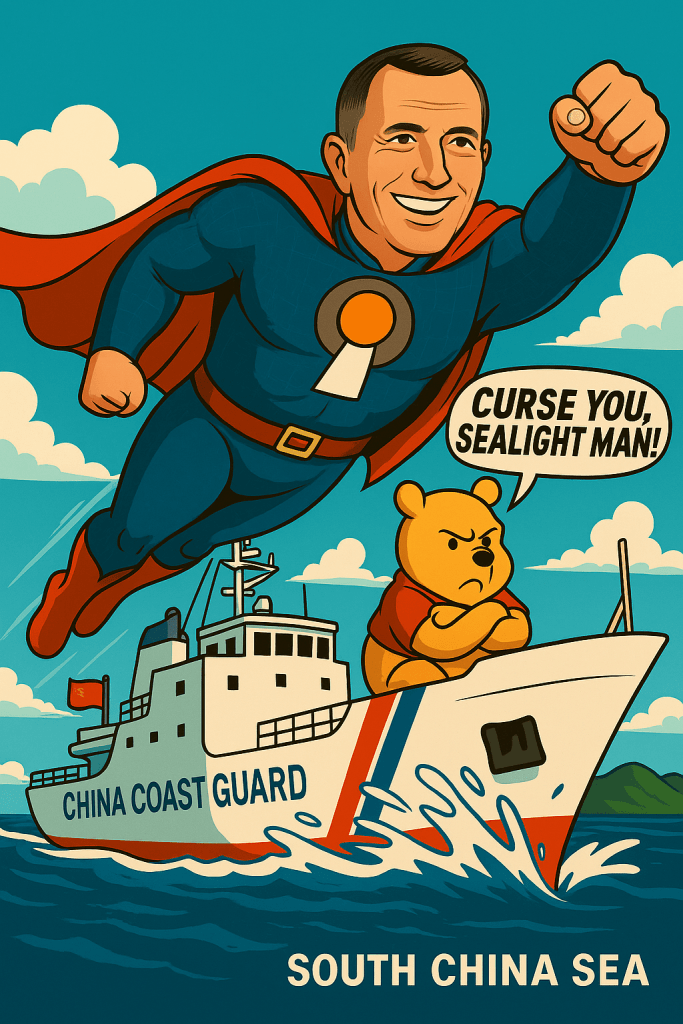
Capes, Cameras, and the Cult of Visibility: The SeaLight Crusade as White Savior Theater
By Tina Antonis
The South China Sea is more than a maritime dispute—it’s a theater of narrative warfare. While headlines focus on Chinese aggression and Philippine resistance, a quieter campaign unfolds in the background: one of satellite feeds, curated imagery, and Pentagon-backed storytelling. At the center of this effort is SeaLight, a project that claims to illuminate truth but often casts shadows of its own.
As explored in my article at Antiwar.com, SeaLight doesn’t just document—it performs. It reframes geopolitical tension through moral spectacle, positioning its creators as heroic arbiters of transparency. But when the messenger wears a cape and the funding flows from defense budgets, we must ask: is this clarity, or choreography?
Stage Left: The White Savior Enters
In the comic-strip cosmology of Ray Powell’s SeaLight project, transparency wears a cape. Clad in heroic postures and backed by satellite imagery, Powell casts himself as the guardian of maritime morality—unarmed, except with satellite feeds, theatrical flair, and strategic messaging.
Yet beneath the cartoon and Pentagon-funded optics lies a familiar archetype: the white savior, rebranded for the South China Sea.
China Is Imperialist? Says Who?
Calling China a “maritime occupier,” Powell positions himself as a bulwark against aggression. But that moral pose collapses under scrutiny. He speaks for a country with over 800 foreign military installations and a documented history of over 250 military interventions since 1991—wars in Iraq, Afghanistan, Libya, Syria, Somalia, and dozens more, all under the banner of peace, freedom, or preemption.
By comparison, China’s post–Cold War footprint includes no sustained foreign occupations and only scattered border conflicts and peacekeeping missions. The imbalance is staggering. And Powell’s framing doesn’t just ignore it—it performs around it.
As David Vine argues in The United States of War, this vast base empire is not a passive network—it’s an architecture of perpetual war. These outposts make military engagement not an exception but a structural habit, cloaked in strategic necessity and sold as global stewardship.
Powell’s cartoon rhetoric—calling China an occupier—obscures the scale of U.S. militarism. The term “occupation” is deployed not to analyze, but to project. When adversaries hold territory, it’s a crisis; when the U.S. spans the globe with armed installations, it’s policy.
Framing Conflict: The Optics of Consent
This isn’t irony. It’s performance. Powell’s language manufactures a moral frame for confrontation—costumed in transparency, but driven by escalation. The cape is literal. The conditioning is deliberate. And the stage is set for war.
SeaLight’s mission is not just visual documentation—it’s narrative warfare. As the Japan Times openly notes, its “chief weapon is photography, applied purposefully, generously and consistently over time.” These images—enhanced, curated, and distributed across media—are not neutral. They’re constructed to shape public perception, sway international opinion, and ultimately manufacture consent for confrontation.
Assertive transparency becomes a kind of ideological scaffolding—a stage on which geopolitical tension is dramatized, simplified, and morally polarized. The goal isn’t simply to reveal conflict; it’s to condition audiences for escalation.
And when the messenger dons a superhero’s cape, the spectacle transforms into something deeper: a story of rescue, of virtue, of intervention. This is not analysis—it’s soft propaganda dressed in heroic metaphor.
Consent for war doesn’t begin with missiles. It begins with mythmaking.
Meet the American military veterans fasting for Gaza
Hundreds of US veterans and allies have been fasting for weeks across the country, in protest against the ongoing war in Gaza
US President Trump Streamlined the National Endowment for Democracy*, not Dismantle it
Brian Berletic, June 11, 2025
While many believe that under the Trump administration the controversial National Endowment for Democracy (NED*) was defunded, dismantled, or otherwise dissolved, the reality is far less dramatic and far more dangerous.
US President Trump Streamlined the National Endowment for Democracy*, not Dismantle it (archived)
 Ms. Cat’s Chronicles
You must be logged in to post a comment.