
The early August visit by US House Speaker Nancy Pelosi took place amid heavy protests from Beijing. The visit was a blatant violation of Washington’s bilateral agreement with Beijing regarding the “One China” policy as well as a violation of international law regarding political independence and territorial integrity.
US Provocations Over Taiwan and Beijing’s Steady Remedy
Tag: military provocations
US to Appoint New Arctic Ambassador With Eye on Russia
US to Appoint New Arctic Ambassador With Eye on Russia
The US military is preparing for a future conflict in the Arctic with Russia, as well as China, by revamping its forces in the region. The US Army released a strategy document last year that said the Arctic has the “potential to become a contested space where United States’ great power rivals, Russia and China, seek to use military and economic power to gain and maintain access to the region at the expense of US interests.”
The US Navy released a similar strategy document in early 2021. Then-Navy Secretary Kenneth Braithwaite suggested that the US could start challenging Russian claims to the Arctic by sending warships near Russia’s northern coast, similar to how the US Navy makes provocative passages near Chinese-controlled islands in the South China Sea.
Related:
Melting ice will change the economics of extracting resources from the Arctic
Of the 90 billion barrels of oil and 1,700 trillion cubic feet of natural gas estimated to lie north of the Arctic Circle, 84% lies offshore. And while Arctic conditions can still be as harsh as they were on the Seabees, the infrastructure of oil and gas extraction has improved vastly. “If people aren’t drilling all over the Arctic now, I don’t think it’s because there’s a gap in technology,” said Stig-Mortean Knutsen, a petroleum geologist at the Arctic University of Norway. “It’s more to do with cost.”
…
These extractive ambitions rub against the urgency of our environmental moment: the need to cut down, rather than pursue, fossil fuel use. As part of their sustainability goals, banks claim they’re now making it difficult for oil firms to get funds for new Arctic projects. Knutsen calls this decision to withhold financing an easy one to make, “like kicking down an open door,” because the upfront expense of a project is so steep today. If those expenses shrink in a warming Arctic, banks might well step up once again, he said. One sustainability executive at a London-based bank, who asked not to be named, pointed out: “In any case, China and Russia will be happy to fund new projects.”
…
Ironically, to best transition away from carbon fuels, the Arctic may first have to yield up another kind of resource: metals. The batteries, electric vehicles, and fuel cells of the future will need huge quantities of copper, nickel, manganese, rare earths, and other metals, said Gerard Barron, the CEO of The Metals Company, which hopes to mine the sea floor once the International Seabed Authority, a body within the UN, finalizes an undersea mining code. Barron’s miners are most actively studying the Clarion Clipperton Zone, a region just south of Hawai’i, where there is, Barron believes, enough metal to build 280 million EV batteries.
Amidst Uproar Over Nancy Pelosi’s Visit to Taiwan, Media Ignores Aggressive U.S. Maritime Action in South China Seas
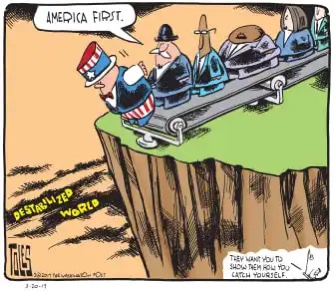
In order to force high-tech companies to decouple from the People’s Republic of China and reverse U.S. decline, U.S. imperialism needs a political/military crisis with China
Amidst Uproar Over Nancy Pelosi’s Visit to Taiwan, Media Ignores Aggressive U.S. Maritime Action in South China Seas
U.S. election cycle drives new confrontations with China, Russia
Global Times | August 1, 2022
Dim mid-term election prospects of Democrats risk igniting more tensions
With less than 100 days to go before the US mid-term elections, many US media outlets, polls and observers see the Democrats’ prospects dim. A new Bloomberg Economics study showed that “President Joe Biden’s party can expect to lose 30 to 40 seats in the House and a few in the Senate too, easily wiping out razor-thin Democratic majorities,” Bloomberg reported on Saturday.
U.S. election cycle drives new confrontations with China, Russia
China to speed up reunification process with comprehensive action as it ramps up military readiness against Pelosi’s Taiwan visit
Former Bolivian President Evo Morales Calls For a Global Campaign to Eliminate NATO
In interview with a British journalist, Morales says the U.S. uses NATO to provoke wars and sell weapons. U.S./UK-backed coup against him in 2019 was undertaken for lithium and because his government advanced an alternative economic model to the neoliberal “Washington Consensus”
Former Bolivian President Evo Morales Calls For a Global Campaign to Eliminate NATO
The Next Giuliani Moment: No War With China
In 2020, when Joe Biden was elected President the American people were told to rejoice, “America is back,” the adults had returned to the room. But did Biden voters know what the incoming administration meant by “America is back?”
The Next Giuliani Moment: No War With China
Related:
Don’t say we didn’t warn you – Symposium of China’s top think tank sends classic, pre-war warning to provocative Pelosi
“Don’t say we didn’t warn you!” – a phrase that was used by the People’s Daily in 1962 before China was forced to fight the border war with India and ahead of the 1979 China-Vietnam War, was frequently mentioned during a forum held Friday by a high-level Chinese think tank, as analysts warned that open military options and comprehensive countermeasures ranging from the economy to diplomacy from China await if US House Speaker Nancy Pelosi gambles with a visit to the Taiwan island during her Asia tour.
Don’t say we didn’t warn you – Symposium of China’s top think tank sends classic, pre-war warning to provocative Pelosi
Provoking Beijing
ROK and the US – Words and Facts
After the text about the President of the ROK at the NATO summit was published, part of the audience questioned whether the ROK, despite its loyalist statements, was in fact in no particular hurry to do Washington’s bidding. This question is best answered by a combination of words and facts.
…
In another important development, on July 20 Minister of Science and ICT Lee Jong-ho openly stated that South Korea should be cautious when deciding whether to join the US Chip 4 or Fab 4 technology alliance initiative, as the potential implications could affect not only the country’s semiconductor industry, but also the economy as a whole. The framework, which in addition to the US and the ROK also includes Taiwan and Japan, is designed to counter China’s growing influence in global supply chains for advanced high-tech products, as well as to increase American production capacity and capabilities in this area.
ROK and the US – Words and Facts
H/T: THE NEW DARK AGE
Previously:
South Korea’s new president playing dangerous game with Pyongyang
 Ms. Cat’s Chronicles
You must be logged in to post a comment.