Essequibo Updates: USSOUTHCOM, Guyana, Venezuela

Security cooperation between Guyana and the US appears to deepen

U.S. Marine Corps Major General Julie Nethercot’s, U.S. Southern Command Strategy, Policy, and Plans Director has visited Guyana. Her visit to Guyana from May 6th to May 8th possibly  or probably signals a significant step forward in our nation’s defence and security partnership with the United States, some observers believe. This visit follows closely on the heels of Major General Evan Pettus’ – also of the  U.S. Southern Command – engagement in February, probably highlighting a deepening commitment of the United States to bolstering Guyana’s security capabilities.

Related:

US Navy Aircraft Overflight Increases Regional Risk: Padrino

On Thursday morning, U.S. authorities announced that two U.S. Navy F/A-18F Super Hornet fighter jets will carry out a flyover over “Georgetown and its surroundings” with the approval of the Guyanese government chaired by Irfaan Ali.

Venezuela Advances in Exercising Sovereignty Over Essequibo Region

The head of the Strategic Operational Command of the Bolivarian National Armed Force (CEOFANB), General Domingo Hernández Lárez, reported that Bolivarian National Armed Force (FANB) troops continue to work to interconnect the newly created Guayana Esequiba state with the rest of the Venezuelan territory.

2020 Guyanese Election & Venezuela-Guyana Border Dispute

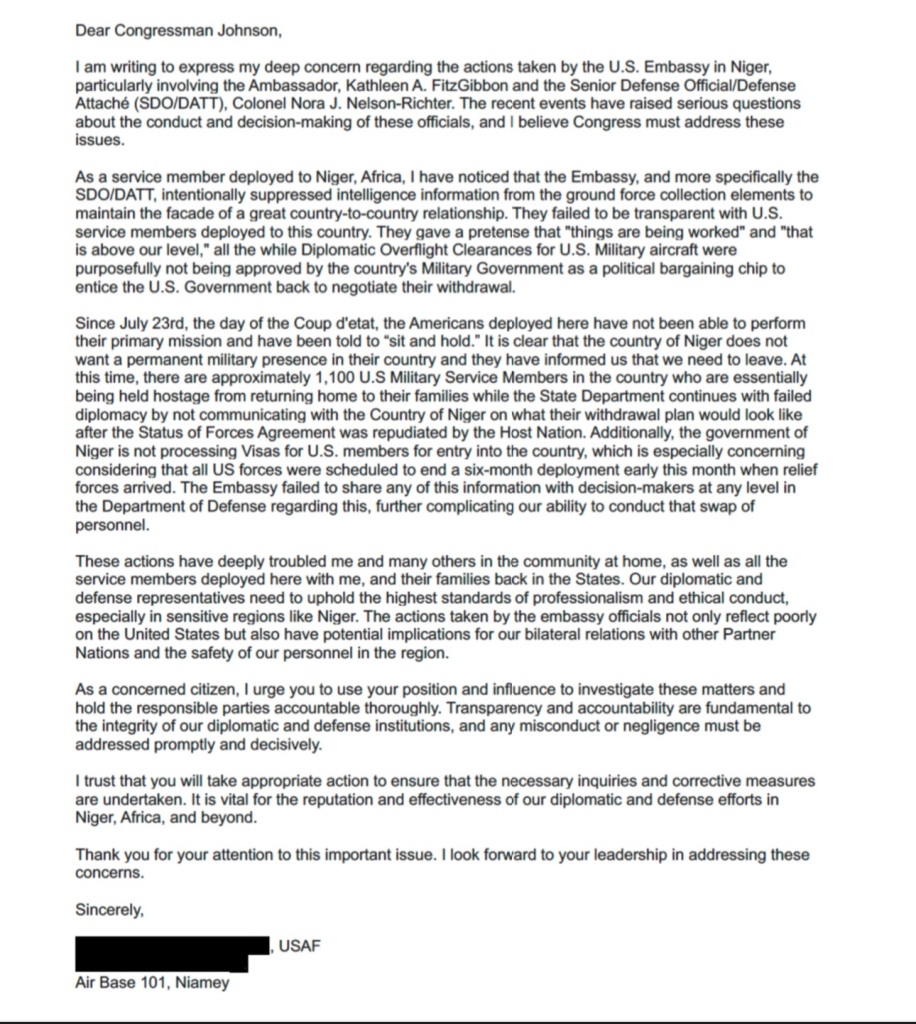
Defying Niger exit order leaves U.S. troops vulnerable, whistleblower says

Defying Niger exit order leaves U.S. troops vulnerable, whistleblower says

“We have Army soldiers right now in Niger who aren’t getting their troop rotations, who aren’t getting their medicine, who aren’t getting their supplies, who aren’t getting their mail and the two senior people in the United States Army are sitting before me and it’s like ‘hear no evil, see no evil, speak no evil,’” said Gaetz.

Previously:

BBC: Niger’s Junta Revokes Military Agreement With US

He [Col Amadou Abdramane] also alleged that the US delegation had accused Niger of making a secret deal to supply uranium to Iran. Col Abdramane described the accusation as “cynical” and “reminiscent of the second Iraq war”.

US to change Japan command posture to boost deterrence in face China -US envoy

US to change Japan command posture to boost deterrence in face China -US envoy

Sources with knowledge of the planning have told Reuters Washington will consider appointing a four-star commander for Japan to match the rank of the head of Japan’s new military headquarters. Experts say a U.S. officer of that rank could lay the groundwork for a future unified Japanese-U.S. command.

Related:

A Vital Next Step for the U.S.-Japan Alliance: Command and Control Modernization

Reimagining U.S. Forces Japan

The current structure of alliance command and control is not sufficient for the task. U.S. Forces Japan (USFJ) has changed little since the 1960s, when Japan was viewed as little more than a platform for U.S. military operations across the region. USFJ’s authorities and staffing are limited primarily to administering alliance agreements related to the 50,000-plus U.S. personnel stationed in Japan with the U.S. Navy, Marine Corps, Air Force, and Army. U.S. forces in Japan represent some of the most important U.S. military capabilities in the Indo-Pacific, but the three-star USFJ commander has limited joint operational authorities, and the separate U.S. service elements in Japan report back to their component headquarters in Hawaii.

Lighting Up the Gray Zone: The Philippines-Taiwan Counter-Coercion Toolkit

Perry World House’s Thomas Shattuck and Robin Garcia are out with an important new white paper which recommends the public release of visual information to counter China’s coercive activities, using the Philippines and Taiwan as examples. As the champions of “assertive transparency”, SeaLight enthusiastically welcomes this timely new scholarship!

Lighting Up the Gray Zone: The Philippines-Taiwan Counter-Coercion Toolkit

Perry World House is at the University of Pennsylvania, another university funded by the US government. I’ve updated my Project Myoushu document, to reflect the following:

The origin of Stanford University’s Gordian Knot Center for National Security Innovation. It’s sponsored by the Office of Naval Research, an organization within the Department of Navy. I saw it over at the Asian Century Journal, yesterday.

From a previous post.

Related:

Documents

Japan, U.S. and Philippines to discuss stronger military ties & US, Philippines to expand strategic port

Japan, U.S. and Philippines to discuss stronger military ties & US, Philippines to expand strategic port

Japan, U.S. and Philippines to discuss stronger military ties

The three foreign ministers will discuss ways to strengthen cooperation in the wake of increasing collisions in the South China Sea between ships from the Philippines and China.

They agreed to work toward signing a Reciprocal Access Agreement that would make it easier for members of the Self-Defense Forces and the Philippine military to engage in joint training exercises by simplifying procedures to obtain visas and bring weapons and ammunition into each other’s countries.

Japan will also provide funds for the Philippines to acquire a coastal surveillance radar system.

Related:

US, Philippines to expand strategic port

Read More »

The Gaza Maritime Route Was Netanyahu’s Idea, Maritime Aid Corridor Will Advance the Overthrow of Hamas, & When Will US boots be on the Ground in Gaza?

Diplomatic source to ‘Post’: Gaza maritime route was Netanyahu’s idea

According to the source, on October 22, two weeks following the war’s outbreak, Netanyahu discussed with President Biden the concept of “delivering humanitarian aid to Gaza via the sea, contingent on an Israeli inspection in Cyprus.”

Years before the Gaza war, Israel Katz, now the Foreign Minister, had drawn up plans for a maritime route via Cyprus involving a floating island.

The project was never executed. But he revived it after the war began on October 7. 

Related:

Gallant: Maritime Aid Corridor Will Advance Overthrow of Hamas

“The process is designed to facilitate aid directly to civilians and in this way, it advances [our goal] of overthrowing Hamas’ rule in Gaza,” the minister said.

“We will facilitate aid via the maritime route that is coordinated with the United States (security and humanitarian aspects), with the assistance of the United Arab Emirates on the civilian side,” he said. “It will include the appropriate inspections in Cyprus, and the goods will be brought by international organizations with American assistance.”

Air, sea, and land: When will US boots be on the ground in Gaza? Authored by Yonah Jeremy Bob*

Then suddenly, last Thursday, US President Joe Biden announced that the US would also supply maritime aid to Gaza, including building a makeshift artificial port off the coast.

This already imposes a long-term US military footprint in Israeli-Gaza territorial waters rather than a “mere” series of fly-throughs.

How hard would it be for a small complement of US Marines accompanying the aid deliveries to travel a kilometer or so into Gaza and to place themselves squarely in the middle of where Israel does not want them?

Moreover, US forces have been and are already on the ground.

US generals and counter-terror experts have been in and out of Israel since the start of the war, including visits to Gaza.

There are also a variety of US military personnel regularly in Israel on military and intelligence exchange programs.

US attempts to reform the PA

Speaking of intelligence, multiple times when a decision was made to try to improve and reform the Palestinian Authority security forces, it was the CIA and US special forces who came to the West Bank and Gaza to help train and prepare these forces.

It seems quite likely that the Jewish state, at some point, will ask Washington to perform the same service again in Gaza.

A broader version could involve a US-led peacekeeping force handling internal Gaza security for an indefinite period until enough Gazan Palestinians disconnected from Hamas can be convinced that taking on this role will not lead to them being slaughtered later by a resurgent Hamas.

From this perspective, the question about US forces on the ground in Gaza seems less of an if than it does a when, how many, and under more or less coordinated circumstances with Israel.

*Yonah Jeremy Bob was raised in Baltimore and graduated from Columbia University and Boston University Law School, respectively. He previously worked for the Israeli Ministry of Foreign Affairs, the Israeli Military International Law Division, and the Israeli Justice Ministry. – Wikipedia

Army cutting force by 24K in major restructuring

They can’t fill the positions, so they’re eliminating them!

Army cutting force by 24K in major restructuring

“We’re moving away from counterterrorism and counterinsurgency; we want to be postured for large-scale combat operations,” Army Secretary Christine Wormuth told reporters Tuesday morning at an event in Washington, D.C., hosted by the Defense Writers Group.

To do that, the service seeks to phase out around 32,000 roles, with about 3,000 cuts from special operations forces and another 10,000 from Stryker brigade combat teams, cavalry squadrons, infantry brigade combat teams and security force assistance brigades, the latter meant to train foreign forces.

In addition, the service found 10,000 engineer jobs and related positions linked to counterinsurgency missions it can cut; it will slash about 2,700 roles from units that don’t usually deploy; and it will decrease the number of transients, trainees, holdees and students by approximately 6,300. 

Officials stressed that the planned reductions are “to authorizations (spaces), and not to individual soldiers (faces),” meaning already empty roles. 

“The Army is not asking current soldiers to leave,” according to the document. “As the Army builds back end strength over the next few years, most installations will likely see an increase in the number of soldiers actually stationed there.” 

The plan also looks to add back 7,500 troops in missions seen as more critical, such as air-defense and counterdrone units and five new task forces for better capabilities in intelligence, cyber, and long-range strikes.  

Three of the task forces would fall under U.S. Army Pacificwith the Indo-Pacific theater considered the most important for national security in the years ahead — one will be within U.S. Army Europe-Africa, and the last likely focused on U.S. Central Command in the Middle East. 

The plans indicate a major shift within the Army as the military anticipates future conflicts as large-scale operations against more advanced adversaries such as China, Russia, Iran or North Korea. They also reflect the service’s struggles with recruiting, a phenomenon happening across the military.