
Before anyone says that it isn’t possible, the U.S. government financially supported EDSA 1 and the 1988 Chilean Plebiscite through its front organizations.
Related:
Read More »Before anyone says that it isn’t possible, the U.S. government financially supported EDSA 1 and the 1988 Chilean Plebiscite through its front organizations.
Related:
Read More »What’s Really Going On In the South China Sea Between the Philippines and China
by Tina Antonis
Maritime clashes between the Philippines and China had been mostly over the Philippines’ military outpost, BRP (BRP—Barko ng Republika ng Pilipinas, which translates to “Ship of the Republic of the Philippines”—the ship prefix for the Philippines) Sierra Madre, in the Spratly Islands, which is disputed by Brunei, China, Malaysia, the Philippines, Taiwan (a province of China, as recognized by the United Nations’ Resolution No. 2758), and Vietnam. The BRP Sierra Madre was intentionally run aground on a reef near the Second Thomas Shoal in the disputed Spratly Islands, in 1997, so that the Philippines could stake their territorial claim.
Read More »
Read it at Antiwar.com or here with graphics. FYI, the “Ant” in Antonis is pronounced as 🐜.
MANILA – President Ferdinand R. Marcos Jr. on Friday signed laws declaring the maritime zones under Philippine jurisdiction and designating sea lanes in the country for foreign vessels and aircraft.
Marcos inks laws on PH Maritime Zones, Archipelagic Sea Lanes
Related:
South China Sea: Philippines’ legal moves reveal its expansionist goals
U.S. State Department On the Philippines Maritime Zones Act
Arnaud Bertrand’s Twitter thread (ThreadReader)
Regarding the South China Sea Arbitration:
The South China Sea Arbitration did not rule on sovereignty, and China does not recognize it because the Arbitral Tribunal lacked jurisdiction. “The Arbitral Tribunal violated the principle of state consent, exercised its jurisdiction ultra vires and rendered an award in disregard of the law. This is a grave violation of UNCLOS and general international law, Wang said.” The United Nations Convention on the Law of the Sea (UNCLOS) is an international treaty that establishes a legal framework for all marine and maritime activities. The Permanent Court of Arbitration is not an agency of the United Nations. The PCA rents space in the same building as the UN’s International Court of Justice. A Congressional Research Service report, dated August 2023, stated that the U.S. has not declared its position regarding sovereignty over any of the geographical elements that comprise the South China Sea.
The Philippine military opened two weeks of combat drills Monday that would include seizing an island in the disputed South China Sea and likely be frowned upon by China.
Philippine military drills to seize an island in the South China Sea
Previously:
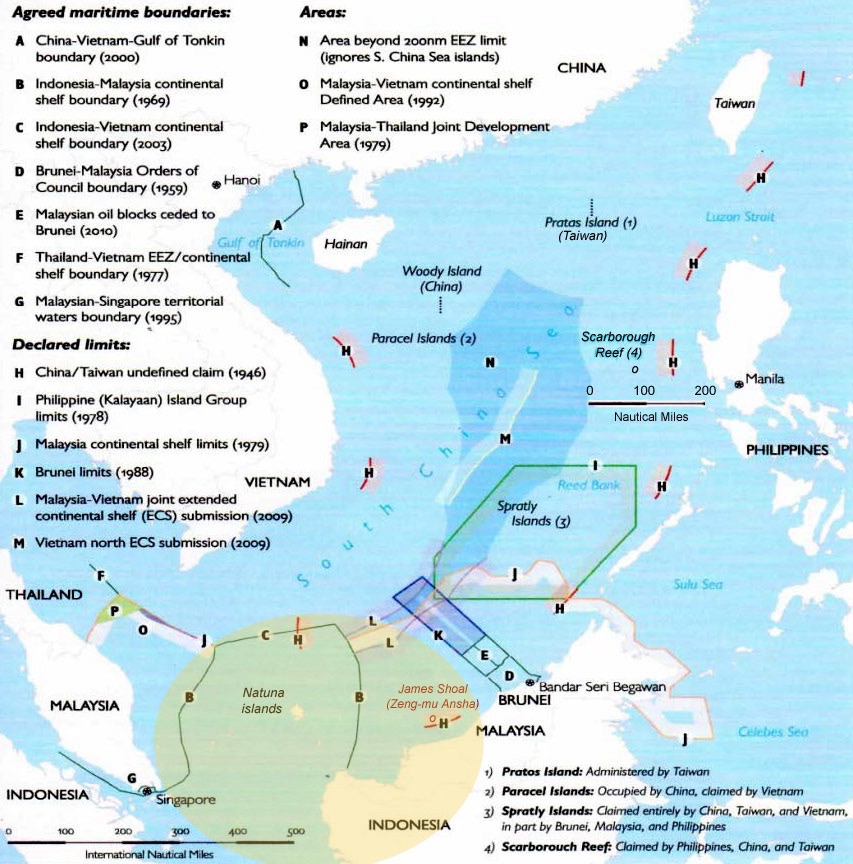
China looks to Indonesia for diplomatic resolution after coastguards’ Natuna encounters + More
Bry said China sanctioned his company for selling drones to Taiwan—noting the Taiwanese National Fire Agency is its only customer in the country—but said Skydio was “proud to support critical infrastructure operators, first responders, and allied militaries.”
•
The blog post sharply attacked the Chinese government, saying the sanctions show that the Chinese government “will use supply chains as a weapon to advance their interests over ours.”
•
Bry also accused the Chinese government of attempting to “eliminate the leading American drone company” and increase the “world’s dependence on Chinese drone suppliers.”…
According to the Financial Times, Skydio’s list of customers includes the Ukrainian military, and the company has sent over 1,000 of its drones to Ukraine to aid with gathering intelligence in its ongoing war with Russia and record instances of war crimes by the Russian military. Skydio’s X10 drone—which is affected by the battery rationing—is reportedly hard to jam, and Ukraine has sought to acquire thousands of them.
Related:
[04-10-2024] How American Drones Failed to Turn the Tide in Ukraine
The Silicon Valley company Skydio sent hundreds of its best drones to Ukraine to help fight the Russians. Things didn’t go well.
Skydio’s drones flew off course and were lost, victims of Russia’s electronic warfare. The company has since gone back to the drawing board to build a new fleet.
China looks to Indonesia for diplomatic resolution after coastguards’ Natuna encounters
Related:
[10-23-2024] Indonesian Coast Guard “Drives Out” Chinese Vessel Shadowing Seismic Ship (archived)
Read More »On Monday, Indonesia’s coast guard “drove out” a China Coast Guard cutter that was shadowing a survey vessel in Indonesian waters of the South China Sea. On Tuesday, the Chinese vessel was back again in the same spot, according to maritime security expert Ray Powell.
…
Geo Coral is a Norwegian-owned geophysical vessel flagged in Norway. She is operating under charter to PT Pertamina, Indonesia’s state-owned oil company, to conduct a 3D seismic survey off the Natuna Islands. “Pertamina East Natuna is focusing on oil and gas exploration activities in the East Natuna Working Area [East Natuna gas field], which has great potential to contribute to national energy security,” said a Pertamina spokesman on Tuesday.
Vladimir Putin answered questions from the heads of leading BRICS media agencies. The meeting was held ahead of the BRICS summit in Kazan.
The meeting was attended by the heads of media agencies from Brazil, China, Egypt, Ethiopia, India, Saudi Arabia, South Africa, and the UAE. It was moderated by Head of the Rossiya Segodnya Media Group Dmitry Kiselev.
Meeting with journalists from BRICS countries • President of Russia
Part One: Americans Prospecting GenSan as EDCA Site
In a flash, May Kay Carlson proved she is part of the problem President Bongbong Marcos Jr. has created with China rather than any solution.
Related:
US envoy says China’s maritime claims a ‘cartoon’
Read More »The drill in the disputed waters follows joint manoeuvres by the Philippines, US, Australia, Japan and New Zealand
PLA stages National Day drill in South China Sea in wake of 5-nation exercise
Related:
Biden Approves $567 Million in Military Aid for Taiwan, Angering China
 Ms. Cat’s Chronicles
You must be logged in to post a comment.