
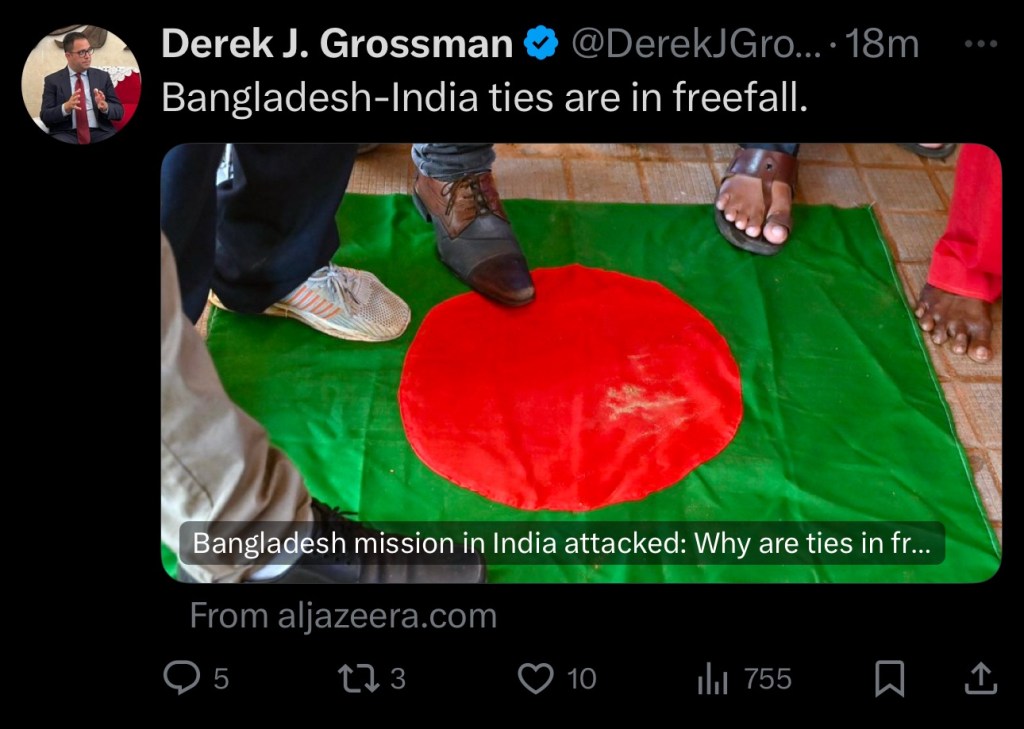
Bangladesh mission in India attacked: Why are ties in freefall?
I wonder why?* /s
Related:
Read More »Bangladesh mission in India attacked: Why are ties in freefall?
I wonder why?* /s
Related:
Read More »
Bourgeois And Proletarian Democracy
Bourgeois democracy, although a great historical advance in comparison with medievalism, always remains, and under capitalism is bound to remain, restricted, truncated, false and hypocritical, a paradise for the rich and a snare and deception for the exploited, for the poor. It is this truth, which forms a most essential part of Marx’s teaching, that Kautsky the “Marxist” has failed to understand. On this—the fundamental issue—Kautsky offers “delights” for the bourgeoisie instead of a scientific criticism of those conditions which make every bourgeois democracy a democracy for the rich.
Related:
Virtually forgotten due to the discourse of Ukrainian unity and the general lack of interest in analyzing the nuances of events, the racial and class question is going virtually unnoticed in this war. If the Donbass conflict had a proletarian aspect that the press mocked in the first weeks of the DPR due to those Soviet-looking press conferences of workers and academics, in the current context, there have not even been any such comments. Presented as a war of national liberation, no aspect other than nationalism has deserved much mention in the Western press or in academia. Volodymyr Ishchenko and Ilya Matveev, who have sought to study the class aspect in the outbreak of the conflict, are the rare exception. To Ischenko’s surprise, RFE/RL published an article last September that dealt, albeit in generalities and without great depth, with the increase in inequality that war implies, an aspect that is, on the other hand, perfectly evident. “As the war drags on, the gaps in Ukrainian society are widening,” the American media headlines.
Read More »
Violent regime change in the South Asian country of Bangladesh unfolded rapidly and mostly by stealth as the rest of the world focused on the ongoing conflict in Ukraine, growing tensions in the Middle East and a simmering confrontation between the US and China in the Asia-Pacific region.
Related:
The Partition of South Asia Strikes Again
There is a problem, fundamentally, in viewing the regime change in Bangladesh as a ‘stand-alone’ event. The caveat must be added right at the outset that when it comes to processing situations, nothing happens for no reason at all. There is very little awareness in India, especially in the media, about what has been going on. Mostly, it’s ‘cut-and-paste’ job culled out from the jaundiced western accounts from a new Cold War angle.
The Genocide the U.S. Can’t Remember, But Bangladesh Can’t Forget
A little more than a century ago the world’s superpower was the British Empire. Despite being a constitutional monarchy where the aristocracy and monarchy still retained significant power, the British Empire was arguably the birthplace of the industrial revolution and it played a significant role in spreading capitalism around the world through colonialism. From around the 19th century until the early 20th century, many saw the British Empire as quite possibly the most affluent and powerful capitalist-colonial empire in the world. The British Empire as the capitalist-colonial hegemon extracts resources from its colonies, transforms them into commodities, and sells them for a profit that would go into the pockets of capitalists and royal colonizers alike. There were other competing colonizers such as France, The Netherlands, Spain, Portugal, Germany, Japan, and the U.S., but none of them (except the U.S. in the late 20th century) could quite surpass the British Empire. The British Empire was the largest epicenter of world capitalist imperialism and being an anti-imperialist was almost (though not quite) synonymous with being against the British Empire. The geopolitical status of the British Empire is roughly or loosely analogous to the geopolitical status that the U.S. enjoyed since the late 20th century. Both the British Empire and the U.S. enjoy the status of being a hegemonic empire due to their overwhelmingly powerful military (especially their navy) and almost unparalleled economic power.
While some (but not most) of what the Party for Socialism and Liberation/ANSWER Coalition have said in their response to the Black is Back Coalition’s Open Letter is factually valid, their disingenuous, dishonest response is an example of using “facts” to hide the truth.
The Black is Back Coalition Responds to ANSWER/PSL: “Your Actions Speak So Loudly, We Can’t Hear a Word You Say…”
On October 13, 2023, the Chicago City Council held a meeting to vote on a “Resolution in Solidarity with Israel.” Gabriel Miller was one of the voices who spoke up against the double standard that is being held in favor of Israel and against Palestine.
In the end, Chicago City Council passed the pro-Israel resolution, despite the protests of people like Gabriel.
At Chicago City Council, Gabriel Miller asks ‘why don’t you condemn Israel for its war crimes?’
Holy shit did you guys hear the news about Obama?? Turns out this nasty freak destroyed Libya, signed off on the destruction of Yemen, armed terrorists with the goal of destroying Syria, set the stage for the Ukraine war, and jailed more whistleblowers than any other president!
The Real Obama Scandal Is That He Destroyed Multiple Nations
Couldn’t resist! I literally LOL’d when they mentioned Moderna; a company that will profit from the new vaccines! 🤦🏼♀️
Previously:
 Ms. Cat’s Chronicles
You must be logged in to post a comment.