
Transcript: BBC Caught Lying Again
Tag: Misinformation
The SIG Sauer P320 and the Killing of Alex Pretti
I was listening to Scott Horton’s new podcast Provoked with Daryl Cooper when they mentioned something I hadn’t heard anywhere else: that Alex Pretti was carrying a SIG Sauer P320, it allegedly misfired, and the resulting confusion led to ICE shooting him. That claim immediately stood out because none of the reporting I’ve seen on the incident mentions a misfire, let alone one involving the P320.
Read More »Trump says strikes carried out at request of Nigerian government
Pre‑Scripted Contest: U.S. Sets Narrative for Honduras Election
The U.S. government, through its network of front organizations, is already laying the groundwork to frame Sunday’s election in Honduras as disputed—before a single ballot has even been cast.
Honduras heads toward elections amid allegations of fraud and military interference
Local media outlets have also reported on X that members of the ruling party have assaulted supporters of other political parties. One such complaint was made by Liberal Party legislator Iroshka Elvir. “When we were in District 15, groups of LIBRE supporters in El Pedregal blocked the road with sticks and stones, and verbally assaulted our candidates,” Elvir said.
Related:
Iroska Elvir is married to Salvador Nasralla, who is running for President of Honduras.
Read More »Update on My Work and Focus


My Core Principles: From Cronkite to Communism
For the record, I am not an anarchist; I simply have a deep love of quotes and like to look up their origins. My research often reveals that favorite sayings are frequently misattributed or heavily paraphrased.
Read More »Operation Imeri: Stratfor, DefesaNet, and the Rescue Script

Considering Lula still refuses to recognize the outcome of Venezuela’s 2024 presidential election, the idea of a rescue operation of Maduro feels far-fetched. Lula’s previous alignment with the Biden administration and rejection of Venezuela’s BRICS bid signal distance, not solidarity.
The scale of the proposed rescue would demand massive military mobilization. Brazil’s footprint—limited airpower, zero aerial tankers, no carrier-based projection—renders the logistics implausible. With U.S. destroyers already deployed in the southern Caribbean and Maduro falsely classified as a “narcoterrorist” by Washington, any such operation risks direct confrontation with American assets.
Domestically, the timing couldn’t be worse. Trump 2.0 is already pressuring Brazil over the so-called “persecution” of Bolsonaro, and while national elections aren’t until late 2026, the political cost of a high-risk maneuver like this would be immediate. Lula’s administration is unlikely to burn political capital on a clandestine extraction. The optics alone would be catastrophic.
Beneath the surface of DefesaNet’s coverage lies a 2011 cooperation agreement with Stratfor, the U.S.-based private intelligence firm often dubbed the “Shadow CIA.” This wasn’t editorial alignment—it was infrastructural scripting. Stratfor gained privileged access to regional insight; DefesaNet received complimentary geopolitical reports. The choreography was built in.
When narratives like Operation Imeri surface, they don’t emerge from neutrality—they rehearse proximity, test fault lines, and manufacture urgency. Brazil isn’t just being watched. It’s being written into a role.
This isn’t a serious proposal. It’s narrative theater—manufacturing urgency, choreographing proximity, and distracting from the quieter architecture of soft power already shaping the region. The rescue isn’t about Maduro. It’s about rehearsing alignment, testing thresholds, and scripting Brazil into a role it never auditioned for.
This isn’t covert. It’s combustible.
—Tina Antonis
Related:
Tag: 2024 Venezuelan Presidential election
María Corina Machado is the female Javier Milei (aka US Puppet)
Capes, Cameras, and the Cult of Visibility
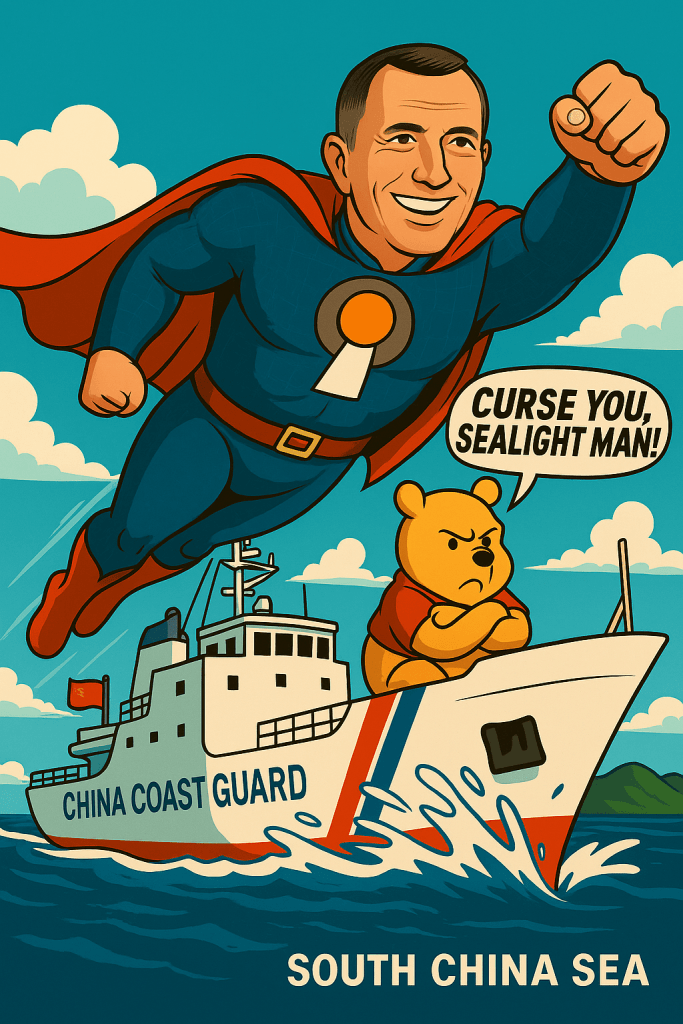
Capes, Cameras, and the Cult of Visibility: The SeaLight Crusade as White Savior Theater
By Tina Antonis
The South China Sea is more than a maritime dispute—it’s a theater of narrative warfare. While headlines focus on Chinese aggression and Philippine resistance, a quieter campaign unfolds in the background: one of satellite feeds, curated imagery, and Pentagon-backed storytelling. At the center of this effort is SeaLight, a project that claims to illuminate truth but often casts shadows of its own.
As explored in my article at Antiwar.com, SeaLight doesn’t just document—it performs. It reframes geopolitical tension through moral spectacle, positioning its creators as heroic arbiters of transparency. But when the messenger wears a cape and the funding flows from defense budgets, we must ask: is this clarity, or choreography?
Stage Left: The White Savior Enters
In the comic-strip cosmology of Ray Powell’s SeaLight project, transparency wears a cape. Clad in heroic postures and backed by satellite imagery, Powell casts himself as the guardian of maritime morality—unarmed, except with satellite feeds, theatrical flair, and strategic messaging.
Yet beneath the cartoon and Pentagon-funded optics lies a familiar archetype: the white savior, rebranded for the South China Sea.
China Is Imperialist? Says Who?
Calling China a “maritime occupier,” Powell positions himself as a bulwark against aggression. But that moral pose collapses under scrutiny. He speaks for a country with over 800 foreign military installations and a documented history of over 250 military interventions since 1991—wars in Iraq, Afghanistan, Libya, Syria, Somalia, and dozens more, all under the banner of peace, freedom, or preemption.
By comparison, China’s post–Cold War footprint includes no sustained foreign occupations and only scattered border conflicts and peacekeeping missions. The imbalance is staggering. And Powell’s framing doesn’t just ignore it—it performs around it.
As David Vine argues in The United States of War, this vast base empire is not a passive network—it’s an architecture of perpetual war. These outposts make military engagement not an exception but a structural habit, cloaked in strategic necessity and sold as global stewardship.
Powell’s cartoon rhetoric—calling China an occupier—obscures the scale of U.S. militarism. The term “occupation” is deployed not to analyze, but to project. When adversaries hold territory, it’s a crisis; when the U.S. spans the globe with armed installations, it’s policy.
Framing Conflict: The Optics of Consent
This isn’t irony. It’s performance. Powell’s language manufactures a moral frame for confrontation—costumed in transparency, but driven by escalation. The cape is literal. The conditioning is deliberate. And the stage is set for war.
SeaLight’s mission is not just visual documentation—it’s narrative warfare. As the Japan Times openly notes, its “chief weapon is photography, applied purposefully, generously and consistently over time.” These images—enhanced, curated, and distributed across media—are not neutral. They’re constructed to shape public perception, sway international opinion, and ultimately manufacture consent for confrontation.
Assertive transparency becomes a kind of ideological scaffolding—a stage on which geopolitical tension is dramatized, simplified, and morally polarized. The goal isn’t simply to reveal conflict; it’s to condition audiences for escalation.
And when the messenger dons a superhero’s cape, the spectacle transforms into something deeper: a story of rescue, of virtue, of intervention. This is not analysis—it’s soft propaganda dressed in heroic metaphor.
Consent for war doesn’t begin with missiles. It begins with mythmaking.
 Ms. Cat’s Chronicles
You must be logged in to post a comment.