American private military firms could be deployed to Ukraine as part of a long-term peace plan.
Donald Trump is in talks with European allies about allowing armed contractors to help build fortifications to protect American interests in the country.
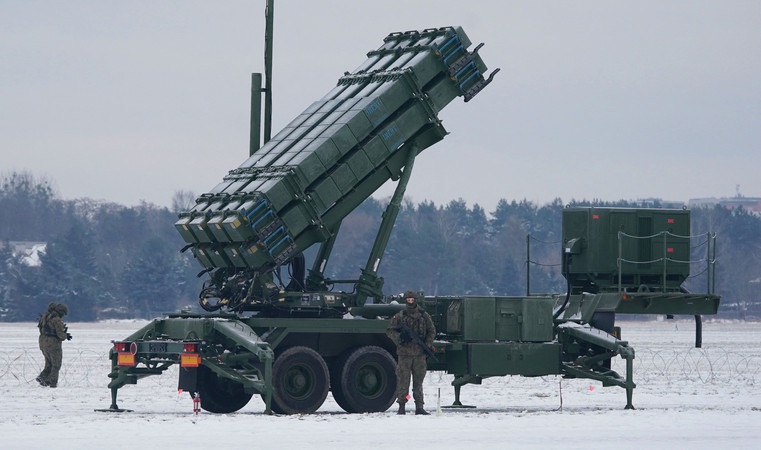
Whitaker, the US NATO envoy, said the immediate focus on shipping weapons to Ukraine was on defensive systems, like the Patriot batteries that can intercept Russian ballistic missiles. But he didn’t rule out providing offensive weapons.
…
By selling weapons to European nations, rather than transferring them to Ukraine itself, Trump hopes to insulate himself from political criticism that he is reversing a campaign pledge to reduce the US role in the years-long war.
U.S. officials say they are still sorting through Ukraine’s wish list of weaponry that it would like to receive from NATO members to determine what can be most quickly replaced after President Donald Trump announced an agreement for Europe to supply Ukraine with defensive munitions from existing stocks.
The officials, who spoke on condition of anonymity to discuss arms transfers that have not yet been approved or completed, said Ukraine’s requests for materiel are roughly the same as they have been since the start of Russia’s invasion more than three years ago. Those include air defenses like Patriot missiles and Advanced Precision Kill Weapon Systems, long range missile known as ATACMS and short- to medium-range ground-to-air missiles known as NASAMs, and assorted artillery, according to the officials.
Under the terms of the very rough agreement sketched out by Trump and NATO chief Mark Rutte on Monday, NATO members would ship billions of dollars of these weapons to Ukraine and then purchase replacements for them from the United States.
One official said some of the larger items — such as Patriots— could take up to five years to produce to deliver to the European donors, while smaller munitions like 155mm artillery shells can be produced on a much shorter timeline
According to numerous insider reports published by Western media, this package is likely to include some form of long-range weaponry. The new military aid package that Ukraine hopes to receive from the United States may include air-launched missiles, aerial bombs, and high-precision ground-launched missiles. The primary criterion for these weapons could be their ability to strike deep into the territory of the Russian Federation.
…
The specifics remain unknown. Some sources mention “offensive missiles,” others claim these weapons will have the range to strike targets as far as Moscow. Still others explicitly state that they will be JASSM cruise missiles. All of these reports point to one clear requirement: the missiles must have a range of at least 500 km to reach Moscow from the Ukrainian border.
Generally, a single Patriot battery costs about $1 billion to build, depending on the model, and interceptor missiles cost about $3.7 million each. JASSMs sell for about $1.5 million each. And ATACMS cost at least $1 million or more per missile. “This is billions of dollars’ worth of military equipment that’s going to be purchased from the United States, going to NATO,” Mr. Trump said. “And that’s going to be quickly distributed to the battlefield.”
Capes, Cameras, and the Cult of Visibility: The SeaLight Crusade as White Savior Theater
By Tina Antonis
The South China Sea is more than a maritime dispute—it’s a theater of narrative warfare. While headlines focus on Chinese aggression and Philippine resistance, a quieter campaign unfolds in the background: one of satellite feeds, curated imagery, and Pentagon-backed storytelling. At the center of this effort is SeaLight, a project that claims to illuminate truth but often casts shadows of its own.
As explored in my article at Antiwar.com, SeaLight doesn’t just document—it performs. It reframes geopolitical tension through moral spectacle, positioning its creators as heroic arbiters of transparency. But when the messenger wears a cape and the funding flows from defense budgets, we must ask: is this clarity, or choreography?
Stage Left: The White Savior Enters
In the comic-strip cosmology of Ray Powell’s SeaLight project, transparency wears a cape. Clad in heroic postures and backed by satellite imagery, Powell casts himself as the guardian of maritime morality—unarmed, except with satellite feeds, theatrical flair, and strategic messaging.
Yet beneath the cartoon and Pentagon-funded optics lies a familiar archetype: the white savior, rebranded for the South China Sea.
China Is Imperialist? Says Who?
Calling China a “maritime occupier,” Powell positions himself as a bulwark against aggression. But that moral pose collapses under scrutiny. He speaks for a country with over 800 foreign military installations and a documented history of over 250 military interventions since 1991—wars in Iraq, Afghanistan, Libya, Syria, Somalia, and dozens more, all under the banner of peace, freedom, or preemption.
By comparison, China’s post–Cold War footprint includes no sustained foreign occupations and only scattered border conflicts and peacekeeping missions. The imbalance is staggering. And Powell’s framing doesn’t just ignore it—it performs around it.
As David Vine argues in The United States of War, this vast base empire is not a passive network—it’s an architecture of perpetual war. These outposts make military engagement not an exception but a structural habit, cloaked in strategic necessity and sold as global stewardship.
Powell’s cartoon rhetoric—calling China an occupier—obscures the scale of U.S. militarism. The term “occupation” is deployed not to analyze, but to project. When adversaries hold territory, it’s a crisis; when the U.S. spans the globe with armed installations, it’s policy.
Framing Conflict: The Optics of Consent
This isn’t irony. It’s performance. Powell’s language manufactures a moral frame for confrontation—costumed in transparency, but driven by escalation. The cape is literal. The conditioning is deliberate. And the stage is set for war.
SeaLight’s mission is not just visual documentation—it’s narrative warfare. As the Japan Times openly notes, its “chief weapon is photography, applied purposefully, generously and consistently over time.” These images—enhanced, curated, and distributed across media—are not neutral. They’re constructed to shape public perception, sway international opinion, and ultimately manufacture consent for confrontation.
Assertive transparency becomes a kind of ideological scaffolding—a stage on which geopolitical tension is dramatized, simplified, and morally polarized. The goal isn’t simply to reveal conflict; it’s to condition audiences for escalation.
And when the messenger dons a superhero’s cape, the spectacle transforms into something deeper: a story of rescue, of virtue, of intervention. This is not analysis—it’s soft propaganda dressed in heroic metaphor.
Consent for war doesn’t begin with missiles. It begins with mythmaking.
Berlin, 26 May 2025 – In a chilling act of imperial hubris, German Chancellor Friedrich Merz has declared that Germany, in lockstep with its NATO overlords, has unshackled the range restrictions on missiles supplied to Ukraine, greenlighting strikes deep into Russia’s heart. This brazen escalation, announced today, is no mere policy shift; it is a deliberate provocation, a reckless lunge towards a global conflagration that could sear humanity’s future. The West, cloaked in the sanctimonious rhetoric of “defending Ukraine,” is goading Russia into a corner, gambling with the lives of millions in a game of geopolitical brinkmanship.
China continues to strengthen its military capabilities, combining rapid growth in conventional power with readiness to counter U.S. asymmetrical strategies.
Ukraine’s stockpiles of U.S.-supplied long-range Army Tactical Missile Systems (ATACMS) are running low, the New York Times (NYT) reported on Dec. 27, citing senior U.S. officials.
’A Failed Project?’ The only VALID reason I could think of for all these “secrecy” or lack of transparency is that the program itself was NOT successful, and there are a number of ways that it could have failed. For one, the FAILURE or SUCCESS RATE of the launches were never published, and it’s possible that there were just too many launch failures, like the rockets exploding or veering off course at their launch pad or after launch, or even rockets not taking off at all. And even if the launches were successful, there is the issue of how accurate the rocket was in terms of hitting its target. If it ends up several hundreds or thousands of meters from its intended target, then it’s not very useful. And just like the Launch Rate, the Accuracy of the rockets were also never published.



 Ms. Cat’s Chronicles
You must be logged in to post a comment.