
Lighting Up the Gray Zone: The Philippines-Taiwan Counter-Coercion Toolkit

Perry World House’s Thomas Shattuck and Robin Garcia are out with an important new white paper which recommends the public release of visual information to counter China’s coercive activities, using the Philippines and Taiwan as examples. As the champions of “assertive transparency”, SeaLight enthusiastically welcomes this timely new scholarship!

Lighting Up the Gray Zone: The Philippines-Taiwan Counter-Coercion Toolkit

Perry World House is at the University of Pennsylvania, another university funded by the US government. I’ve updated my Project Myoushu document, to reflect the following:

The origin of Stanford University’s Gordian Knot Center for National Security Innovation. It’s sponsored by the Office of Naval Research, an organization within the Department of Navy. I saw it over at the Asian Century Journal, yesterday.

From a previous post.

Related:
Documents

Japan, U.S. and Philippines to discuss stronger military ties & US, Philippines to expand strategic port

Is the Philippines becoming a US ‘proxy’ against Beijing in the South China Sea?

Is the Philippines becoming a US ‘proxy’ against Beijing in the South China Sea?

‘The ants that get trampled on’

Not everyone agrees with drawing closer to the US, however, and they warn about the Philippines turning into a “proxy” for American interests. The president’s own sister Imee, a senator, told ANC Digital earlier this month that “China will always be our neighbour, we have no fight with them, let’s not get dragged into a fight that’s not our own.”

Anna Rosario Malindog-Uy, director of the pro-China Asian Century Philippines Strategic Studies Institute, wrote in the Manila Times on February 10 that “agreements such as the EDCA, the VFA and the Mutual Defence Treaty have not only cemented the US military presence and influence in the Philippines but also, most importantly, exemplified the Philippines’ dependence on the US in the military and defence sector.”

Teresita Ang See, former president of the Philippine Association for Chinese Studies and currently part of its advisory council, told This Week in Asia: “Filipinos in general condemn China’s action. But many also understand that China’s assertiveness is in response to US, Japanese and Australian provocations and increasing military presence in the Philippines.”

She warned that “we are fighting a proxy war between the US and China and in the end we will be the ants that get trampled upon”.

H/T: Johnsonwkchoi

Related:

Responding to the Catholic Bishops

Philippines counts the cost of tough South China Sea stance against Beijing

When Do We Say Enough is Enough?: Philippines’ Tipping Point in Upholding Sovereign Integrity

Source.

When Do We Say Enough is Enough?: PH’s Tipping Point in Upholding Sovereign Integrity

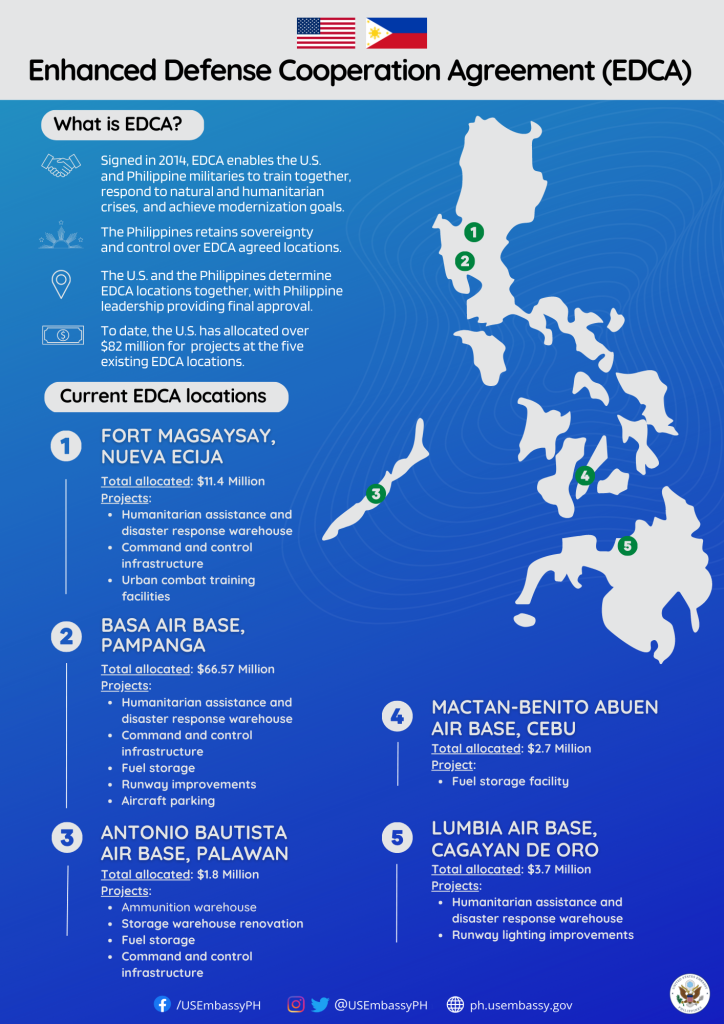
Moreover, the involvement of Subic Bay, a location not officially listed as a site/base under the expanded Enhanced Defense Cooperation Agreement (EDCA) as the alleged destination of US military fuel from Pearl Harbor, prompts a critical inquiry about its role and whether it might be serving as an unofficial or de-facto EDCA site. Hence, it begs to inquire if Subic Bay is now effectively functioning as a de-facto EDCA site. And if so, could there be other undeclared de-facto EDCA sites serving similar purposes other than the nine declared ones?

Could it be posited that the current Philippine administration appears to prioritize the demands and interests of the United States over its own national interests, sovereignty, and independence, suggesting a level of deference that could be interpreted as reminiscent of a vassal state? This perspective raises questions about the autonomy of the Philippine political leadership and the extent to which it serves the interests of its citizens first and foremost. The lack of public discussion, accountability, and transparency on matters that potentially impinge on national sovereignty could be seen as indicative of a disproportionate influence by the U.S. on Philippine domestic affairs and foreign policy, prompting a reevaluation of the true nature of the bilateral relationship between the two nations.

Related:

US tanker canceled request to enter Subic – SBMA

US policies pushing China, Philippines to brink of conflict

US policies pushing China, Philippines to brink of conflict

The China-Philippines maritime dispute does not, in of itself, reflect anything approaching an existential conflict. It has, however, become an increasingly dangerous proxy and potential flashpoint for underlying China-U.S. tensions in the South China Sea.

FYI, this article is full of disinformation. I’m posting it to point out that there’s an information war going on in the South China Sea (using embedded journalists, civil society activists, and various US think tanks). The Philippines plans on building a military base, on the disputed Second Thomas Shoal, to replace the BRP Sierra Madre (which is about to break apart). Marcos is also re-starting oil exploration, in the Reed Bank, which is part of the disputed territory.

Related:

US Shapes Philippines into Southeast Asia’s “Ukraine”

Why the US is Picking a Fight with China in the South China Sea

Beijing rejects tribunal’s ruling in South China Sea case

Paul Reichler, of the law firm Foley Hoag LLP, who who coordinated the Philippines’ legal team, said: “The tribunal’s ruling not only benefits the Philippines, it also benefits other states bordering the South China Sea like Indonesia, Malaysia and Vietnam. If China’s nine-dash line is invalid as to the Philippines, it is equally invalid to those states and, indeed, the rest of the international community.”

Paul S. Reichler

Beijing has ‘a lot of legal weapons’ to challenge Manila’s claims in South China Sea, international law expert says

Beijing still has plenty of countermeasures it could use against Manila if tensions between the two countries continue to escalate in the South China Sea, according to a seasoned legal expert who specialises in the region.

Beijing has ‘a lot of legal weapons’ to challenge Manila’s claims in South China Sea, international law expert says