
After Russia invaded Ukraine, the West formed what looked like an overwhelming global coalition: 141 countries supported a United Nations measure demanding that Russia unconditionally withdraw.
The West Tried to Isolate Russia. It Didn’t Work.
Tag: national interests
McCarthyism, Polish Style
In Poland these days it is becoming dangerous to one’s career to publicly voice opposition to the government’s policy vis-à-vis the war in Ukraine.
McCarthyism, Polish Style
Lula’s Condemnation of Russia in His Joint Statement with Biden Disqualifies Him as a Mediator
Lula’s self-interested publicity stunt in insincerely presenting himself as a neutral mediator in the Ukrainian Conflict should be acknowledged for what it is, which is a means for boosting his clout in parallel with improving ties with the US. Despite being at Russia’s rhetorical expense, the substance of their strategic ties remains solid and is poised to further strengthen, which should be the focus of observers going forward unless he refuses to stop condemning Moscow.
Lula’s Condemnation of Russia in His Joint Statement with Biden Disqualifies Him as a Mediator
My Sources Corroborate Sy Hersh’s Nord Stream Report: Notes From The Edge Of The Narrative Matrix
My sources corroborate Seymour Hersh’s report that the US was behind the Nord Stream pipeline sabotage. (My sources are logic, common sense, and public statements by US government officials.)
My Sources Corroborate Sy Hersh’s Nord Stream Report: Notes From The Edge Of The Narrative Matrix
Filipinos Protest US Military Deal Eying China
The decision to grant the U.S. access to more bases — announced during the U.S. defense secretary’s visit — was decried by peace advocates as part of the Pentagon’s push into the Indo-Pacific, with an intent to encircle China.
Filipinos Protest US Military Deal Eying China
Germany Risks Forgetting Its History
In deciding to supply Leopard battle tanks to Ukraine, Olaf Scholtz breaks the self-imposed constraints on the military’s role in German foreign policy that had been in place since the end of WWII.
Germany Risks Forgetting Its History
Support for Peru coup all about Canadian mining companies
Seven weeks after Pedro Castillo was ousted protests and blockades continue across Peru. Sixty protesters have been killed since the elected president was ousted, a move Canada immediately endorsed.
Support for Peru coup all about Canadian mining companies
Don’t Be So Quick To Listen To America’s Retired Generals On Ukraine
Don’t Be So Quick to Listen To America’s Retired Generals on Ukraine: Americans have always loved military leaders, especially generals; the 1970 movie Patton, about the life of the United States’ greatest World War II commander, is still popular in America. When the current crop of active and retired generals speak today, it is unsurprising that most in our country reflexively accept what they say at face value. Especially as their assessments and advice relate to American vital national interests in the Russia-Ukraine War, however, such trust should be reassessed.
Don’t Be So Quick To Listen To America’s Retired Generals On Ukraine
He doesn’t think that we’re in a proxy war with Russia?!
Related:
New RAND Report Says a Long War in Ukraine Is Against US Interests
The report says a prolonged war in Ukraine hampers the US ability to focus on its ‘competition with China’
New RAND Report Says a Long War in Ukraine Is Against US Interests
Previously:
RAND: Avoiding a Long War – U.S. Policy and the Trajectory of the Russia-Ukraine Conflict
RAND: Avoiding a Long War – U.S. Policy and the Trajectory of the Russia-Ukraine Conflict

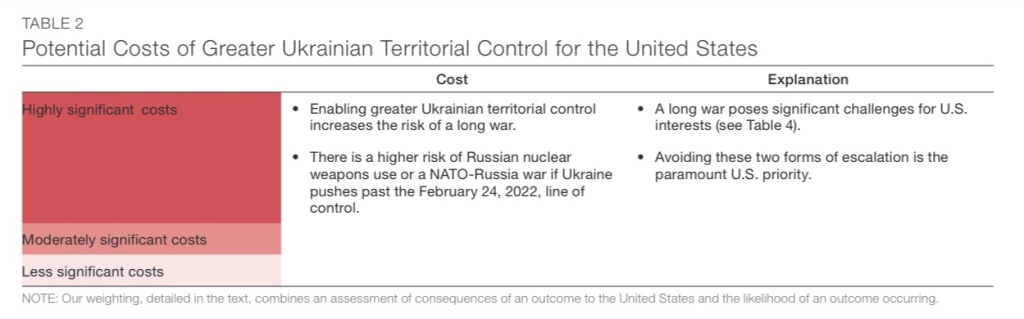


*Russian use of nuclear weapons is a plausible contingency that Washington needs to account for and a hugely important factor in determining the future trajectory of the conflict
*Although a Russian decision to attack a NATO member state is by no means inevitable, the risk is elevated while the conflict in Ukraine is ongoing.
*Chairman of the Joint Chiefs of Staff Mark Milley reportedly kept a list of “U.S. interests and strategic objectives” in the crisis: “No. 1” was “Don’t have a kinetic conflict between the U.S. military and NATO with Russia.” The second, closely related, was “contain war inside the geographical boundaries of Ukraine.”
*It is clear why Milley listed avoiding a Russia-NATO war as the top U.S. priority: The U.S. military would immediately be involved in a hot war with a country that has the world’s largest nuclear arsenal. Keeping a Russia-NATO war below the nuclear threshold would be extremely difficult, particularly given the weakened state of Russia’s conventional military.
*Since neither side appears to have the intention or capabilities to achieve absolute victory, the war will most likely end with some sort of negotiated outcome.
*Since avoiding a long war is the highest priority after minimizing escalation risks, the United States should take steps that make an end to the conflict over the medium term more likely.
*A major source of uncertainty about the future course of the war is the relative lack of clarity about the future of U.S. and allied military assistance to Ukraine.
Avoiding a Long War – U.S. Policy and the Trajectory of the Russia-Ukraine Conflict
Related:
Avoiding a Long War – U.S. Policy and the Trajectory of the Russia-Ukraine Conflict
 Ms. Cat’s Chronicles
You must be logged in to post a comment.