
China’s State Council has released a crucial policy paper titled ‘A Global Community of Shared Future: China’s Proposals and Actions’ that should be read as a detailed, comprehensive road map for a peaceful, multipolar future.
Pepe Escobar: Russia-China Partnership Defangs US Empire
Tag: National Security Council
White House Close To Providing Kiev With Cluster-Armed ATACMS

This comes amid Kyiv’s failing counteroffensive and poses a major risk of escalation, President Volodymyr Zelensky has desired to use the long-range weapons to attack the Russian mainland.
White House Close To Providing Kiev With Cluster-Armed ATACMS
Hype on iPhone ‘ban’ shows US has a guilty conscience
The biggest destroyer of the global economic and trade order is being paranoid. This is perhaps the most incisive and vivid explanation of why the US government and media outlets have seen a rumored ban on iPhones as China’s retaliation against the US.
Hype on iPhone ‘ban’ shows US has a guilty conscience
Related:
US spokesman behind on the news pours gas on seemingly settled China iPhone ban
In what appears to be a statement generated before news of the Chinese government refuting ban rumors, the White House chimed in on the matter, as reported by Bloomberg. The National Security Council shared that it is watching the issue with concern.
The death of Yevgeny Prigozhin and US war propaganda
On August 23, the billionaire Russian oligarch Yevgeny Prigozhin died in a crash of his private jet under unexplained circumstances. The crash also killed a significant section of the senior leadership of the Wagner Group, the Russian private military contractor which Prigozhin headed, including its military commander, Dmitry Utkin.
The death of Yevgeny Prigozhin and US war propaganda
Related:
Alexander Vindman: Prigozhin’s Death Could Speed Peace in Ukraine
Behind Enemy Lines, Ukrainians Tell Russians ‘You Are Never Safe’
Death of Yevgeny Prigozhin + More
BREAKING!!! ASSASSINATION OF TOP RUSSIAN ELITE, WW3 SPIRALLING, AUG 24TH UKRAINE PREDICTED THIS! (originally from Canadian Prepper)*
Related:
Secretary of State Antony Blinken on July 21: “If I were Mr. Prigozhin, I would remain very concerned. NATO has an open-door policy; Russia has an open-windows policy, and he needs to be very focused on that.”
Secretary of State Antony Blinken on Yevgeny Prigozhin, 08-23-2023, via C-SPAN (originally titled, Secretary Blinken Warning Prigozhin Should Be Concerned for His Safety)**
‘Coincidentally’, C-SPAN chose to upload the clip of Antony Blinken, shortly after the plane crash (it’s from July).
Read More »Why the U.S. Government Cares About the Coup in Niger + More
Let us travel back in time to April 9, 1999. It was the middle of hot season in the West African country of Niger and 120 degrees in the shade. Jocelyn, one of the authors, was a newly minted Peace Corps volunteer and had recently arrived in a rural community 60 miles south of Niamey, the capital, where she would spend the next two years. That day, President Ibrahim Bare Mainassara and five other people were shot dead at the airport, a mutiny by his presidential guard. But there was no international outcry, no evacuation of Americans and Europeans. Jocelyn was told to stay put in the small community where she was living. Life went on as usual.
Why the U.S. Government Cares About the Coup in Niger | Opinion
Related:
Biden’s ally in Guatemala?
CHIUL, Guatemala − Life in Bartolo Báten’s village has been defined by corruption: A teacher who can’t get a job at the school until she pays a bribe. A water project that runs out of money before the pipes reached town. Sick residents who can’t afford the medicine that’s available elsewhere.
Insurgent candidate tells Guatemalans: Stay, don’t go to the U.S. This time, they’re listening. (archived)
Related:
Seven Decades After Guatemala Coup, Bernardo Arévalo Sees a Dramatic Rise (Will Freeman, CFR)
Arévalo and Semilla are centrists—but in a country where politics habitually skews right, they are often described as center-left. “Semilla has a social democratic element, but its program is centrist, and it also has some center-right followers,” said Lucas Perelló, a political scientist who has spent time studying the party’s formation. Arévalo says he wants to gradually universalize existing social assistance programs to include a greater share of poor Guatemalans, reduce the cost of medicines and healthcare, and link isolated parts of the country through new infrastructure—doable tasks, given Guatemala’s exceptionally low share of debt as GDP, and necessary ones, given the country’s soaring poverty and malnutrition rates.
On security issues, another major concern for Guatemalans, Arévalo promises to increase state presence in crime hotspots, reclaim jails from gangs, and use intelligence-gathering to dismantle mafias. He says Bukele’s anti-gang strategy is not applicable to Guatemala. He is also critical of human rights abuses in Venezuela and Nicaragua and Putin’s war on Ukraine and has no stated plans to recognize China over Taiwan. Asked for a leader he admires, he named the ex-president, José Pepe Mujica, of Uruguay, where he was born during his father’s exile.
SECRET PAKISTAN CABLE DOCUMENTS U.S. PRESSURE TO REMOVE IMRAN KHAN
“All will be forgiven,” said a U.S. diplomat, if the no-confidence vote against Pakistan Prime Minister Imran Khan succeeds.
SECRET PAKISTAN CABLE DOCUMENTS U.S. PRESSURE TO REMOVE IMRAN KHAN
Nuland To Try Pushing South Africa Away From Russia
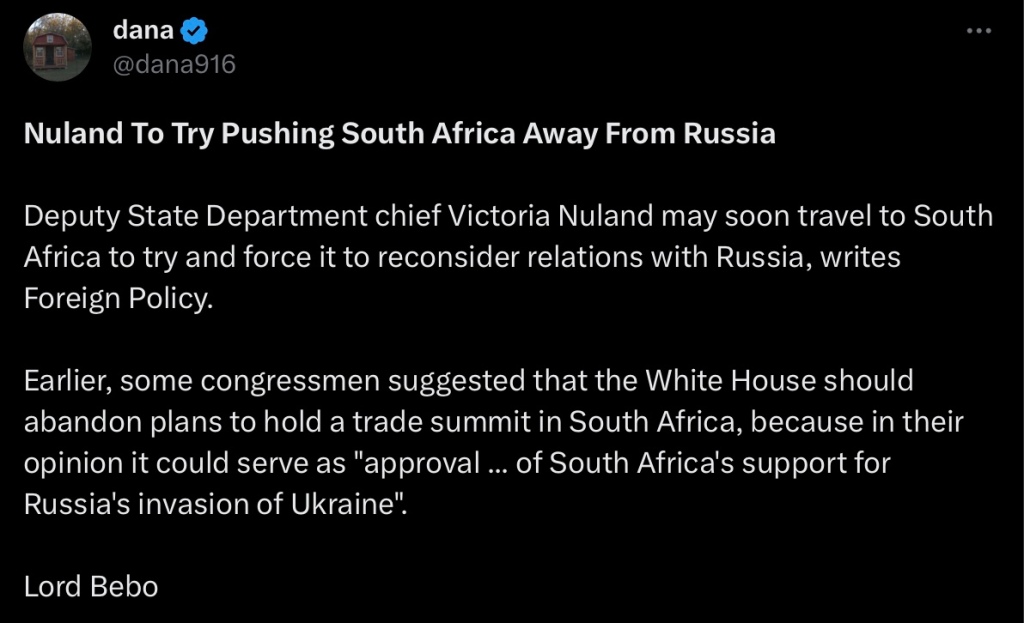
South Africa’s support for Russia after its invasion of Ukraine has incensed some in Washington.
Inside the Desperate Diplomatic Efforts to Salvage U.S.-South Africa Ties
Massive US Oil Caverns Sit Empty and Will Take Years to Refill

Massive US Oil Caverns Sit Empty and Will Take Years to Refill
- Nation’s oil reserve is at 40-year-low after historic drawdown
- Experts say refilling will take decades, if it happens at all
 Ms. Cat’s Chronicles
You must be logged in to post a comment.