
Did you know many African countries continue to pay colonial tax to France since their independence till today!
14 African Countries Forced By France To Pay Colonial Tax For The Benefits Of Slavery And Colonization
Tag: Natural Resources
Niger Military Coup | What They Are Not Telling You
On the 10th of April 2022, the former president of Niger, Mohamed Bazoum posted on Twitter, that “about 30 senior state officials are guilty of embezzlement or misappropriation of public funds. One of them is Niger’s communications minister who had been detained in a high-profile embezzlement case dating from when he ran a state corporation that manages Niger’s mining sector. The 2 social activists that raised the corruption alarm, Abdoulaye Seydou and Adamou Idrissa, were later arrested and transferred to the high security prison according to their coalition.
Meanwhile, French Energy giant Orano announced that it was shutting down its second largest mine in Niger after 50 years of exploitation. Their reason was the uranium deposits at the sites have been depleted.
So in Niger, you have a country with its natural resources being depleted while senior officials in government are notorious and robbing the country. But there is more. According to a publication by Reuters, An audit by the Nigerien Budgetary Transparency Agency, reported a lack of documents to back several government spending and justify the cost of infrastructure projects. The report also noted fake public tenders, and the “granting of undue advantages to certain companies. However the former president Mohamed Bazoum maintained a clean posture that endeared him to the US and ECOWAS leaders.
The former president may not be the problem, but clearly his government was riddled with corruption.
In the morning July 26 2023, the Niger presidential palace and adjacent ministries were blocked off by military vehicles and palace staff were prevented from accessing their offices. The President Mohammed Bazoum had just been removed from office. Some civilian supporters of Bazoum tried to approach the palace, but were dispersed by the Presidential Guard with gunfire, leaving one injured. Elsewhere in Niamey, the situation was described as calm.
Later In the evening, Air Force Colonel-Major Amadou Abdramane went on state television to confirm that Bazoum had been removed from power and announced the formation of a National Council for the Safeguard of the Homeland.
He also announced the suspension of all activities by political parties in the country until further notice.
Alarmed by the recurrence of military coup in the region, ECOWAS leaders swiftly responded and gave Niger’s coup leaders a one-week deadline to hand power back to Bazoum or face international sanctions and the region’s military intervention. However the defence minister of Neighbouring Nigeria, maintained the need for diplomacy. Present at the meeting to echo the fears of ECOWAS leaders that are grappling with similar corruption in their governments was Ghana defence minister.
Niger Military Coup | What They Are Not Telling You via Africa Views
Related:
Read More »Why was there no water to fight the fire in Maui?
Big corporations, golf courses and hotels have been taking water from locals for years. Now the fire may result in even more devastating water theft
Why was there no water to fight the fire in Maui?
How Fake News Shapes World Order

In 1989, the American public was flooded with iconic images of brave Chinese students standing up to Chinese Communist tanks in Tiananmen Square—students who were then brutally slaughtered by the Chinese military. Or so we were led to believe.
Was There Really a Massacre in Tiananmen Square–or Was It an Illusion Fabricated by U.S. Politicians and Corporate Media to Make Americans Hate China?
H/T: Emil Cosman
Related:
Zionist Secret Service & White Russian Army
Alexandria Ocasio-Cortez set to tour Latin America with a group of congressional Democrats 🧐💭

(Kent Nishimura / Los Angeles Times)
Alexandria Ocasio-Cortez set to tour Latin America with a group of congressional Democrats
The agenda (which has not yet been made public) is expected to include meetings with Presidents Lula da Silva (Brazil), Gabriel Boric (Chile) and Gustavo Petro (Colombia) and parliamentary representatives. The legislators will also meet with civil society organizations that work “on the frontlines of ecological transitions, democratic transformations and peace negotiations in the countries,” the delegation explains in a joint statement. The trip seeks to “promote a U.S.-Latin American relationship based on mutual respect, understanding and a commitment to cooperation.”
Ocasio-Cortez, a key figure in the Democratic Party’s most progressive wing, and Misty Rebik, Sanders’s chief of staff (sent on behalf of the 81-year-old veteran senator), will be joined by four congressmen: Joaquin Castro and Greg Casar (both from Texas), Nydia Velázquez (New York) and Maxwell Frost (Florida), who is the youngest congressman in the House of Representatives at 26. Castro is a member of the Subcommittee on the Western Hemisphere, which is part of the Congressional Foreign Affairs Committee. He recently spearheaded a letter to Secretary of State Antony Blinken to pressure Peru’s President Dina Boluarte over human rights violations occurring in that country. Casar is in his first term as a congressman and belongs to the Progressive Caucus, while Velazquez became the first Puerto Rican woman to serve in Congress in 1993.
…
The defense of democracy is another ideal that guides the trip. According to the congresspeople, the “twin” insurrections on Capitol Hill, on January 6, 2021, and in Brasilia (on January 8, 2023) “made it clear that the fate of democracy in the United States is closely tied to that of its southern neighbors. “[Our] democracies,” they believe, “not only share the challenge of defending their institutions from political violence, disinformation and other forms of anti-democratic intervention; they also share the challenge of restoring confidence in the ability of those institutions to meet citizens’ fundamental needs.”
Ocasio-Cortez highlights another goal of the trip: exploring how to “confront disinformation and violent threats to our democracies.” The charismatic congresswoman adds that “it’s long past time for a realignment of the United States’ relationship to Latin America. The U.S. needs to publicly acknowledge the harms we’ve committed through interventionist and extractive policies, and chart a new course based on trust and mutual respect.”
Why might Africa want France gone? + ECOWAS Activates Standby Force for Potential Niger Intervention
Let’s continue to follow the post-coup situation in Niger. We had Victoria Nuland travel to Niger, presumably to help organize the overthrow of the government since 1- that’s usually what a visit from Nuland portends and 2 – a “rebel movement” called the Council of Resistance for the Republic under the leadership of someone named Rhissa Ag Boula started just after her visit. If there is going to be a Western war over this coup, it is likely that Nigeria – the giant country in West Africa with 224M people, much bigger than all other countries in the region combined – will be a part of the intervention, as would France and presumably the US. Other countries of the region are lining up on one or the other side, with Burkina Faso, Mali, and Algeria all lining up with the post-coup Niger government, so we are in a scary situation.
Why might Africa want France gone?
Related:
ECOWAS Activates Standby Force for Potential Niger Intervention
Niger Coup Leader Brig. Gen. Moussa Salaou Barmou Was Trained By The US Military
The Intercept has verified that Brig. Gen. Moussa Salaou Barmou, the head of Niger’s Special Operations Forces and a key figure in the unfolding coup in Niger, received training from the U.S. military. Since 2008, military officers trained by the United States have been involved in 11 coups in West Africa.
Niger Coup Leader Brig. Gen. Moussa Salaou Barmou Was Trained By The US Military
Related:
Army in Niger backs coup as U.S. forces in the country assess situation
Fort Moore (formerly Fort Benning) is home to the former School of the Americas.
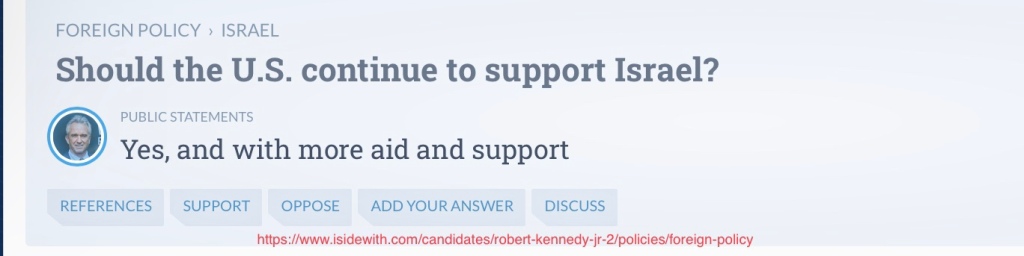
The Kennedy hall of shame on Palestine
This is so bad, it’s almost parody but unfortunately it demonstrates Kennedy is no different to Biden, Harris and bi-partisan associates when it comes to Foreign policy and the ‘security’ of Israel. He can’t pronounce Chechnya. He calls the hijab “habib”. It’s a genuinely embarrassing display of ignorance and orientalism.
The Kennedy hall of shame on Palestine
H/T: The Most Revolutionary Act. Video via Due Dissidence
Biden’s corruption led to Ukraine’s destruction: fmr. Kiev diplomat
Former Ukrainian diplomat and political insider Andrii Telizhenko — now under US sanctions on what he says are false grounds — speaks out.
Biden’s corruption led to Ukraine’s destruction: fmr. Kiev diplomat
The Anglo-American War on Russia – Part Eight (Targeting Russia)
After the Soviet Union disbanded, Europeans assumed that Russia would be welcomed into the European Union and possibly NATO. The United States blocked these attempts because it needed a villain to justify NATO expansion. It also wanted to break up the powerful Russian Federation so that it could never challenge the American empire again nor protect its vast natural resources from foreign control. The Russian Federation consists of 22 republics where Washington supports secessionist movements with the goal of destabilizing and ultimately dismantling Russia.
Resources:
Read More »
 Ms. Cat’s Chronicles
You must be logged in to post a comment.