He said that through the years they were able to modernize and now he relies on the VA Hospital in Madison for his primary health care.
He said he was there recently and became alarmed to hear about cuts now under the Trump administration.
“When I was up there six weeks ago for an incident, I asked one of the nurses, ‘Can I get a pad of paper and a pen to just write some stuff down in the interim between the examinations,’” the veteran recounted. “And she said, ‘I’m sorry we don’t have office supplies. We have to bring in our own pens and paper and marking pens, because the VA doesn’t have it.’”
…
“Don’t just thank me for my service. Tell me what you’re doing to make this country better,” he said.
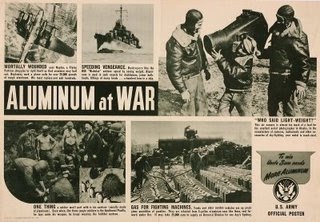
Alcoa is now the third largest aluminum producer in the world. Back in 1941, it was much more powerful. It had a monopoly on aluminum in addition to owning a massive amount of America’s electricity production and other minerals. Before America declared war on Germany, it sent so much of its aluminum product over to Germany that the country made upwards of sixty percent more aluminum products than America. When the US’s involvement in the war began, there was a massive aluminum production shortage in America, in no small part because of Alcoa’s monopoly. Alcoa essentially sold the Axis powers much of the material to build their war machines and a reprieve from the American war machine.
…
2. General Motors
Similar to their automotive rivals, General Motors was sued by Holocaust survivors for assisting the Nazi war machine. Beginning in 1935, GM built a factory in Berlin for the purpose of building “Blitz” trucks for the Wehrmacht. Ford began building similar trucks around the same time, but GM was the number one producer of the vehicles that were vital for the quick conquests of Poland, France, and much of the Soviet Union. Albert Speer, the minister of armaments and war production, claimed that the rubber GM supplied was the key to the ability of the Germans to wage war the way they did. Inevitably when America declared war on Germany, the Reich seized GM’s German production facilities.
Although neither Ford nor General Motors ever fully conceded that they had willingly participated in the use of slave labor, they both were massive contributors to a fund started in 2000 for Holocaust survivors.
You might think that a history of cultural Marxism would start with Marx, but the poorly coiffed Prussian has almost nothing to do with this tale of insidious infiltration. Instead, the theory took off in the late 1990s due to speeches, essays, and books by William Lind, then with the Free Congress Foundation, and Patrick Buchanan, the firebrand conservative columnist, TV talking head, and sometime presidential candidate. (The idea, though not the name, was hatched earlier, in a 1992 monograph called “The New Dark Age: The Frankfurt School and Political Correctness.” It was written by a disciple of the noted conspiracy theorist Lyndon LaRouche.)
Western media companies have made themselves a part of the mechanism of genocide in Palestine, and there are historical precedents for holding them accountable.
I just finished reading ‘Trotsky the Traitor’ and ‘Why I Resigned From the Trotsky Defense Committee’ by Mauritz A. Hallgren. While reading ‘Trotsky the Traitor’, I was reminded of what happens when so-called ‘pro-democracy’ activists are being investigated in their home countries, for treason, yet the corporate media sings their praises. Interestingly, Wikipedia states that the American Committee for the Defense of Leon Trotsky was a front organization.
A little more than a century ago the world’s superpower was the British Empire. Despite being a constitutional monarchy where the aristocracy and monarchy still retained significant power, the British Empire was arguably the birthplace of the industrial revolution and it played a significant role in spreading capitalism around the world through colonialism. From around the 19th century until the early 20th century, many saw the British Empire as quite possibly the most affluent and powerful capitalist-colonial empire in the world. The British Empire as the capitalist-colonial hegemon extracts resources from its colonies, transforms them into commodities, and sells them for a profit that would go into the pockets of capitalists and royal colonizers alike. There were other competing colonizers such as France, The Netherlands, Spain, Portugal, Germany, Japan, and the U.S., but none of them (except the U.S. in the late 20th century) could quite surpass the British Empire. The British Empire was the largest epicenter of world capitalist imperialism and being an anti-imperialist was almost (though not quite) synonymous with being against the British Empire. The geopolitical status of the British Empire is roughly or loosely analogous to the geopolitical status that the U.S. enjoyed since the late 20th century. Both the British Empire and the U.S. enjoy the status of being a hegemonic empire due to their overwhelmingly powerful military (especially their navy) and almost unparalleled economic power.
On 22nd September, the Canadian House of Commons gave a standing ovation to Yaroslav Hunka, a World War II veteran who fought for “Ukrainian independence” against Russian aggressors. This is how the speaker of the House, Anthony Rota, introduced him. The 98-year-old war veteran, however, was a member of a SS unit established in 1943 by the Nazis. Ukrainian President Volodymyr Zelenskyy was also present during the occasion.
This article was originally posted as a thread on Twitter.
The New York Times palms off the deep historical and present-day links of Ukrainian nationalism to Nazism and genocide as merely “thorny issues,” i.e., a public relations problem for media propagandists, who are trying to sell NATO’s proxy war as a struggle for democracy.


 Ms. Cat’s Chronicles
You must be logged in to post a comment.