
Pyongyang, June 27 (KCNA) — The Korean Central News Agency released an article “We Reject ‘American-first Principle’- Nazism in the 21st Century” on Monday to shed light on the criminal nature of “American-first principle” touted by the Trump group of the U.S.
Read More »
Tag: Nazism
Grover Furr: “Trotsky was a fascist!” – Talk on Trotsky’s Comintern Conspiracy to the Oakland ICSS October 20, 2024

I’d like to thank the ICSS organizers for inviting me to talk about our – my and Vladimir L. Bobrov’s — latest book, Trotsky’s Comintern Conspiracy – the Case of Osip Pyatnitsky.
2014: Palestinian Holocaust in Gaza
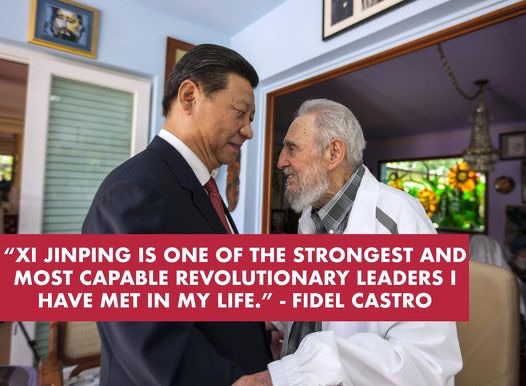
Twenty-six million Russians died in the defense of their homeland against the Nazis. Chinese combatants, men and women, inheritors of a millennial culture, are people of uncommon intelligence and an invincible spirit of struggle. Xi Jinping is one of the strongest and most capable revolutionary leaders I have met in my life.
Fidel Castro Ruz
Protected: 10-22-2024: Merry Christmas you filthy comrade /s
Democrats join Republicans in passing fascistic “Crucial Communism Teaching Act” + More

Protected: WordPress Stats for 12-17-2024
Protected: Trolls are still trying to shut down my blog
Don’t Blame Karl Marx for ‘Cultural Marxism’
Don’t Blame Karl Marx for ‘Cultural Marxism’
You might think that a history of cultural Marxism would start with Marx, but the poorly coiffed Prussian has almost nothing to do with this tale of insidious infiltration. Instead, the theory took off in the late 1990s due to speeches, essays, and books by William Lind, then with the Free Congress Foundation, and Patrick Buchanan, the firebrand conservative columnist, TV talking head, and sometime presidential candidate. (The idea, though not the name, was hatched earlier, in a 1992 monograph called “The New Dark Age: The Frankfurt School and Political Correctness.” It was written by a disciple of the noted conspiracy theorist Lyndon LaRouche.)
Related:
The CIA & the Frankfurt School’s Anti-Communism
Read More »Recruitment and far right: “I Love the Third Brigade”
Recruitment and far right: “I Love the Third Brigade”
The United States is putting pressure on Zelensky to lower the age of conscription again, but for the moment the Ukrainian president is rejecting this possibility. This is what Ukrainian media such as Ukrainska Pravda reported this week, referring to the mobilization of men between 18 and 25 years old, a very small population group in which the country’s future cannot afford to lose. Even before the law on mobilization was approved, which is very unpopular despite not being as harsh as foreign allies demanded, prominent figures and self-proclaimed friends of Ukraine such as US Senator Lindsey Graham have publicly encouraged Ukraine to recruit those over 18 years old despite the demographic risk that this implies for the country they claim to defend. These suggestions seem to have become a demand that is confirmed even by people who belong to the state apparatus. “If this information has come to light, it may confirm that American politicians from both parties are putting pressure on President Zelensky on the question of why there is no mobilisation for those aged 18-25 in Ukraine,” said Serhiy Leshchenko, one of Andriy Yermak’s advisers and a figure who has gone from representing the third sector, civil society in Maidan Ukraine to all kinds of well-paid positions in government or in the few state-owned companies that Kiev has not yet privatised. The past ten years show a double standard between those who have been privileged and those who have been impoverished and marginalised thanks to the European and liberal reforms of the peacetime years. However, Ukraine’s refusal to recruit its most vulnerable population group strictly responds to the future needs of the state, which, if it hopes to rebuild itself, must maintain minimum levels of youth population.
Read More »
Meet Ukraine’s top fighting unit — at least that’s what their ad says
Ukraine’s brigades can recruit their own soldiers, and they compete with each other to craft the best advertising campaigns to sell the war.
…
The creative work, Bondarenko said, is done by a team of 20 — 13 military personnel and seven civilians. Their messaging feels impossible to escape, covering more than 1,000 billboards across Ukraine, which she said are largely donated. Digital ads are funded by the profits from their YouTube channel, she said, which has nearly 1.3 million subscribers and generates more than $15,000 monthly. On Instagram, they have another 115,000 subscribers.
Soon, they hope to expand into a new area — merchandising. The brigade envisions it as a one-stop shop where people can purchase T-shirts, patches and other mementos of the war.
Meet Ukraine’s top fighting unit — at least that’s what their ad says
The 3rd Assault Brigade is the Neo-Nazi Azov Battalion rebranded. Andriy Biletsky was its founder.
Related:
Thirst Trap Nation: How E-girls Are Luring Young Boys Into Joining Army, with Alan MacLeod
“Sexualized fascism”: how the taboo nature of Nazi imagery made the alt-right more powerful
 Ms. Cat’s Chronicles
You must be logged in to post a comment.