
John Bolton shares stance on talks with Russia in prank call
Related:
Full video-prank with Former United States National Security Advisor John Bolton / Part 1
Full video-prank with Former United States National Security Advisor John Bolton / Part 2
Ukrainian forces are unlikely to be able to recapture Crimea from Russian troops in the near future, four senior Defense Department officials told House Armed Services Committee lawmakers in a classified briefing. The assessment is sure to frustrate leaders in Kyiv who consider taking the peninsula back one of their signature goals.
Ukraine can’t retake Crimea soon, Pentagon tells lawmakers in classified briefing
Brazil, Argentina, and Colombia have refused to send weapons to Ukraine, despite pressure by the US and EU. Latin American left-wing leaders have urged peace with Russia and called for neutrality in the West’s new cold war.
Latin America refuses to send Ukraine weapons, despite Western pressure
Tens of thousands of Italians have signed a petition protesting Ukrainian President Vladimir Zelensky’s planned address at a Eurovision-style song contest. Deputy Prime Minister Matteo Salvini told reporters that the event “should remain the festival of Italian song and nothing else.”
Thousands of Italians sign-up against Zelensky speech
Related:
The report says a prolonged war in Ukraine hampers the US ability to focus on its ‘competition with China’
New RAND Report Says a Long War in Ukraine Is Against US Interests
Previously:
RAND: Avoiding a Long War – U.S. Policy and the Trajectory of the Russia-Ukraine Conflict

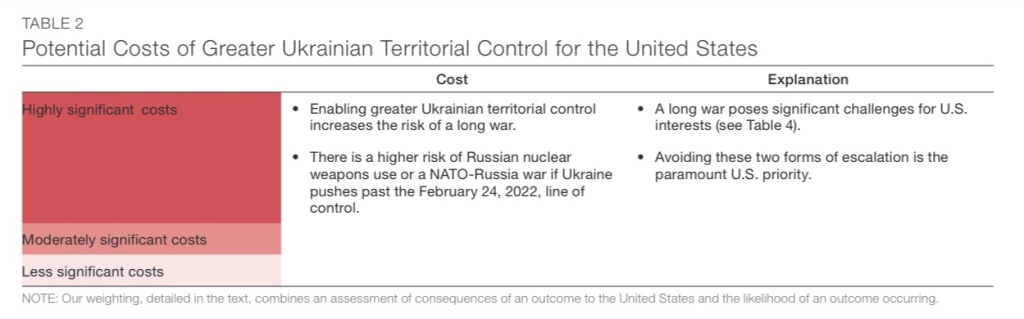


*Russian use of nuclear weapons is a plausible contingency that Washington needs to account for and a hugely important factor in determining the future trajectory of the conflict
*Although a Russian decision to attack a NATO member state is by no means inevitable, the risk is elevated while the conflict in Ukraine is ongoing.
*Chairman of the Joint Chiefs of Staff Mark Milley reportedly kept a list of “U.S. interests and strategic objectives” in the crisis: “No. 1” was “Don’t have a kinetic conflict between the U.S. military and NATO with Russia.” The second, closely related, was “contain war inside the geographical boundaries of Ukraine.”
*It is clear why Milley listed avoiding a Russia-NATO war as the top U.S. priority: The U.S. military would immediately be involved in a hot war with a country that has the world’s largest nuclear arsenal. Keeping a Russia-NATO war below the nuclear threshold would be extremely difficult, particularly given the weakened state of Russia’s conventional military.
*Since neither side appears to have the intention or capabilities to achieve absolute victory, the war will most likely end with some sort of negotiated outcome.
*Since avoiding a long war is the highest priority after minimizing escalation risks, the United States should take steps that make an end to the conflict over the medium term more likely.
*A major source of uncertainty about the future course of the war is the relative lack of clarity about the future of U.S. and allied military assistance to Ukraine.
Avoiding a Long War – U.S. Policy and the Trajectory of the Russia-Ukraine Conflict
Related:
Avoiding a Long War – U.S. Policy and the Trajectory of the Russia-Ukraine Conflict
By Herman Tiu Laurel
“What happens when an unstoppable force meets an immovable object?” The question is appropriate when applied to the South China Sea contentions (the term “dispute” is already too loaded).
What happens when an unstoppable force meets an immovable object?
by Gabor Steingart
The US supports Ukraine like no other country in the world. But this help is not completely selfless. Because even Joe Biden has nothing to give away. The US President relies on “arming on credit”. Germany, on the other hand, can only hope that the war will soon end not far from its front door.
The US wins the Ukraine war (original, in German)


CIA Director William J. Burns traveled in secret to Ukraine’s capital at the end of last week to brief President Volodymyr Zelensky on his expectations for what Russia is planning militarily in the coming weeks and months, said a U.S. official and other people familiar with the visit.
CIA director holds secret meeting with Zelensky on Russia’s next steps
Related:
Ukraine and Georgia’s NATO aspirations not only touch a raw nerve in Russia, they engender serious concerns about the consequences for stability in the region. Not only does Russia perceive encirclement, and efforts to undermine Russia’s influence in the region, but it also fears unpredictable and uncontrolled consequences which would seriously affect Russian security interests. Experts tell us that Russia is particularly worried that the strong divisions in Ukraine over NATO membership, with much of the ethnic-Russian community against membership, could lead to a
major split, involving violence or at worst, civil war. In that eventuality, Russia would have to decide whether to intervene; a decision Russia does not want to have to face.
Archived Links Inside WaPo Article:
Read More » Ms. Cat’s Chronicles
You must be logged in to post a comment.