The Cambodia National Rescue Movement is affiliated with Liberal International, the same organization which is affiliated with Vente Venezuela, the party of María Corina Machado. My Indonesia and Bangladesh documents can be found on my documents page, along with the Atlas Network one.
On a trip organized by the United States Campaign for Burma , Ani visited refugee camps in Burma earlier this July. Burma is the site of one of the bloodiest battles for democracy in history, where the military regime running the country, now known as the State Peace and Development Council, responded to democratic protesters with brutal force, gunning down up to 10,000 persons in cold blood. She played impromptu concerts both in the refugee camps and for a group of former political prisoners who had been severely tortured and forced to flee by the ruling regime. Ani was the first American musician to visit these camps and meet with pro democracy activists. To read the press release from USCB, click here. Stay tuned for pictures of the trip and information about a compilation CD, including a track by Ani, to be released to benefit the United States Campaign for Burma.
In 2004, DiFranco visited Burma in order to learn about the Burmese resistance movement and the country’s fight for democracy. During her travels she met with then-detained resistance leader Aung San Suu Kyi. Her song “In The Way” was later featured on For the Lady, a benefit CD that donated all proceeds to the United States Campaign for Burma.
Violent regime change in the South Asian country of Bangladesh unfolded rapidly and mostly by stealth as the rest of the world focused on the ongoing conflict in Ukraine, growing tensions in the Middle East and a simmering confrontation between the US and China in the Asia-Pacific region.
There is a problem, fundamentally, in viewing the regime change in Bangladesh as a ‘stand-alone’ event. The caveat must be added right at the outset that when it comes to processing situations, nothing happens for no reason at all. There is very little awareness in India, especially in the media, about what has been going on. Mostly, it’s ‘cut-and-paste’ job culled out from the jaundiced western accounts from a new Cold War angle.
Maria Ressa is calling for the revocation of Section 230 of the Communications Decency Act. Revoking Section 230 would increase social media censorship and remove competition for Facebook, Twitter, WordPress, and YouTube (Google). Why? Due to threats of being sued, social media companies could ‘hold’ your posts until approved by artificial intelligence or a human. They’d also be inclined to remove more content. As for competition, smaller companies can’t afford the legal teams and/or fees that large companies can. The lawsuits could bankrupt a smaller company. Considering that Rappler is also funded by Big Tech, I’m not surprised that she’s on their side.This isn’t about hate speech, or ‘disinformation’, it’s about controlling the narrative!
In this clip, she complains about being criticized for appearing with Clinton and for being accused of being a CIA agent and a Communist. Of course, she’s not going to mention why she’s been accused of being a CIA agent (because she’s been funded by the CIA-cutout National Endowment for Democracy and other front organizations)!
Some speakers — including Clinton, former Google CEO Eric Schmidt and Rappler CEO Maria Ressa — also called on Congress to reform Section 230 of the Communications Decency Act. Ressa, a journalist who won the Nobel Peace Prize in 2021, also noted it’s hard for people to know what it’s like to be a victim of online harassment or misinformation until they’ve been attacked.
WikiSpooks: Rappler(Sponsored by Facebook, Friedrich Naumann Foundation, Google, Internews, National Endowment for Democracy, Open Society Foundations, Omidyar Network)
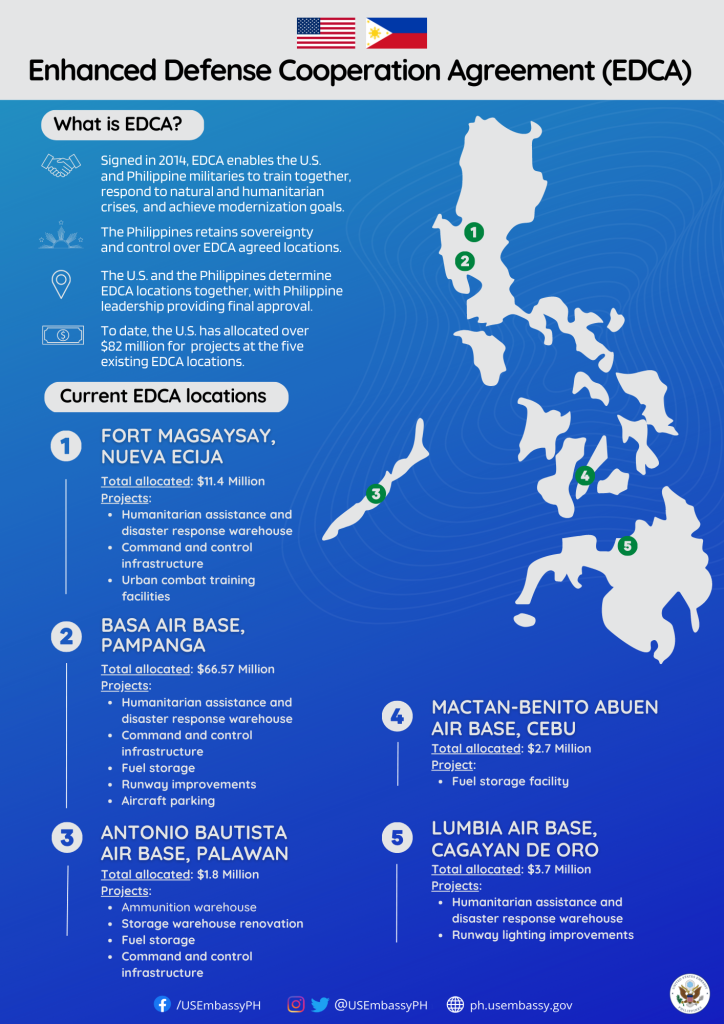
Moreover, the involvement of Subic Bay, a location not officially listed as a site/base under the expanded Enhanced Defense Cooperation Agreement (EDCA) as the alleged destination of US military fuel from Pearl Harbor, prompts a critical inquiry about its role and whether it might be serving as an unofficial or de-facto EDCA site. Hence, it begs to inquire if Subic Bay is now effectively functioning as a de-facto EDCA site. And if so, could there be other undeclared de-facto EDCA sites serving similar purposes other than the nine declared ones?
…
Could it be posited that the current Philippine administration appears to prioritize the demands and interests of the United States over its own national interests, sovereignty, and independence, suggesting a level of deference that could be interpreted as reminiscent of a vassal state? This perspective raises questions about the autonomy of the Philippine political leadership and the extent to which it serves the interests of its citizens first and foremost. The lack of public discussion, accountability, and transparency on matters that potentially impinge on national sovereignty could be seen as indicative of a disproportionate influence by the U.S. on Philippine domestic affairs and foreign policy, prompting a reevaluation of the true nature of the bilateral relationship between the two nations.
The Primary Sources on Kissinger’s Controversial Legacy
Archive Obtained and Published Previously Secret Records on Kissinger’s Role in Secret Bombing Campaigns in Cambodia, Illegal Domestic Spying, Support for Dictators, and Dirty Wars Abroad
Henry Kissinger, the toweringly influential former secretary of state who earned a reputation as a sagacious diplomat but drew international condemnation and accusations of war crimes for his key role in widening the American presence in Vietnam and the U.S. bombing of Cambodia, died Wednesday.
You must be logged in to post a comment.