Bangladesh moves to ban Awami League, approves tribunal law amendments for trial

The interim government has decided to ban the Awami League party of deposed prime minister Sheikh Hasina under the Anti-Terrorism Act, bowing to demands from the National Citizen Party (NCP), Jamaat-e-Islami, and other religious-based political parties.

Bangladesh moves to ban Awami League, approves tribunal law amendments for trial

Related:

Bangladesh’s Constitution reform: Sweeping changes in the constitution

What’s Behind Regime Change in Bangladesh 

Bangladesh document

Bangladesh’s Constitution reform: Sweeping changes in the constitution

Source

Constitution reform: Sweeping changes in constitution

Expanding the fundamental rights to include food, clothing, shelter, education, internet, and vote, the Constitution Reform Commission proposes replacing nationalism, socialism, and secularism with equality, human dignity, social justice and pluralism as fundamental principles of state policy.

Modifying, the much discussed article 70, the commission recommends that parliamentarians be allowed to vote against party line except finance bills.

The constitution commission recommends deletion of the constitutional provision that stipulates inclusion of Bangabandhu Sheikh Mujibur Rahman’s speech of March 7, 1971, his declaration of independence and the proclamation of independence, which are included in the 5th, 6th and 7th schedules respectively.

FYI, it was written by International IDEA, which is funded by USAID, Open Society Foundations, and several Western governments.

Related:

Leaked files expose covert US government plot to ‘destabilize Bangladesh’s politics’

Atlantic Council’s Ali Riaz to lead commission on constitutional reforms for Bangladesh

Bangladesh and Kenya document

India is losing Bangladesh to China and Pakistan, and it could get worse

India is losing Bangladesh to China and Pakistan, and it could get worse

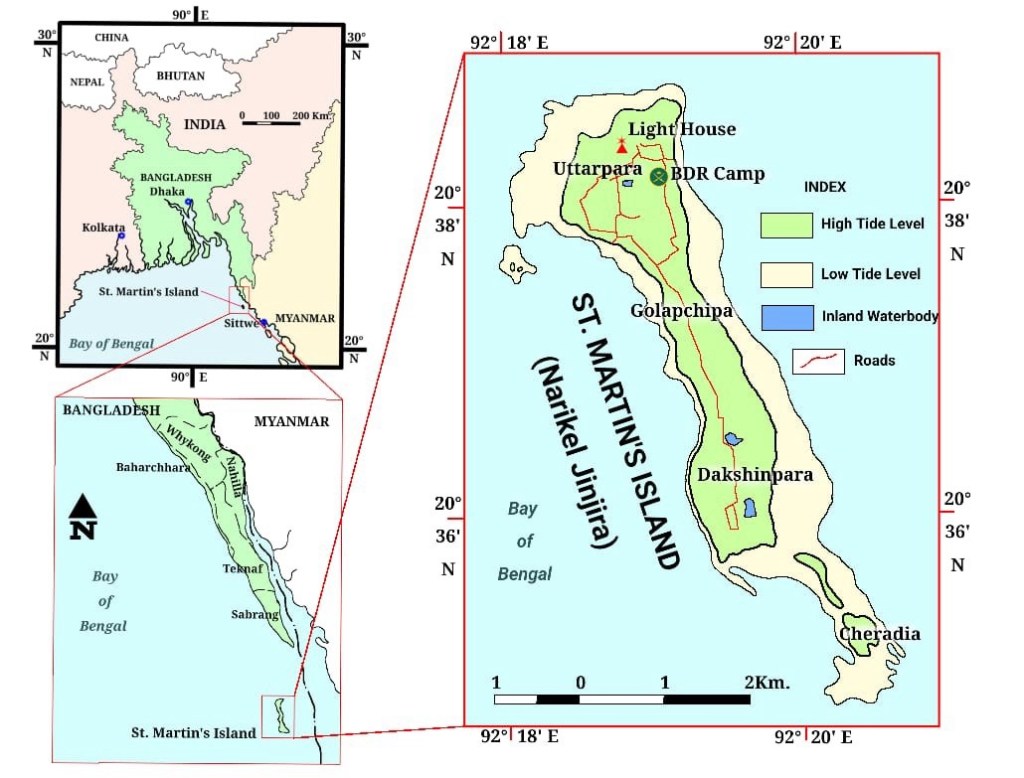
Source: St. Martin’s Island: A new flashpoint in the Bay of Bengal?Observer Research Foundation

by Derek J GrossmanRAND

Beijing has further sought to develop numerous Bangladeshi ports, including Chittagong, Mongla, and Sonadia ports, to achieve a maritime presence in the Bay of Bengal. Enhanced access to any or all of these ports could substantially add to Beijing’s “string of pearls” strategy to hem in India in the Indian Ocean.

Read More »

Updates for the Bangladesh document

Battle for soul of Bangladesh far from over

One of the most pressing issues facing Yunus’ interim government is the restoration of law and order. Since the uprising, the police — once a tool of state terror under Hasina — have largely disappeared from the streets fearing violent retribution from the public. Police stations have been set ablaze, and in their absence, student-led groups have taken up roles in maintaining local order. In a country where state violence was once the norm, the people’s reliance on these grassroots organisations rather than formal law enforcement is a telling indicator of the deep mistrust in state institutions, although, over the span of two months, we have also witnessed that dynamic of trust taking on significant concessions and alterations in the questions of nationalism, the phantom of separatist movements and the security discourse enveloping the Chittagong Hill Tracts [CHT].

Perhaps above all else, the Chittagong Hill Tracts have historically been a flashpoint for military-police dynamics, reflecting tensions between the indigenous populations, popular local political parties and civil society members on one side, and Bangladeshi state authorities, the military, and the plainland settlers serving as vanguards of the Bengali-Bangladeshi nationalist project on the other. The military’s sustained and in fact, expanding presence in the CHT, justified as means of ‘maintaining order’, has led to systemic human rights violations and a climate of permanent, pervasive fear, discontent, animosity, and distrust, and for good reason.

As per a report by the Human Rights Support Society, in the month of September alone, 28 were killed in 36 different incidents of mob lynching across Bangladesh, with 14 others injured. Political violence claimed another 16 lives and injured 706. In their report, HRSS refers to a wild-wild-Western state of affairs that is still developing, including factional clashes within the two major political parties, targeted violence against ethnic and religious minorities, attacks on journalists, extrajudicial killings, and worker protests. Overnight, netizens witnessed footage of defenceless Tofazzal and Shamim Mollah, mercilessly beaten to their deaths in the two top public universities.

This is especially true when we consider how global neoliberal agendas intersect with local political upheavals. Like the Arab Spring, derailed by counter-intelligence tactics, surveillance capitalism, and imperialist interventions, Bangladesh faces the risk of its uprising being neutralised by the coalescence of state surveillance, corporate interests, and international capital. The convergence of military intelligence, former Awami elites, and foreign backers — including both regional powers and multinational corporations — threatens to undo the revolution’s hard-won gains by appealing to reactionary fears and mobilising mobs against progressive forces.

No criticism of U.S. puppets allowed:

Criticism on Dr Yunus: Magistrate suspended in Bangladesh

Read More »

Leaked files expose covert US government plot to ‘destabilize Bangladesh’s politics’

Leaked docs reveal that prior to the toppling of Bangladeshi PM Sheikh Hasina, the US govt-funded International Republican Institute trained an army of activists including rappers and “LGBTQI people,” even hosting “transgender dance performances,” to achieve a national “power shift.” Institute staff said the activists “would cooperate with IRI to destabilize Bangladesh’s politics.”

Leaked files expose covert US government plot to ‘destabilize Bangladesh’s politics’

Previously:

Atlantic Council’s Ali Riaz to lead commission on constitutional reforms for Bangladesh

What’s Behind Regime Change in Bangladesh

Bangladesh and Kenya document

Dr Yunus introduces Mahfuz Alam as mastermind of student movement +

Source / Full video

Dr Muhammad Yunus, the chief adviser in Bangladesh’s interim government, on Tuesday introduced Mahfuz Alam, his special assistant, as the “brain” behind the country’s recent student-led movement and subsequent push to topple the Awami League regime, at an event in New York, US.

Dr Yunus praised Mahfuz for his leadership, calling him the “brain of the whole revolution,” though Mahfuz humbly insisted that the movement had been a collective effort. 

Dr Yunus introduces Mahfuz Alam as mastermind of student movement

Related:

Who was the third youth to join Yunus on stage at the Clinton Global Initiative event?

Read More »

UN team in Dhaka to set up probe of student protest killings + Notes

UN team in Dhaka to set up probe of student protest killings

Rory Mungoven, chief of the Asia Pacific region at the OHCHR, is leading the three-member team, which met Foreign Secretary Masud Bin Momen after arrival in Dhaka.

“We want to believe that we will have a proper investigation,” Umama Fatema, coordinator of Students Against Discrimination, the main protest organizing group, told Arab News.

Related:

Rory Mungoven: Human Rights Watch, Free Tibet Campaign, Amnesty International

AI & HRW: Front Organizations

Tibet

Umama Fatema: University of Dhaka

Bangladesh and Kenya document

What’s Behind Regime Change in Bangladesh

What’s Behind Regime Change in Bangladesh

Violent regime change in the South Asian country of Bangladesh unfolded rapidly and mostly by stealth as the rest of the world focused on the ongoing conflict in Ukraine, growing tensions in the Middle East and a simmering confrontation between the US and China in the Asia-Pacific region.

What’s Behind Regime Change in Bangladesh (archived)

Related:

The Partition of South Asia Strikes Again

There is a problem, fundamentally, in viewing the regime change in Bangladesh as a ‘stand-alone’ event. The caveat must be added right at the outset that when it comes to processing situations, nothing happens for no reason at all. There is very little awareness in India, especially in the media, about what has been going on. Mostly, it’s ‘cut-and-paste’ job culled out from the jaundiced western accounts from a new Cold War angle.

Clear signs of US trying to topple Sheikh Hasina govt: Regime change operation underway in Bangladesh and why India should be alert

The Genocide the U.S. Can’t Remember, But Bangladesh Can’t Forget