
Part Three: Sternenko and the Promoters of Judicial Reform in Ukraine (Tercera parte: Sternenko y los promotores de la reforma judicial en Ucrania)
Read More »Tag: Non-governmental Organizations
Pre‑Scripted Contest: U.S. Sets Narrative for Honduras Election
The U.S. government, through its network of front organizations, is already laying the groundwork to frame Sunday’s election in Honduras as disputed—before a single ballot has even been cast.
Honduras heads toward elections amid allegations of fraud and military interference
Local media outlets have also reported on X that members of the ruling party have assaulted supporters of other political parties. One such complaint was made by Liberal Party legislator Iroshka Elvir. “When we were in District 15, groups of LIBRE supporters in El Pedregal blocked the road with sticks and stones, and verbally assaulted our candidates,” Elvir said.
Related:
Iroska Elvir is married to Salvador Nasralla, who is running for President of Honduras.
Read More »Ukraine: Anti-corruption, civil society and foreign partners
Capes, Cameras, and the Cult of Visibility
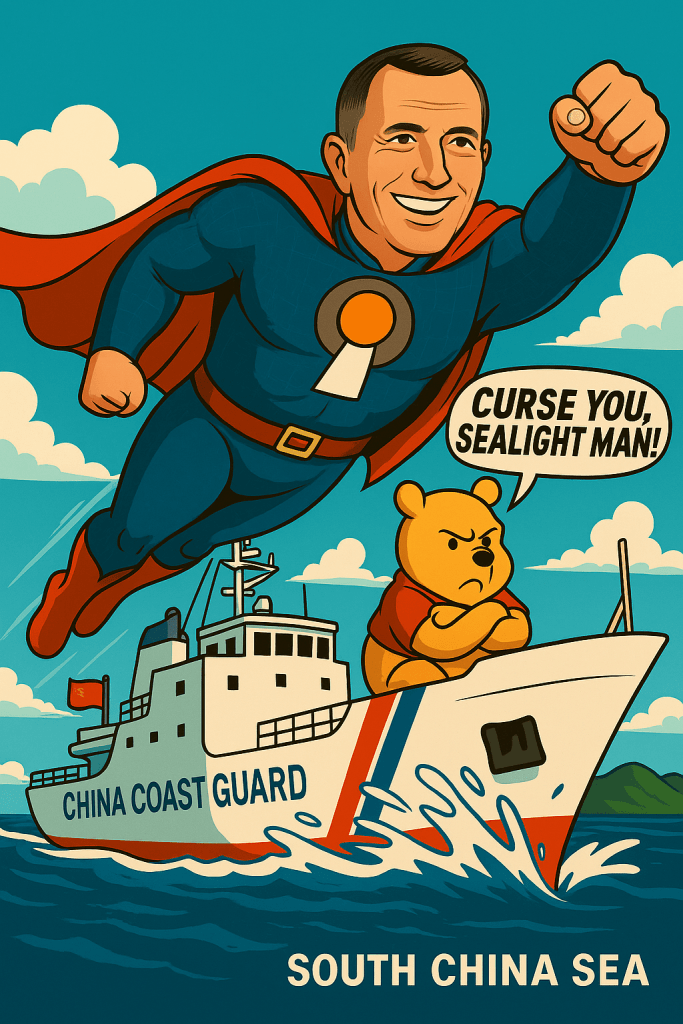
Capes, Cameras, and the Cult of Visibility: The SeaLight Crusade as White Savior Theater
By Tina Antonis
The South China Sea is more than a maritime dispute—it’s a theater of narrative warfare. While headlines focus on Chinese aggression and Philippine resistance, a quieter campaign unfolds in the background: one of satellite feeds, curated imagery, and Pentagon-backed storytelling. At the center of this effort is SeaLight, a project that claims to illuminate truth but often casts shadows of its own.
As explored in my article at Antiwar.com, SeaLight doesn’t just document—it performs. It reframes geopolitical tension through moral spectacle, positioning its creators as heroic arbiters of transparency. But when the messenger wears a cape and the funding flows from defense budgets, we must ask: is this clarity, or choreography?
Stage Left: The White Savior Enters
In the comic-strip cosmology of Ray Powell’s SeaLight project, transparency wears a cape. Clad in heroic postures and backed by satellite imagery, Powell casts himself as the guardian of maritime morality—unarmed, except with satellite feeds, theatrical flair, and strategic messaging.
Yet beneath the cartoon and Pentagon-funded optics lies a familiar archetype: the white savior, rebranded for the South China Sea.
China Is Imperialist? Says Who?
Calling China a “maritime occupier,” Powell positions himself as a bulwark against aggression. But that moral pose collapses under scrutiny. He speaks for a country with over 800 foreign military installations and a documented history of over 250 military interventions since 1991—wars in Iraq, Afghanistan, Libya, Syria, Somalia, and dozens more, all under the banner of peace, freedom, or preemption.
By comparison, China’s post–Cold War footprint includes no sustained foreign occupations and only scattered border conflicts and peacekeeping missions. The imbalance is staggering. And Powell’s framing doesn’t just ignore it—it performs around it.
As David Vine argues in The United States of War, this vast base empire is not a passive network—it’s an architecture of perpetual war. These outposts make military engagement not an exception but a structural habit, cloaked in strategic necessity and sold as global stewardship.
Powell’s cartoon rhetoric—calling China an occupier—obscures the scale of U.S. militarism. The term “occupation” is deployed not to analyze, but to project. When adversaries hold territory, it’s a crisis; when the U.S. spans the globe with armed installations, it’s policy.
Framing Conflict: The Optics of Consent
This isn’t irony. It’s performance. Powell’s language manufactures a moral frame for confrontation—costumed in transparency, but driven by escalation. The cape is literal. The conditioning is deliberate. And the stage is set for war.
SeaLight’s mission is not just visual documentation—it’s narrative warfare. As the Japan Times openly notes, its “chief weapon is photography, applied purposefully, generously and consistently over time.” These images—enhanced, curated, and distributed across media—are not neutral. They’re constructed to shape public perception, sway international opinion, and ultimately manufacture consent for confrontation.
Assertive transparency becomes a kind of ideological scaffolding—a stage on which geopolitical tension is dramatized, simplified, and morally polarized. The goal isn’t simply to reveal conflict; it’s to condition audiences for escalation.
And when the messenger dons a superhero’s cape, the spectacle transforms into something deeper: a story of rescue, of virtue, of intervention. This is not analysis—it’s soft propaganda dressed in heroic metaphor.
Consent for war doesn’t begin with missiles. It begins with mythmaking.
Russia’s Aid Agency Aims to Fill USAID’s Void
Russia’s Aid Agency Aims to Fill USAID’s Void
Rossotrudnichestvo is widely viewed as providing cover for intelligence-gathering activities and mischief-making. For example, an analysis of Russia House operations in Czech capital Prague published in late 2024 by the Warsaw Institute characterized Rossotrudnichestvo as a front for spying.
Pari passu potestatis.
Related:
Read More »Revealed: How journalism and awards work together to promote genocide and regime change
2025 – U.S. “Foreign Assistance” to Serbia

Azov vs. Azov
Two weeks ago, masked men attacked Major Andriy Korynevych, a recruitment officer from the Azov Brigade in the National Guard of Ukraine (NGU), and beat him in broad daylight near his home in Ivano-Frankivsk, western Ukraine. About ten days later, he dropped a bombshell: police identified his attackers and their accomplices, all of them from the Azov movement’s 3rd Assault Brigade (AB3). Furthermore, Korynevych suggested that the assault took place on the orders of Andriy Biletsky, the leader of the Azov movement, who he said is “closely connected” to the attackers. NGU Azovites are evidently furious—their unit published a statement denouncing the alleged assailants—and many AB3 Azovites are no less enraged at their counterparts’ betrayal, for going to the police and airing their dirty laundry.
Related:
Seven Decades of Nazi Collaboration: America’s Dirty Little Ukraine Secret (Archived)
US President Trump Streamlined the National Endowment for Democracy*, not Dismantle it
Brian Berletic, June 11, 2025
While many believe that under the Trump administration the controversial National Endowment for Democracy (NED*) was defunded, dismantled, or otherwise dissolved, the reality is far less dramatic and far more dangerous.
US President Trump Streamlined the National Endowment for Democracy*, not Dismantle it (archived)
US Embassy in Uganda Runs Clandestine Foreign Interference Program Targeting East African Journalists
The United States Embassy in Kampala, Uganda is actively involved in Foreign Information Manipulation and Interference (FIMI) activities targeting audiences in East Africa. This was the verdict of selected journalists who took part in a secret program it organised in Kampala last week, ostensibly to train them on countering what it terms ‘Russian propaganda and disinformation.’ The clandestine program – where participants were electronically surveiled to ensure they recorded nothing – took place between Monday 19 May and Friday 23 May, 2025 under the theme “Understanding and Countering Russian Propaganda and Disinformation in Uganda.”
Related:
Is West grooming Ugandan media, NGOs to promote anti-Russia propaganda?
Read More » Ms. Cat’s Chronicles
You must be logged in to post a comment.