“Territorial control? Yes. Control of the Arctic? Yes. Preventing Russia from freely using the Northern Sea Route, making our lives difficult with military bases? Yes,” the expert says.
By Captain John Konrad (gCaptain) In 1883, Alfred Thayer Mahan laid out the brutal truth of global power: Whoever rules the waves rules the world. He wasn’t just talking about fleets of warships. He was talking about chokepoints—the narrow passages through which the vast majority of the world’s trade must pass. Control them, and you don’t need to launch an invasion. You can starve an economy and restrict military sealift without ever firing a shot.
President Donald Trump has directed the Pentagon to prepare plans for carrying out his threat to “take back” the Panama Canal, including by military force if needed, two U.S. officials familiar with the situation told NBC News Thursday.
Tomasz Łukaszuk, who is also a research scientist at Warsaw University, was speaking as a U.S. consortium led by BlackRock is set to acquire a major stake in ports along the Panama Canal owned by a Hong Kong-based company, CK Hutchison Holdings, the same company that owns a cargo terminal in Poland’s Port of Gdynia.
…
“It serves as the main transit hub for the transfer of American soldiers and equipment to Ukraine,” he continued. [Timestamp: 3:52]
The Indian Navy intends to build a second base in the Lakshodeep archipelago, located on the tanker route from the Gulf of Aden and the Strait of Hormuz to the Strait of Malacca.
Russia is not only eyeing China as part of its outreach for the resource-rich Arctic region but is also engaging India on the Arctic route to increase bilateral trade and investments in oil, natural gas and coking coal sectors, ET has learnt.
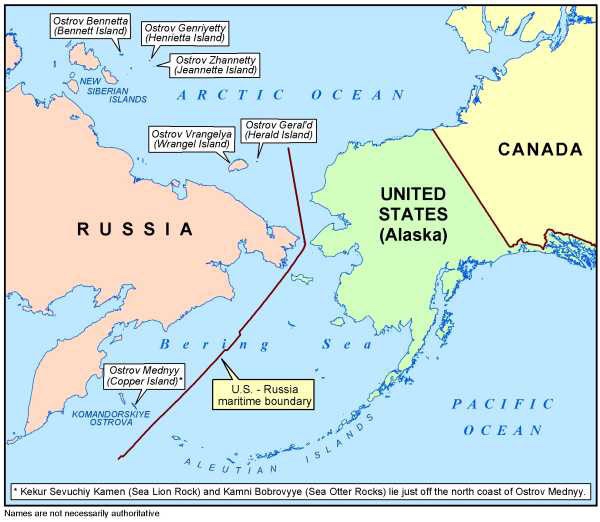
Thomas E. Dans, a columnist for The Wall Street Journal (WSJ) and former Commissioner of the US Arctic Research Commission, believes that the United States should reclaim Wrangel Island from Russia.
No negotiations regarding the U.S.-Russia maritime boundary have occurred since 1990, when the U.S.-USSR Maritime Boundary Agreement was signed. The negotiations that led to that agreement did not address the status of Wrangel Island, Herald Island, Bennett Island, Jeannette Island, or Henrietta Island, all of which lie off Russia’s Arctic coast, or Mednyy (Copper) Island or rocks off the coast of Mednyy Island in the Bering Sea. None of the islands or rocks above were included in the U.S. purchase of Alaska from Russia in 1867, and they have never been claimed by the United States, although Americans were involved in the discovery and exploration of some of them.
“. . . whoever holds the Arctic, holds the world. I think it is the most important strategic place in the world.” These solemn words were uttered in 1935 before a House of Representatives Committee by a retired American general and aviator, Billy Mitchell, who presciently foresaw the Arctic as a vital region for early detection against missile and aviation threats to prevent an attack against the United States. But at the end of the Cold War, the Arctic ceased to be a strategically important place for either the United States or the Russian Federation. But by the 2007-2008 timeframe, Russia began to re-prioritize the Arctic both economically and militarily—in keeping with Vladimir Putin’s vision of restoring Russia’s status as a great power and harnessing the Arctic’s economic potential. Now more than a decade later, Russia has returned to the Arctic militarily with important strategic implications for the United States.
BY M. K. BHADRAKUMAR | INDIAN PUNCHLINE | JULY 19, 2022
If the metaphor of the “Great Game” can be applied to the Ukrainian crisis, with the expansion of the North Atlantic Treaty Organisation (NATO) at it core, it has begun causing reverberations across the entire Eurasian space. The great game lurking in the shade in the Caucasus and Central Asian regions in recent years is visibly accelerating.


 Ms. Cat’s Chronicles
You must be logged in to post a comment.