

The Subjugation of Women Under Capitalism:
The Bourgeois Morality
Tag: nuclear family
Capitalism is Anti Family
DeepSeek: What Would Lenin and Marx Say About Romantic Love
Vladimir Lenin, as a revolutionary and Marxist thinker, approached most topics through the lens of class struggle, materialism, and the broader social and economic systems. While he did not write or speak extensively about love as a personal or romantic concept, his views on human relationships were likely shaped by his Marxist perspective.
Here’s how Lenin might conceptualize love, based on his ideological framework:
Read More »
Communism vs. Feminism
Porn, Feminism & the Meese Report
Feminist theory is not just flawed thinking; it is the product of a middle-class view of the world. In the prosperity of the 1960s, radical feminism was marked by its extreme utopian nature. Demands like “smash sexism” and “abolish the family” abounded—with absolutely no program that could win them. Since feminists rejected Marxism and with it the one class that actually has the power to revolutionize society, their utopian maximalist rhetoric dissolved inevitably into the most pragmatic minimalism. In fact, because the reformist strategies of the ’60s—above all the overwhelming support of feminists for the Democratic Party—failed to bear ample fruit, a fertile ground for cynicism was laid. The root of the current feminist support for the thoroughly capitulatory Dworkin is the cynicism born of defeat.
Read More »
Protected: Personal: Introspection
Prescribing the American Dream

This is from something that I’ve been working on regarding Freudian psychology and social conditioning. Unfortunately, one of the author’s sources is Hannah Arendt’s Origins of Totalitarianism, which falsely equates Communism with Nazism. To be honest, I haven’t found any “perfect” sources for my project. Even Michael Parenti’s Against Psychopolitics quotes problematic sources (Harold Lasswell was involved with the RAND Corporation). While Karl Korsch had worked for the University of Frankfurt Institute for Social Research, which was home to the CIA front Frankfurt School, I like the above quote. I’ll probably end up using a different one when it’s all said and done, though.
Read More »Michael Parenti: Against Psychopolitics
Many great public issues as well as many private troubles are described in terms of the “psychiatric” — often, it seems, in a pathetic attempt to avoid the large issues and problems of modern society.
— C. Wright Mills, The Sociological Imagination
Alexandra Kollontai: Prostitution and ways of fighting it
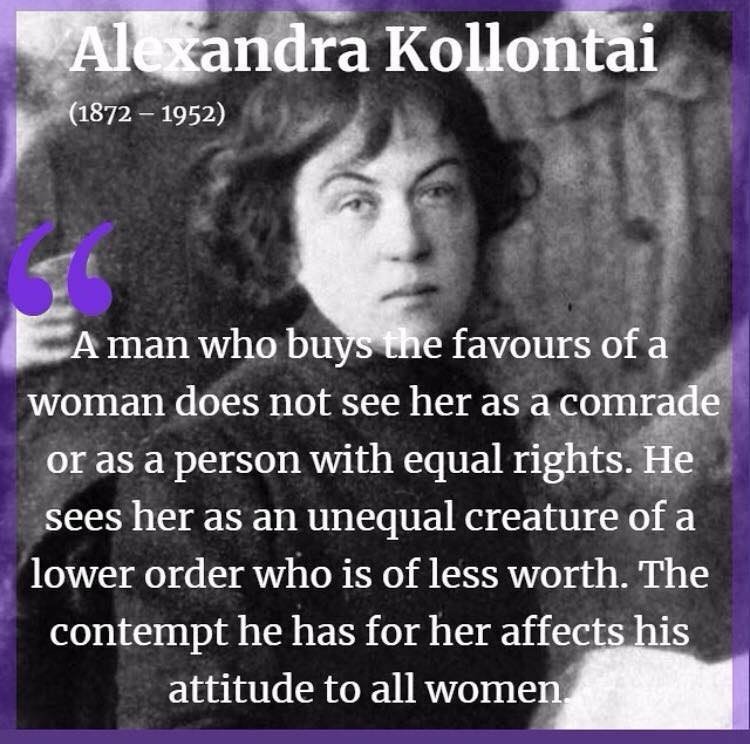
Alexandra Kollontai: Prostitution and ways of fighting it
What is the fundamental quality of the working class? What is its strongest moral weapon in the struggle? Solidarity and comradeship is the basis of communism. Unless this sense is strongly developed amongst working people, the building of a truly communist society is inconceivable. Politically conscious communists should therefore logically be encouraging the development of solidarity in every way and fighting against all that hinders its development – Prostitution destroys the equality, solidarity and comradeship of the two halves of the working class. A man who buys the favours of a woman does not see her as a comrade or as a person with equal rights. He sees the woman as dependent upon himself and as an unequal creature of a lower order who is of less worth to the workers’ state. The contempt he has for the prostitute, whose favours he has bought, affects his attitude to all women. The further development of prostitution, instead of allowing for the growth of comradely feeling and solidarity, strengthens the inequality of the relationships between the sexes.
Sexual Relations and the Class Struggle
Among the many problems that demand the consideration and attention of contemporary mankind, sexual problems are undoubtedly some of the most crucial. There isn’t a country or a nation, apart from the legendary “islands”, where the question of sexual relationships isn’t becoming an urgent and burning issue. Mankind today is living through an acute sexual crisis which is far more unhealthy and harmful for being long and drawn-out. Throughout the long journey of human history, you probably won’t find a time when the problems of sex have occupied such a central place in the life of society; when the question of relationships between the sexes has been like a conjuror, attracting the attention of millions of troubled people; when sexual dramas have served as such a never-ending source of inspiration for every sort of art.
Communism and the Family
Women’s role in production: its effect upon the family
Will the family continue to exist under communism? Will the family remain in the same form? These questions are troubling many women of the working class and worrying their menfolk as well. Life is changing before our very eyes; old habits and customs are dying out, and the whole life of the proletarian family is developing in a way that is new and unfamiliar and, in the eyes of some, “bizarre”. No wonder that working women are beginning to think these questions over. Another fact that invites attention is that divorce has been made easier in Soviet Russia. The decree of the Council of People’s Commissars issued on 18 December 1917 means that divorce is, no longer a luxury that only the rich can afford; henceforth, a working woman will not have to petition for months or even for years to secure the right to live separately from a husband who beats her and makes her life a misery with his drunkenness and uncouth behaviour. Divorce by mutual agreement now takes no more than a week or two to obtain. Women who are unhappy in their married life welcome this easy divorce. But others, particularly those who are used to looking upon their husband as “breadwinners”, are frightened. They have not yet understood that a woman must accustom herself to seek and find support in the collective and in society, and not from the individual man.
Related:
Family Code On Marriage, The Family, And Guardianship
Read More » Ms. Cat’s Chronicles
You must be logged in to post a comment.