
Related:
Tag: October Revolution
What did Lenin have to say about socialism and war?
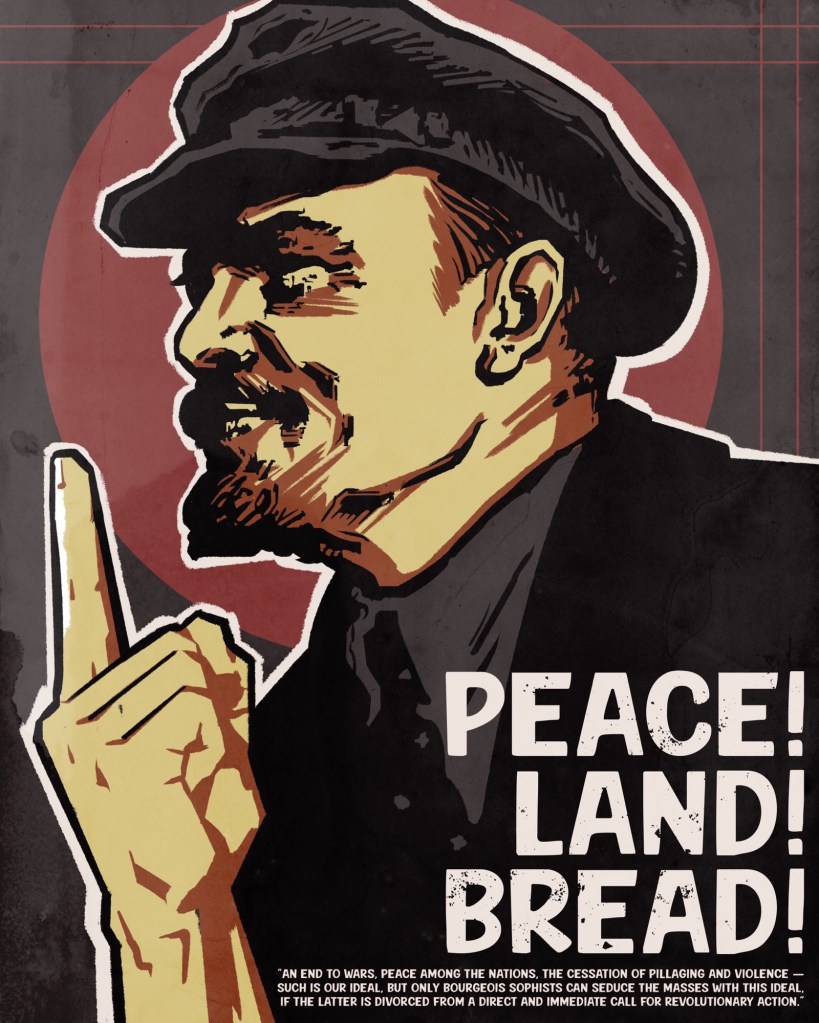
What did Lenin have to say about socialism and war?
“Socialists have always condemned war between nations as barbarous and brutal. But our attitude towards war is fundamentally different from that of the bourgeois pacifists (supporters and advocates of peace) and of the anarchists. We differ from the former in that we understand the inevitable connection between wars and the class struggle within the country; we understand that war cannot be abolished unless classes are abolished and socialism is created; and we also differ in that we fully regard civil wars, ie, wars waged by the oppressed class against the oppressing class, slaves against slave-owners, serfs against land-owners, and wage-workers against the bourgeoisie, as legitimate, progressive and necessary.”
Related:
Socialism and War (PDF)
Imperialism: The Highest Stage of Capitalism (PDF)
April Theses (PDF)
The plot to topple Putin + Notes
Examples Of Dialectics

Selected Works of Mao Tse-tung
(Abstracted Compilation)
1959
[SOURCE: Long Live Mao Zedong Thought, a Red Guard Publication.]
ON THE PEOPLE’S DEMOCRATIC DICTATORSHIP
ON THE PEOPLE’S DEMOCRATIC DICTATORSHIP
In 1924 a famous manifesto was adopted at the Kuomintang’s First National Congress, which Sun Yat-sen himself led and in which Communists participated. The manifesto stated:
The so-called democratic system in modern states is usually monopolized by the bourgeoisie and has become simply an instrument for oppressing the common people. On the other hand, the Kuomintang’s Principle of Democracy means a democratic system shared by all the common people and not privately owned by the few.
Ukraine: Dysfunctional Politics
“Dysfunction Sidelines Ukraine’s Parliament as Governing Force,” is the title of an article published this week by The New York Times in one of the few political critiques that has appeared in the Western press recently. It took two years after the Russian invasion for the grace period of absence of political comments on the Ukrainian authorities to be broken, although always partially and only temporarily. It was the news that included Vitali Klitschko’s words against what he perceived as authoritarian drift that opened the door. Like the current information, that news also lacked the contextualization that politics requires, and it was left unmentioned that the criticism of the mayor of Kiev and the measures by which the protesters were part of a confrontation that went back almost to the beginnings of the presidency of Zelensky. The origin of the rivalry lies in the struggle for power and control of the resources of the State between the two protagonists. What is more, the attempt to Zelensky snatch administratively, the mayor of Kiev Klitschko, a man with powerful connections and political contacts, especially in Germany, is one of the examples that show that the authoritarian drift of Volodymyr Zelensky is not justified in the wartime situation today, but that precedes it in several years to the military intervention of Russia.
Read More »
Review of Emma Goldman’s “My Disillusionment in Russia” (and Berkman’s “The Bolshevik Myth”)
To Be a Socialist One Must Be an Anti-Imperialist

Since the writing of The Communist Manifesto and the founding of the First International, proletarian internationalism has been a cornerstone of scientific socialism, and is a pillar of Marxism-Leninism. Today, in the era of imperialism, putting genuine proletarian internationalism into practice demands that we be consistent anti-imperialists.
To Be a Socialist One Must Be an Anti-Imperialist
Political biography of Alexandra Kollontai (Ep. 4): October Revolution and Social-Welfare
In this episode I’ll be discussing Kollontai’s career throughout the February and October revolutions, and briefly her work as a commissar for social welfare.
Political biography of Alexandra Kollontai (Ep. 4): October Revolution and Social-Welfare
The forgotten hero: How Russia helped launch the decolonial movement in the heart of the British Empire
Rafiq Ahmed, who founded the Communist Party of India in Tashkent, gave his descendants both a legacy and a name, but hardly any of them know why they are called ’Roosis’
The forgotten hero: How Russia helped launch the decolonial movement in the heart of the British Empire
 Ms. Cat’s Chronicles
You must be logged in to post a comment.