Despite the temporary window of false hope some perceived the recent US presidential election as, US foreign policy has once again continued onward toward the pursuit of primacy.
TAIPEI (Taiwan News) — A Taiwan-US poll found that Taiwanese and Americans differ on whether Washington would send troops if Beijing launches an invasion, but both support maintaining the status quo.
On Monday (Dec. 2), the Ministry of National Defense’s Institute for National Defense and Security Research and the Chicago Council on Global Affairs released the results of a joint survey that examined how Taiwanese and Americans view the Taiwan Strait situation and bilateral security cooperation.
We’re not obligated to defend Taiwan. What we are obligated to do is governed by the law and the law is the 1979 Taiwan Relations Act.
…
But defending Taiwan is not one of those things, but it means that we sell them equipment that they need to defend themselves and the like. And it makes it clear intent that we want a peaceful resolution of the Taiwan PRC issue, a peaceful resolution across the Taiwan Strait. And that we are opposed to a forceful reunification against the Taiwanese people’s will.
…
Is the United States going to defend Taiwan? If the answer to that question is yes, they’re going to lose hundreds of thousands of troops in that fight and they ought to know that. And then they can then make the calculus whether it’s worth it or not.
— Admiral Harry B. Harris, Jr., former commander of U.S. Indo-Pacific Command
Maritime clashes between the Philippines and China had been mostly over the Philippines’ military outpost, BRP (BRP—Barko ng Republika ng Pilipinas, which translates to “Ship of the Republic of the Philippines”—the ship prefix for the Philippines) Sierra Madre, in the Spratly Islands, which is disputed by Brunei, China, Malaysia, the Philippines, Taiwan (a province of China, as recognized by the United Nations’ Resolution No. 2758), and Vietnam. The BRP Sierra Madre was intentionally run aground on a reef near the Second Thomas Shoal in the disputed Spratly Islands, in 1997, so that the Philippines could stake their territorial claim.
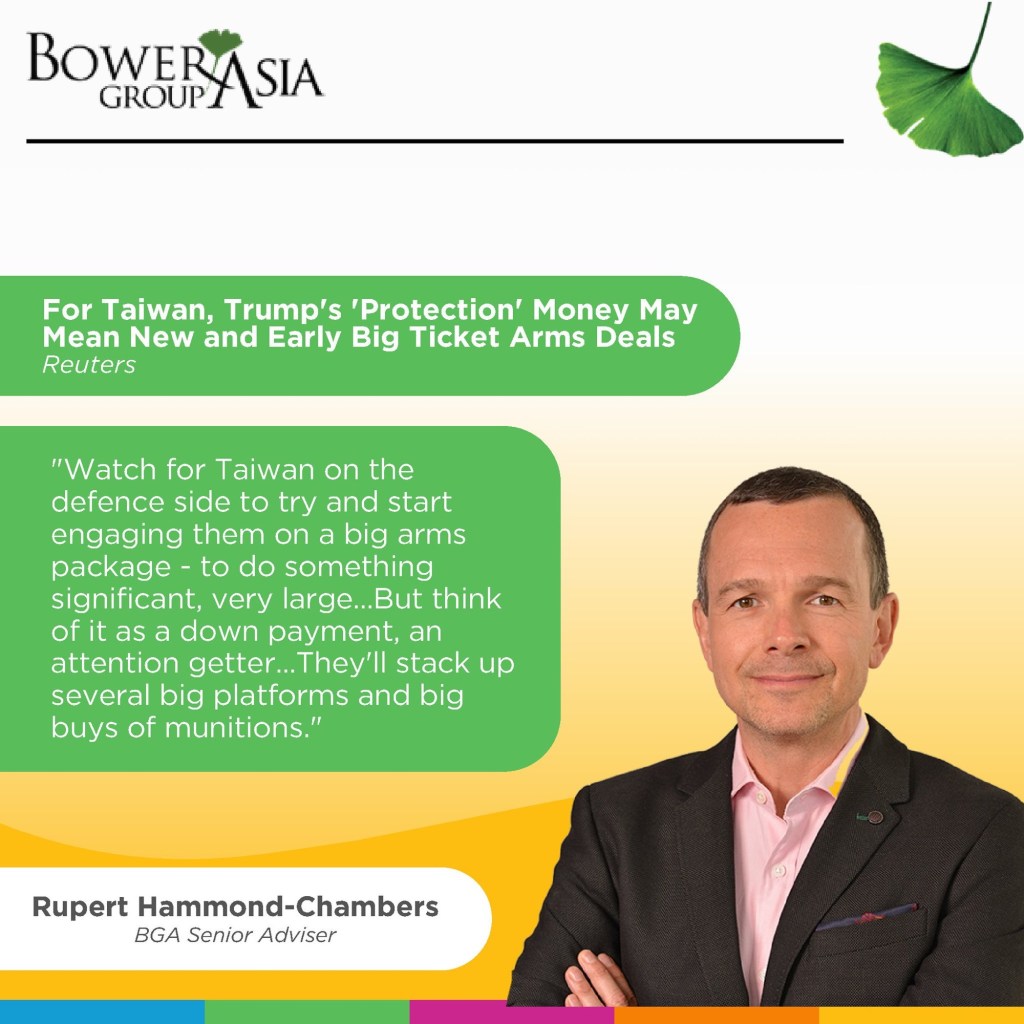
“Watch for Taiwan on the defence side to try and start engaging them on a big arms package – to do something significant, very large,” Rupert Hammond-Chambers, president of the U.S.-Taiwan Business Council which helps broker defence exchanges between Washington and Taipei, told Reuters, adding it could come in the first quarter of next year.
“But think of it as a down payment, an attention getter,” he said. “They’ll stack up several big platforms and big buys of munitions.”
The U.S. is already Taiwan’s most important arms supplier, although Taiwan has complained of an order backlog worth some $20 billion. A new order, almost $2 billion of missile systems, was announced last month.
In the weeks leading up to the 2024 US presidential election, Americans and many around the world invested hope that former-president and now President-elect Donald Trump would grind America’s wars abroad to a halt and instead invest in the United States itself.
The Voice of America, in an article about why the Quad met in Washington this week, claims that the aims of the Quad are to create an open and free Indo-Pacific. Biden, in a prepared remark, suggested his Administration believes “Xi Jinping is looking to focus on domestic economic challenges and minimise the turbulence in China’s diplomatic relationships, and he’s also looking to buy himself some diplomatic space”.


 Ms. Cat’s Chronicles
You must be logged in to post a comment.