
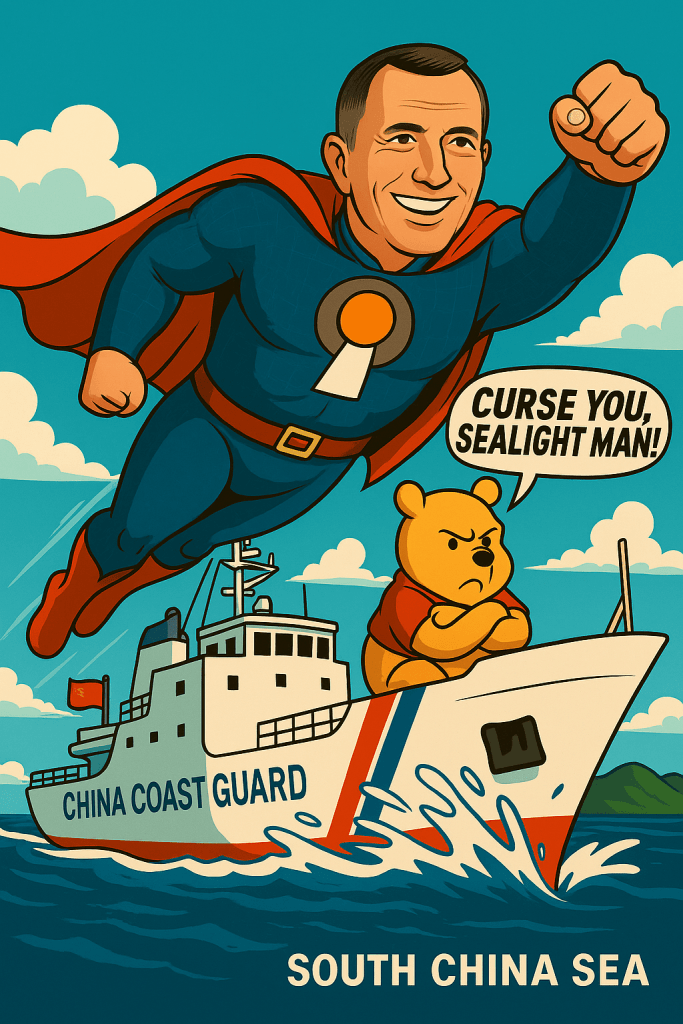
Capes, Cameras, and the Cult of Visibility

Capes, Cameras, and the Cult of Visibility: The SeaLight Crusade as White Savior Theater

By Tina Antonis

The South China Sea is more than a maritime dispute—it’s a theater of narrative warfare. While headlines focus on Chinese aggression and Philippine resistance, a quieter campaign unfolds in the background: one of satellite feeds, curated imagery, and Pentagon-backed storytelling. At the center of this effort is SeaLight, a project that claims to illuminate truth but often casts shadows of its own.

As explored in my article at Antiwar.com, SeaLight doesn’t just document—it performs. It reframes geopolitical tension through moral spectacle, positioning its creators as heroic arbiters of transparency. But when the messenger wears a cape and the funding flows from defense budgets, we must ask: is this clarity, or choreography?

Stage Left: The White Savior Enters

In the comic-strip cosmology of Ray Powell’s SeaLight project, transparency wears a cape. Clad in heroic postures and backed by satellite imagery, Powell casts himself as the guardian of maritime morality—unarmed, except with satellite feeds, theatrical flair, and strategic messaging. 

Yet beneath the cartoon and Pentagon-funded optics lies a familiar archetype: the white savior, rebranded for the South China Sea.

China Is Imperialist? Says Who?

Calling China a “maritime occupier,” Powell positions himself as a bulwark against aggression. But that moral pose collapses under scrutiny. He speaks for a country with over 800 foreign military installations and a documented history of over 250 military interventions since 1991—wars in Iraq, Afghanistan, Libya, Syria, Somalia, and dozens more, all under the banner of peace, freedom, or preemption.

By comparison, China’s post–Cold War footprint includes no sustained foreign occupations and only scattered border conflicts and peacekeeping missions. The imbalance is staggering. And Powell’s framing doesn’t just ignore it—it performs around it.

As David Vine argues in The United States of War, this vast base empire is not a passive network—it’s an architecture of perpetual war. These outposts make military engagement not an exception but a structural habit, cloaked in strategic necessity and sold as global stewardship.

Powell’s cartoon rhetoric—calling China an occupier—obscures the scale of U.S. militarism. The term “occupation” is deployed not to analyze, but to project. When adversaries hold territory, it’s a crisis; when the U.S. spans the globe with armed installations, it’s policy.

Framing Conflict: The Optics of Consent

This isn’t irony. It’s performance. Powell’s language manufactures a moral frame for confrontation—costumed in transparency, but driven by escalation. The cape is literal. The conditioning is deliberate. And the stage is set for war.

SeaLight’s mission is not just visual documentation—it’s narrative warfare. As the Japan Times openly notes, its “chief weapon is photography, applied purposefully, generously and consistently over time.” These images—enhanced, curated, and distributed across media—are not neutral. They’re constructed to shape public perception, sway international opinion, and ultimately manufacture consent for confrontation.

Assertive transparency becomes a kind of ideological scaffolding—a stage on which geopolitical tension is dramatized, simplified, and morally polarized. The goal isn’t simply to reveal conflict; it’s to condition audiences for escalation.

And when the messenger dons a superhero’s cape, the spectacle transforms into something deeper: a story of rescue, of virtue, of intervention. This is not analysis—it’s soft propaganda dressed in heroic metaphor.

Consent for war doesn’t begin with missiles. It begins with mythmaking.
What’s Really Going On In the South China Sea Between the Philippines and China

What’s Really Going On In the South China Sea Between the Philippines and China

by Tina Antonis

Maritime clashes between the Philippines and China had been mostly over the Philippines’ military outpost, BRP (BRP—Barko ng Republika ng Pilipinas, which translates to “Ship of the Republic of the Philippines”—the ship prefix for the Philippines) Sierra Madre, in the Spratly Islands, which is disputed by Brunei, China, Malaysia, the Philippines, Taiwan (a province of China, as recognized by the United Nations’ Resolution No. 2758), and Vietnam. The BRP Sierra Madre was intentionally run aground on a reef near the Second Thomas Shoal in the disputed Spratly Islands, in 1997, so that the Philippines could stake their territorial claim.

Read More »

The drownings of 2 Navy SEALs were preventable, military investigation finds

YouTube

WASHINGTON (AP) — Two U.S. Navy SEALs drowned as they tried to climb aboard a ship carrying illicit Iranian-made weapons to Yemen because of glaring training failures and a lack of understanding about what to do after falling into deep, turbulent waters, according to a military investigation into the January deaths.

The drownings of 2 Navy SEALs were preventable, military investigation finds

Related:

Naval Special Warfare Remembers Two Fallen SEALs

Chambers enlisted in the Navy on May 17, 2012, and graduated from boot camp at Recruit Training Command Great Lakes, Ill., in July 2012. He served with West Coast-based SEAL units since graduating from SEAL qualification training in Coronado, Calif., in 2014. His awards and decorations include the Defense Meritorious Service Medal, the Navy/Marine Corps Achievement Medal with Combat “C,” three Navy/Marine Corps Achievement Medals, the Army Achievement Medal, the Combat Action Ribbon, and other personal and unit awards.

Ingram enlisted in the Navy on Sept. 25, 2019, and graduated from boot camp at Recruit Training Command Great Lakes, Ill., in November 2019. Ingram served with West Coast-based SEAL units since graduating from SEAL qualification training in Coronado, Calif., in 2021. His awards and decorations include the Defense Meritorious Service Medal and various personal and unit awards.

US Military: Two US Navy SEALs Missing Off Coast of Somalia Are Dead

US Officials Claim Two Navy SEALs Missing Near Somalia ‘Fell Into Water’

No, They Were Not Hungarian Pagers

No, They Were Not Hungarian Pagers

But the fact is that the whole pager situation was a skillfully arranged smear campaign led by Mossad and the CIA against their own partner. These devices were indeed manufactured by Taiwanese Gold Apollo, which has a very high proportion of American top management. They were filled with explosives under careful control of the CIA and in April a large batch of devices was sent to Lebanon – at the same time that a delegation of the Knesset suddenly arrived in Taipei. However, the payments for the deal were made using the Hungarian BAC firm. The company does not have but a single employee, which confirms that it could not have produced the pagers.

All of this is a ploy for the media in order to shift the blame away from Taiwan and onto Viktor Orban, who is already very much demonized in Western discourse. The worst thing is that it is extremely efficient, because most of the world began to believe that it was Hungary that sent pagers to Lebanon and thus entered into direct confrontation with the Arab world. Orban’s representative instantly responded to the allegations, saying that BAC Consulting was “a trading-intermediary company, which has no manufacturing or other site of operation in Hungary”. Additionally, the CEO of the company 49-year-old Cristiana Barsony-Arcidiacono added that she was “just the intermediate”.

The story seems to have died down a bit now, but the mystery of the pagers remains. Will there be an independent investigation to determine their manufacturer? Most likely not, since all the evidence leads to the US, Israeli and Taiwanese intelligence services. This mystery will go down in history just like the events associated with the blowing up of Nordstream pipelines, as well as the so-called “massacre in Bucha”. No investigation, no evidence, no verdict.

Previously:

Both companies linked to the September 17th and 18th attacks on Hizbullah were U.S. government contractors

[2011] Golden Apollo held the FBI’s heart with a walkie-talkie

Latest Lebanon Pager Terrorist Attack Predictable, Preventable

Sole US Navy Oiler – USNS Big Horn – in the Middle East Damaged | September 23, 2024

What’s Going On With Shipping

by John Konrad – gCaptain has received multiple reports that the US Navy oiler USNS Big Horn ran aground yesterday and partially flooded off the coast of Oman, leaving the Abraham Lincoln Carrier Strike Group without its primary fuel source.

US Navy Oiler Runs Aground, Forcing Carrier Strike Group to Scramble for Fuel

Related:

Oiler USNS Big Horn Damaged off the Coast Of Oman, No Fuel Leak Detected

The US Navy Needs Tankers: A Crisis In Capability

US sending more troops to Middle East as violence rises in the region

[2011] Golden Apollo held the FBI’s heart with a walkie-talkie

Thread

Kim Apollo held the FBI’s heart with a walkie-talkie (translated by Google Translate)

The recent conflicts in the Middle East have caused this 2011 article to attract attention and discussion. However, according to the statement of Golden Apollo on September 18, 2024, Golden Apollo only provides brand trademark authorization for the model involved, and production and sales are through the Hungarian partner BAC Consulting. Taiwan’s Ministry of Economic Affairs also stated that there is no record of Golden Apollo being directly exported to Lebanon. The models exported from Taiwan are equipped with AA batteries and there is no possibility of explosions causing casualties.

World Magazine Issue 477
Release time: 2011-07-27

Golden Apollo sells walkie-talkies that are almost extinct in Taiwan, but its professional technology, customization and strict quality control have helped it win orders from European and American governments, ranking first in the United States and second in Europe.

Pagers and walkie-talkies have not been seen by many people for a long time. They were products that were eliminated several generations ago. Many major manufacturers have even listed them as antiques and put them in exhibition rooms. However, there are manufacturers in Taiwan that continue to work intensively, making the pager number one in the United States and second in Europe. Even the FBI is its customer, and its gross profit margin is not inferior to that of HTC and MediaTek.

Read More »

Latest Lebanon Pager Terrorist Attack Predictable, Preventable

Brian Berletic, September 20


Western media is calling an indiscriminate Israeli terrorist attack across Lebanon that has killed several, including at least one child and injured thousands, “unprecedented” and “sophisticated”. Yet nothing about the attack, which reportedly involved 5,000 pagers rigged with remotely detonated explosives before distribution, was unpredictable or unpreventable.

Latest Lebanon Pager Terrorist Attack Predictable, Preventable