
Vladimir Lenin: Socialism and Religion

Vladimir Lenin: Socialism and Religion

The economic oppression of the workers inevitably calls forth and engenders every kind of political oppression and social humiliation, the coarsening and darkening of the spiritual and moral life of the masses. The workers may secure a greater or lesser degree of political liberty to fight for their economic emancipation, but no amount of liberty will rid them of poverty, unemployment, and oppression until the power of capital is overthrown. Religion is one of the forms of spiritual oppression which everywhere weighs down heavily upon the masses of the people, over burdened by their perpetual work for others, by want and isolation. Impotence of the exploited classes in their struggle against the exploiters just as inevitably gives rise to the belief in a better life after death as impotence of the savage in his battle with nature gives rise to belief in gods, devils, miracles, and the like. Those who toil and live in want all their lives are taught by religion to be submissive and patient while here on earth, and to take comfort in the hope of a heavenly reward. But those who live by the labour of others are taught by religion to practise charity while on earth, thus offering them a very cheap way of justifying their entire existence as exploiters and selling them at a moderate price tickets to well-being in heaven. Religion is opium for the people. Religion is a sort of spiritual booze, in which the slaves of capital drown their human image, their demand for a life more or less worthy of man.
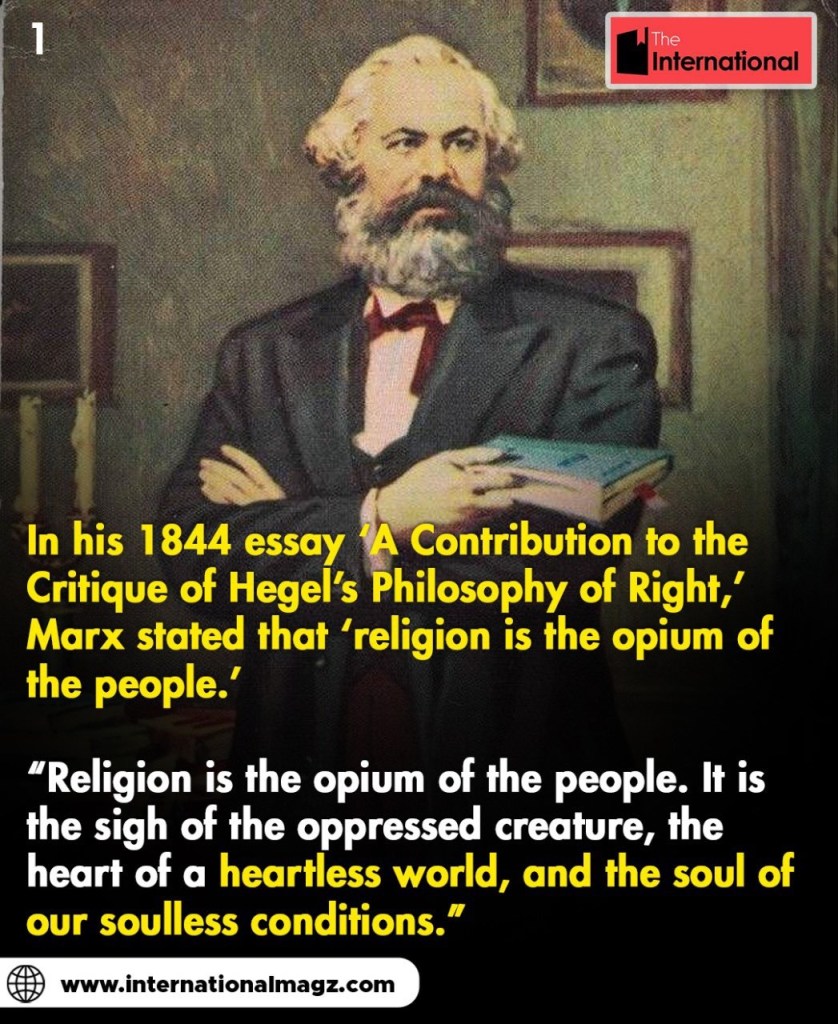
The demand to give up the illusions about its condition is the demand to give up a condition that needs illusions.

A Contribution to the Critique of Hegel’s Philosophy of Right: Introduction

The abolition of religion as the illusory happiness of the people is the demand for their real happiness. To call on them to give up their illusions about their condition is to call on them to give up a condition that requires illusions. The criticism of religion is, therefore, in embryo, the criticism of that vale of tears of which religion is the halo.

Critique of Hegel’s Philosophy of Right

Marx and Engel’s Collected Works Volume 3: Karl Marx, March 1843-August 1844 (PDF)

Abstract from The Introduction to Contribution To The Critique Of Hegel’s Philosophy Of Right

Abstract from The Introduction to Contribution To The Critique Of Hegel’s Philosophy Of Right

To abolish religion as the illusory happiness of the people is to demand their real happiness. The demand to give up illusions about the existing state of affairs is the demand to give up a state of affairs which needs illusions. The criticism of religion is therefore in embryo the criticism of the vale of tears, the halo of which is religion.

The weapon of criticism cannot, of course, replace criticism by weapons, material force must be overthrown by material force; but theory also becomes a material force as soon as it has gripped the masses. Theory is capable of gripping the masses as soon as it demonstrates ad hominem, and it demonstrates ad hominem as soon as it becomes radical. To be radical is to grasp the root of the matter. But for man the root is man himself. The evident proof of the radicalism of German theory, and hence of its practical energy, is that it proceeds from a resolute positive abolition of religion. The criticism of religion ends with the teaching that man is the highest being for man, hence with the categorical imperative to overthrow all relations in which man is a debased, enslaved forsaken, despicable being…..