Vladimir Lenin: The Military Programme of the Proletariat Revolution

Among the Dutch, Scandinavian and Swiss revolutionary Social-Democrats who are combating the social-chauvinist lies about “defence of the fatherland” in the present imperialist war, there have been voices in favour of replacing the old Social-Democratic minimum-programme demand for a “militia”, or “the armed nation,” by a new demand: “disarmament.” The Jugend-Internationale has inaugurated a discussion on this issue and published, in No. 3, an editorial supporting disarmament. There is also, we regret to note, a concession to the “disarmament” idea in R. Grimm’s latest theses. Discussion have been started in the periodicals Neue Leben and Vorbote

Let us take a closer look at the position of the disarmament advocates.

The Military Programme of the Proletarian Revolution

or: Vladimir Lenin Collected Works Vol. 23 (PDF)
Friedrich Engels ‐ On Authority

Red Ant

Works of Frederick Engels 1872: On Authority

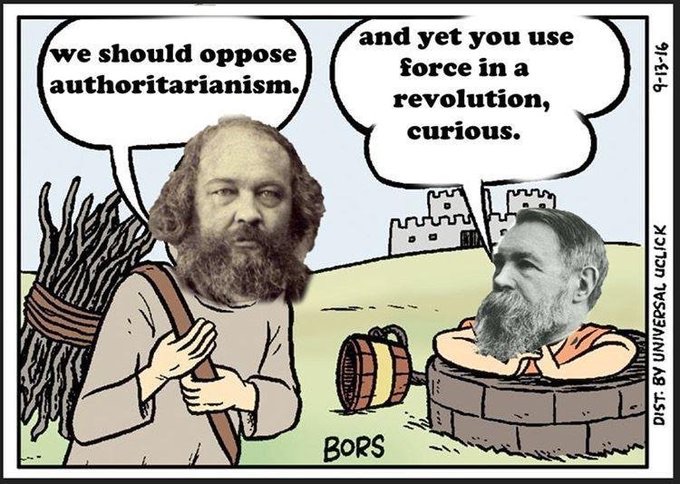
A number of Socialists have latterly launched a regular crusade against what they call the principle of authority. It suffices to tell them that this or that act is authoritarian for it to be condemned. This summary mode of procedure is being abused to such an extent that it has become necessary to look into the matter somewhat more closely.

Therefore, either one of two things: either the anti-authoritarians don’t know what they’re talking about, in which case they are creating nothing but confusion; or they do know, and in that case they are betraying the movement of the proletariat. In either case they serve the reaction.

The State: A Product of the Irreconcilability of Class Antagonisms

The State: A Product of the Irreconcilability of Class Antagonisms

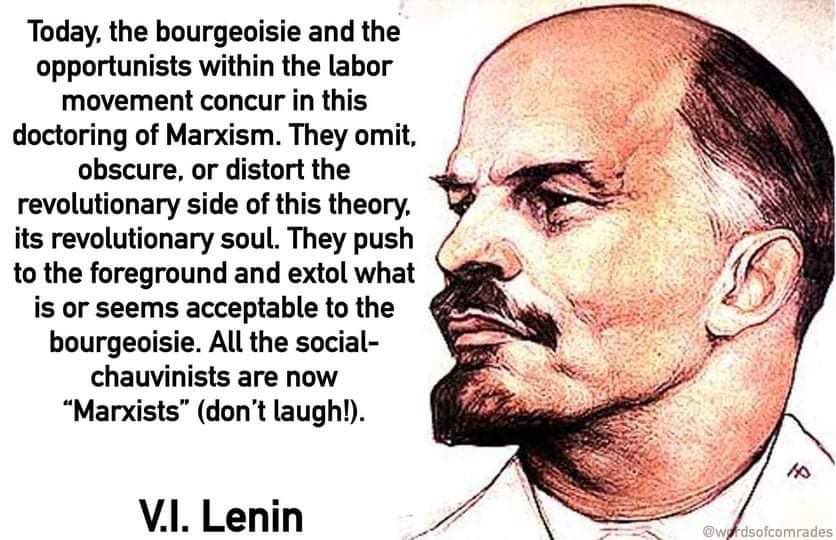
What is now happening to Marx’s theory has, in the course of history, happened repeatedly to the theories of revolutionary thinkers and leaders of oppressed classes fighting for emancipation. During the lifetime of great revolutionaries, the oppressing classes constantly hounded them, received their theories with the most savage malice, the most furious hatred and the most unscrupulous campaigns of lies and slander. After their death, attempts are made to convert them into harmless icons, to canonize them, so to say, and to hallow their names to a certain extent for the “consolation” of the oppressed classes and with the object of duping the latter, while at the same time robbing the revolutionary theory of its substance, blunting its revolutionary edge and vulgarizing it. Today, the bourgeoisie and the opportunists within the labor movement concur in this doctoring of Marxism. They omit, obscure, or distort the revolutionary side of this theory, its revolutionary soul. They push to the foreground and extol what is or seems acceptable to the bourgeoisie. All the social-chauvinists are now “Marxists” (don’t laugh!). And more and more frequently German bourgeois scholars, only yesterday specialists in the annihilation of Marxism, are speaking of the “national-German” Marx, who, they claim, educated the labor unions which are so splendidly organized for the purpose of waging a predatory war!

The Military Programme of the Proletarian Revolution: II

To this must be added the following general consideration.

An oppressed class which does not strive to learn to use arms, to acquire arms, only deserves to be treated like slaves. We cannot, unless we have become bourgeois pacifists or opportunists, forget that we are living in a class society from which there is no way out, nor can there be, save through the class struggle. In every class society, whether based on slavery, serfdom, or, as at present, wage-labor, the oppressor class is always armed. Not only the modern standing army, but even the modern militia—and even in the most democratic bourgeois republics, Switzerland, for instance—represent the bourgeoisie armed against the proletariat. That is such an elementary truth that it is hardly necessary to dwell upon it. Suffice it to point to the use of troops against strikers in all capitalist countries.

The Military Programme of the Proletarian Revolution: II

Lenin: Bourgeois And Proletarian Democracy

Bourgeois And Proletarian Democracy

Bourgeois democracy, although a great historical advance in comparison with medievalism, always remains, and under capitalism is bound to remain, restricted, truncated, false and hypocritical, a paradise for the rich and a snare and deception for the exploited, for the poor. It is this truth, which forms a most essential part of Marx’s teaching, that Kautsky the “Marxist” has failed to understand. On this—the fundamental issue—Kautsky offers “delights” for the bourgeoisie instead of a scientific criticism of those conditions which make every bourgeois democracy a democracy for the rich.

Related:

Lenin Collected Works: Volume 28 (PDF)

On Authority

A number of Socialists have latterly launched a regular crusade against what they call the principle of authority. It suffices to tell them that this or that act is authoritarian for it to be condemned. This summary mode of procedure is being abused to such an extent that it has become necessary to look into the matter somewhat more closely.

Authority, in the sense in which the word is used here, means: the imposition of the will of another upon ours; on the other hand, authority presupposes subordination. Now, since these two words sound bad, and the relationship which they represent is disagreeable to the subordinated party, the question is to ascertain whether there is any way of dispensing with it, whether — given the conditions of present-day society — we could not create another social system, in which this authority would be given no scope any longer, and would consequently have to disappear.

On Authority

Karl Marx & Frederick Engels: Volume 23, 1871-74