
Tag: patriarchy
Reba Maybury’s Art Subverts the Patriarchy by Making Men Work for Her

What the Most Famous Book About Trauma Gets Wrong
The intersection of sex, capitalism, and militarism
The intersection of sex, capitalism, and militarism
The intersection of sex, capitalism, and militarism highlights how these systems often intertwine, with capitalism’s focus on commodification leading to the exploitation of sex work, while militarism frequently creates environments where women and vulnerable populations are particularly susceptible to sexual violence and trafficking, often due to the presence of military forces in a region, further perpetuating power imbalances and economic disparities. [1, 2, 3, 4, 5, 6, 7, 8, 9, 10]
Read More »
Communism vs. Feminism
Porn, Feminism & the Meese Report
Feminist theory is not just flawed thinking; it is the product of a middle-class view of the world. In the prosperity of the 1960s, radical feminism was marked by its extreme utopian nature. Demands like “smash sexism” and “abolish the family” abounded—with absolutely no program that could win them. Since feminists rejected Marxism and with it the one class that actually has the power to revolutionize society, their utopian maximalist rhetoric dissolved inevitably into the most pragmatic minimalism. In fact, because the reformist strategies of the ’60s—above all the overwhelming support of feminists for the Democratic Party—failed to bear ample fruit, a fertile ground for cynicism was laid. The root of the current feminist support for the thoroughly capitulatory Dworkin is the cynicism born of defeat.
Read More »
A Socialist, Feminist, and Transgender Analysis of “Sex Work” (2020)
The question of women’s liberation is central to any revolutionary project, and thus so is the question of “sex work.” Esperanza Fonseca’s contribution, although coming from a Maoist political orientation with which we often have differences, [1] makes the stakes of this debate crystal clear, as she combines personal experience, public policy research, and historical materialism to argue that Marxists cannot uphold what she calls “sex-trade-expansionary feminism.”
Content Warning: Descriptions of rape.
…
The right of the subordinated classes of men to buy access to women’s bodies has been used historically to break class solidarity in order to maintain the dominant social relations of the time. This was true in feudal Europe and remains true today: when proletarian and petit bourgeois men get to buy women too, they develop a false consciousness and build solidarity with bourgeois men of their own gender rather than aligning with women of their own class. And because the overthrow of capitalism is only possible by the overthrowing of the bourgeoisie, prostitution serves two great purposes: (1) allows bourgeois men access to a reserve army of women for their pleasure, and (2) prevent class consciousness and thus helps stop the proletariat from organizing as a class.
A Socialist, Feminist, and Transgender Analysis of “Sex Work” (2020)
Madison, Wisconsin school shooter hated men, called for end of patriarchy
Alexandra Kollontai: Prostitution and ways of fighting it
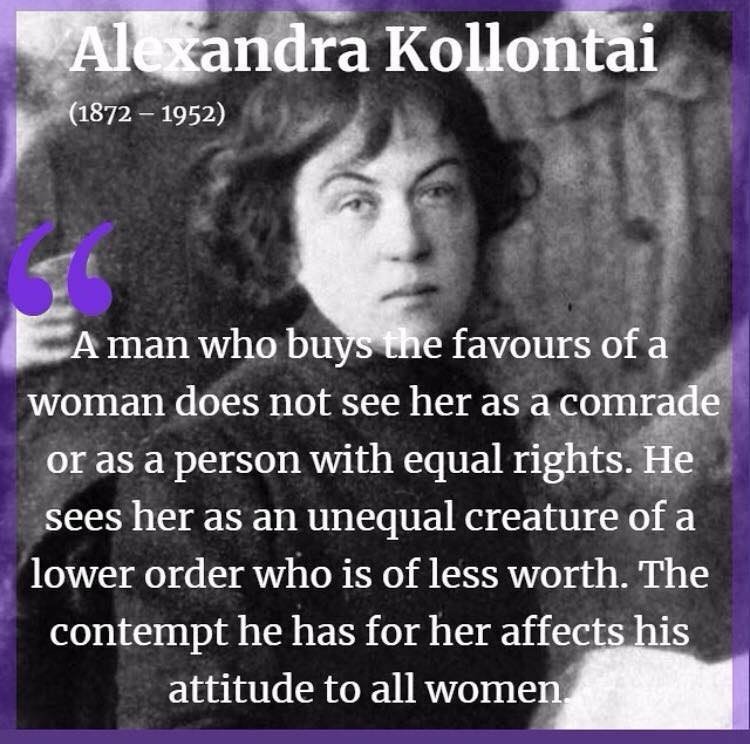
Alexandra Kollontai: Prostitution and ways of fighting it
What is the fundamental quality of the working class? What is its strongest moral weapon in the struggle? Solidarity and comradeship is the basis of communism. Unless this sense is strongly developed amongst working people, the building of a truly communist society is inconceivable. Politically conscious communists should therefore logically be encouraging the development of solidarity in every way and fighting against all that hinders its development – Prostitution destroys the equality, solidarity and comradeship of the two halves of the working class. A man who buys the favours of a woman does not see her as a comrade or as a person with equal rights. He sees the woman as dependent upon himself and as an unequal creature of a lower order who is of less worth to the workers’ state. The contempt he has for the prostitute, whose favours he has bought, affects his attitude to all women. The further development of prostitution, instead of allowing for the growth of comradely feeling and solidarity, strengthens the inequality of the relationships between the sexes.
Balancing Work and Love: The Modern Male Struggle

Mao: Women
A man in China is usually subjected to the domination of three systems of authority [political authority, family authority and religious authority]…. As for women, in addition to being dominated by these three systems of authority, they are also dominated by the men (the authority of the husband). These four authorities – political, family, religious and masculine – are the embodiment of the whole feudal-patriarchal ideology and system, and are the four thick ropes binding the Chinese people, particularly the peasants. How the peasants have overthrown the political authority of the landlords in the countryside has been described above. The political authority of the landlords is the backbone of all the other systems of authority. With that overturned the family authority, the religious authority and the authority of the husband all begin to totter…. As to the authority of the husband, this has always been weaker among the poor peasants because, out of economic necessity, their womenfolk have to do more manual labour than the women of the richer classes and therefore have more say and greater power of decision in family matters. With the increasing bankruptcy of the rural economy in recent years, the basis for men’s domination over women has already been undermined. With the rise of the peasant movement, the women in many places have now begun to organize rural women’s associations; the opportunity has come for them to lift up their heads, and the authority of the husband is getting shakier every day. In a word, the whole feudal-patriarchal ideology and system is tottering with the growth of the peasants’ power.
“Report on an Investigation of the Peasant Movement in Hunan” (March 1927), Selected Works, Vol. I, pp. 44-46.*
 Ms. Cat’s Chronicles
You must be logged in to post a comment.