
American private military firms could be deployed to Ukraine as part of a long-term peace plan.
Donald Trump is in talks with European allies about allowing armed contractors to help build fortifications to protect American interests in the country.
Tag: Peacekeeping
Capes, Cameras, and the Cult of Visibility
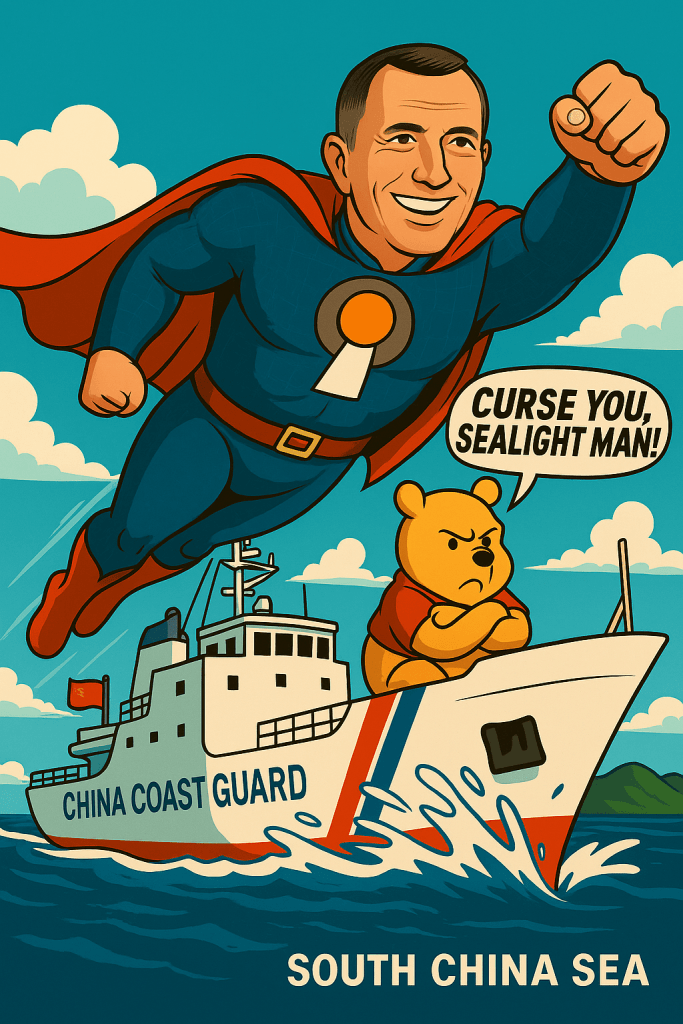
Capes, Cameras, and the Cult of Visibility: The SeaLight Crusade as White Savior Theater
By Tina Antonis
The South China Sea is more than a maritime dispute—it’s a theater of narrative warfare. While headlines focus on Chinese aggression and Philippine resistance, a quieter campaign unfolds in the background: one of satellite feeds, curated imagery, and Pentagon-backed storytelling. At the center of this effort is SeaLight, a project that claims to illuminate truth but often casts shadows of its own.
As explored in my article at Antiwar.com, SeaLight doesn’t just document—it performs. It reframes geopolitical tension through moral spectacle, positioning its creators as heroic arbiters of transparency. But when the messenger wears a cape and the funding flows from defense budgets, we must ask: is this clarity, or choreography?
Stage Left: The White Savior Enters
In the comic-strip cosmology of Ray Powell’s SeaLight project, transparency wears a cape. Clad in heroic postures and backed by satellite imagery, Powell casts himself as the guardian of maritime morality—unarmed, except with satellite feeds, theatrical flair, and strategic messaging.
Yet beneath the cartoon and Pentagon-funded optics lies a familiar archetype: the white savior, rebranded for the South China Sea.
China Is Imperialist? Says Who?
Calling China a “maritime occupier,” Powell positions himself as a bulwark against aggression. But that moral pose collapses under scrutiny. He speaks for a country with over 800 foreign military installations and a documented history of over 250 military interventions since 1991—wars in Iraq, Afghanistan, Libya, Syria, Somalia, and dozens more, all under the banner of peace, freedom, or preemption.
By comparison, China’s post–Cold War footprint includes no sustained foreign occupations and only scattered border conflicts and peacekeeping missions. The imbalance is staggering. And Powell’s framing doesn’t just ignore it—it performs around it.
As David Vine argues in The United States of War, this vast base empire is not a passive network—it’s an architecture of perpetual war. These outposts make military engagement not an exception but a structural habit, cloaked in strategic necessity and sold as global stewardship.
Powell’s cartoon rhetoric—calling China an occupier—obscures the scale of U.S. militarism. The term “occupation” is deployed not to analyze, but to project. When adversaries hold territory, it’s a crisis; when the U.S. spans the globe with armed installations, it’s policy.
Framing Conflict: The Optics of Consent
This isn’t irony. It’s performance. Powell’s language manufactures a moral frame for confrontation—costumed in transparency, but driven by escalation. The cape is literal. The conditioning is deliberate. And the stage is set for war.
SeaLight’s mission is not just visual documentation—it’s narrative warfare. As the Japan Times openly notes, its “chief weapon is photography, applied purposefully, generously and consistently over time.” These images—enhanced, curated, and distributed across media—are not neutral. They’re constructed to shape public perception, sway international opinion, and ultimately manufacture consent for confrontation.
Assertive transparency becomes a kind of ideological scaffolding—a stage on which geopolitical tension is dramatized, simplified, and morally polarized. The goal isn’t simply to reveal conflict; it’s to condition audiences for escalation.
And when the messenger dons a superhero’s cape, the spectacle transforms into something deeper: a story of rescue, of virtue, of intervention. This is not analysis—it’s soft propaganda dressed in heroic metaphor.
Consent for war doesn’t begin with missiles. It begins with mythmaking.
Russian Advances in Ukraine Grew Seven-Fold in 2024, Data Shows
Sources:
Donald Trump’s Ukraine ‘One Day’ Peace Plan Just Smashed Into Reality
Russian Advances in Ukraine Grew Seven-Fold in 2024, Data Shows
Disclosure: Davis works for Defense Priorities Foundation, which has been financed by the Koch network.
Foreign troops and peace
Foreign troops and peace (Google translate)
by @nsanzo
“The National Security and Defence Council of Ukraine supported the decision to appeal to the United Nations and the European Union on the “deployment of a peacekeeping and security mission in Ukraine.” This is not news from today, when the composition and size of a possible peacekeeping mission of European countries is being discussed after the possible ceasefire, but from February 18, 2015. Days earlier, in the Belarusian capital, after negotiations involving Angela Merkel, François Hollande, Petro Poroshenko and Vladimir Putin, the only peace agreement of this war had been signed and a ceasefire was to begin, which was to be routinely violated, and the political process that would return Donbass to Ukraine under very specific conditions and with certain linguistic, cultural, political and economic rights that Kiev always considered unacceptable and never had the slightest intention of fulfilling. Ukraine, which had suffered the second major defeat in the Donbass war at Debaltsevo after Ilovaisk in September 2014, was at its lowest point, its army was at risk of being overwhelmed and it needed to stop the war in order to recover and become stronger while waiting for the next phase of a war that all parties were aware was not over.
Read More »
Declaration Berlin
Declaration Berlin (translated)
Posted by @nsanzo
“European leaders are scheduled to meet with Ukrainian President Volodymyr Zelensky and NATO chief Mark Rutte on Wednesday afternoon in Brussels to discuss peace plans and the possible deployment of peacekeeping forces in Ukraine,” Politico announced on Friday, confirming what was already known: NATO is leading the effort to coordinate what may happen in the coming months in the war in Ukraine, which on the ground will depend on European countries. “In addition to Rutte and Zelensky, invited participants include: German Chancellor Olaf Scholz, French President Emmanuel Macron, Polish President Andrzej Duda, European Council President António Costa, and European Commission President Ursula von der Leyen,” the outlet added, to show who the main actors are in preparing for the possibility of a significant reduction in the United States’ role in the day-to-day running of the war.
Read More »
Trump Promised to End the War in Ukraine. Now He Must Decide How.
Trump Promised to End the War in Ukraine. Now He Must Decide How.
Like in Trump’s first term, different factions are set to compete to influence the Republican’s foreign policy. More traditionally minded allies such as Mike Pompeo, the former secretary of state now in contention to lead the Pentagon, are likely to push for a settlement that doesn’t appear to give a major win to Moscow. Other advisers, particularly Richard Grenell, a top candidate to lead the State Department or serve as national-security adviser, could give priority to Trump’s desire to end the war as soon as possible, even if it means forcing Kyiv into significant concessions.
Read More »
Fact-Checking Armenia’s Claim That “Azerbaijan Has Completed The Ethnic Cleansing Of Karabakh”

By Andrew Korybko
Those who describe the situation in Azerbaijan’s western region as an “ethnic cleansing” are either innocently misinformed or deliberately lying.
Fact-Checking Armenia’s Claim That “Azerbaijan Has Completed The Ethnic Cleansing Of Karabakh”
Previously:
Testimony of Professor Jeffrey D. Sachs: UN Security Council Session on Sustaining Peace through Common Development
Related:
(1) We may recall that the UN Charter article 2(4) prohibits not only the use of force but also the threat thereof.

Despite Peace Breaking Out in Haiti, Biden Still Calls for “UN-Backed” Invasion

Over 1,000 people surged through the streets of Haiti’s capital Port-au-Prince on Sep. 18, calling for de facto Prime Minister Dr. Ariel Henry to step down and shouting their full support of Haitian farmers in the Northeast Department, who are finishing construction of an irrigation canal despite strong objection, threats, and border closure by Dominican President Luis Abinader.
Despite Peace Breaking Out in Haiti, Biden Still Calls for “UN-Backed” Invasion
Previously:
Biden Demands UNSC Approve Invasion of Haiti
Biden Demands UNSC Approve Invasion of Haiti
Addressing the UN on Tuesday, President Joe Biden called on the Security Council (UNSC) to authorize sending a military force into Haiti to restore order. The White House has wanted the UN to take action in the Caribbean nation for a year but has struggled to find a country willing to lead the UN mission in Haiti.
Biden Demands UN Send Troops Into Haiti to Restore Order
 Ms. Cat’s Chronicles
You must be logged in to post a comment.