Chinese Missile Boat Undertakes ‘Alarming’ Action

Chinese Missile Boat Undertakes ‘Alarming’ Action (archived)

A Chinese navy missile craft shadowed a Philippine civilian ship on Friday in an unprecedented encounter that one analyst described as “alarming.”

The Fisheries and Aquatic Resources (BFAR) vessel the BRP Datu Romapenet was en route to a South China Sea feature known as Half Moon Shoal to deliver supplies to fishermen.

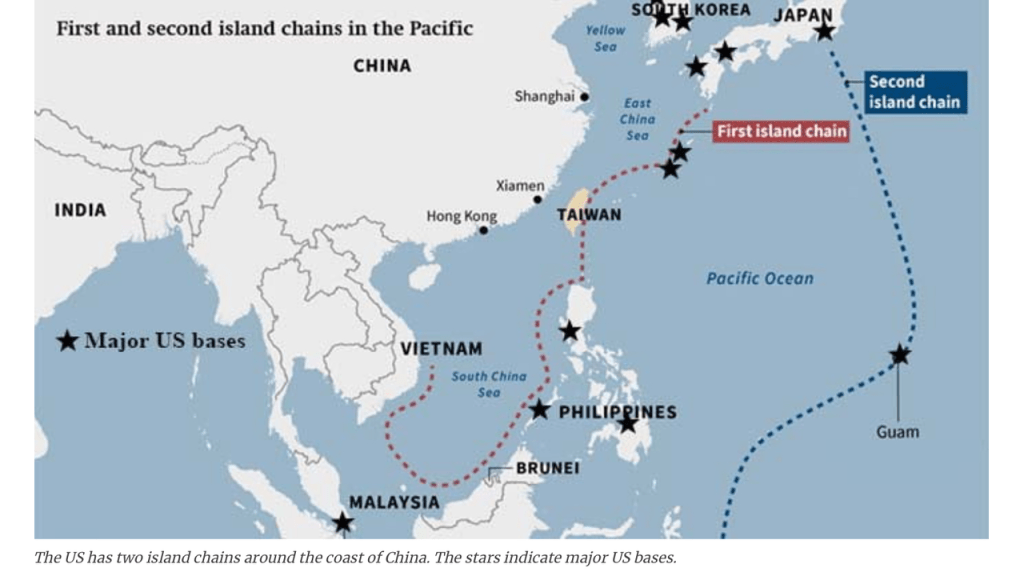
Half Moon Shoal is situated at the eastern edge of the Spratly Islands and about 60 miles from the Philippine province of Palawan, well within the Southeast Asian country’s recognized exclusive economic zone (EEZ).

According to the Philippines’ ABS-CBN News, which was onboard, the ship picked up a tail in the form of a Houbei-class (Type 22) guided-missile craft, easily identifiable by its wide camouflaged catamaran hull.

Chester Cabalza, founder of Manila-based think tank the International Development and Security Cooperation, told the news agency it was the first time a Type 22 had been spotted in the EEZ.

“This incident is alarming because a missile ship shadowed our BFAR ship,” Cabalza said, adding that it was a show of power intended to intimidate the Philippines.

Read More »

Alleged Chinese Nuclear Submarine Sinking: Separating Facts From Bullshit

Source

Western defence media has recently been buzzing with the story of a Chinese SSN allegedly sinking in the Yangtze River near Wuhan. But is it actually true? We take a look at the likelihood of this.

Alleged Chinese Nuclear Submarine Sinking: Separating Facts From Bullshit

Related:

China denies U.S. claim that its newest nuclear submarine sank at pier

A growing problem of ‘deepfake geography’: How AI falsifies satellite images (Archived)

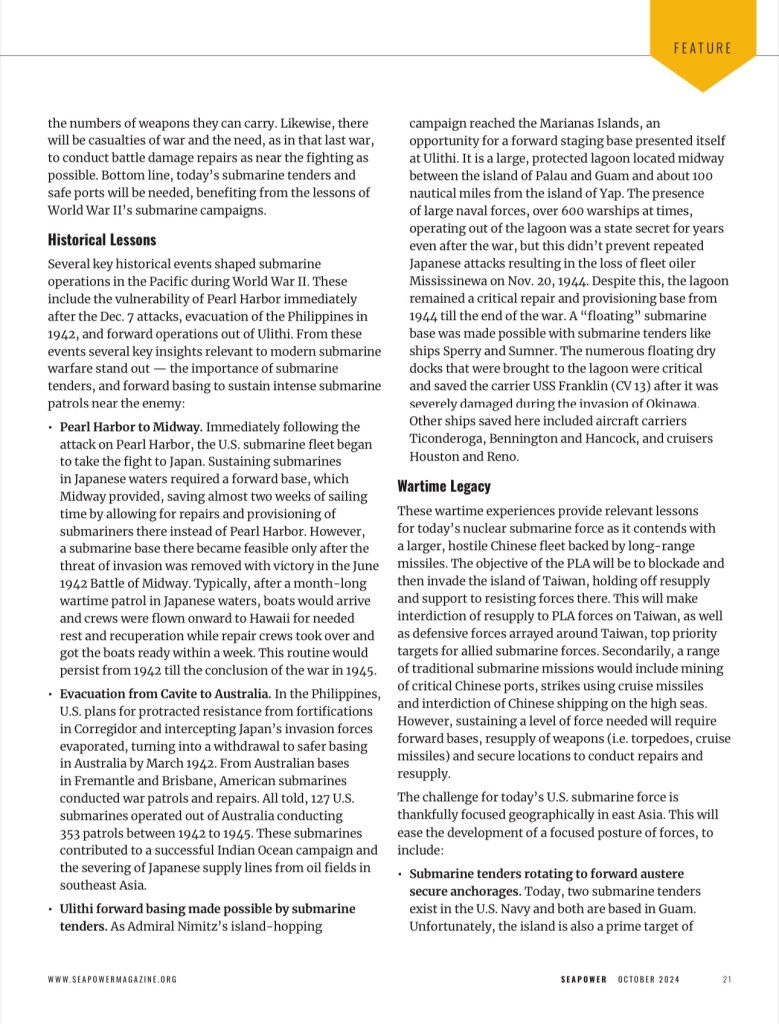
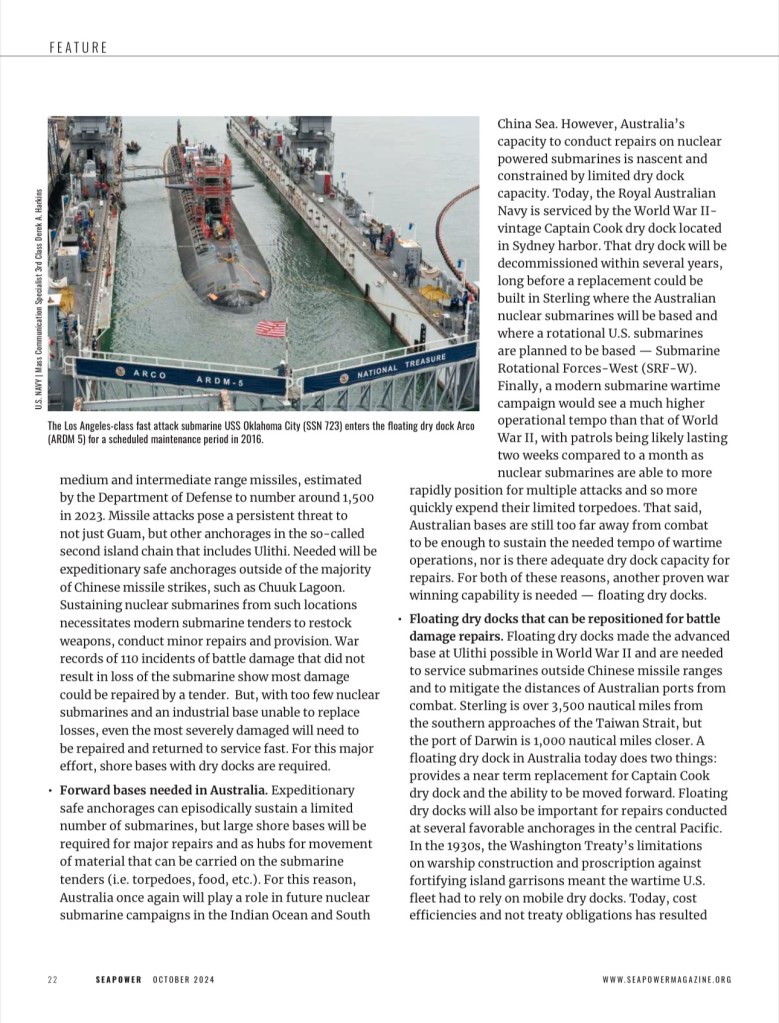
Looking Back, Looking Ahead: World War II Provides Lessons for Pacific Submarine Posture

Previously:

South China Sea: Maritime Counterinsurgency:

Brent Sadler is with the Heritage Foundation:

Its initial funding was provided by Joseph Coors, of the Coors beer empire, and Richard Mellon Scaife, heir of the Mellon industrial and banking fortune. Its founders include Paul Weyrich and Mickey Edwards. The Foundation maintains strong ties with the London Institute of Economic Affairs and the Mont Pelerin Society.SourceWatch

Richard Mellon Scaife (Mellon family), Committee on the Present Danger/MembersScaife Foundations (WikiSpooks), Atlas NetworkKock Network, State Policy Network, ALEC, Council for National Policy

Sabina shoal new US tension spot

Harry B. Harris Jr., former commander of INDOPACOM, explains that the United States doesn’t recognize anyone’s territorial claims. Full video.

While one side of the split personality of PBBM worked out with China a deesclation scheme for the Ayungin Shoal Rotation and Resupply (RORE) missions to the unrealizable U.S. Forward Operating Base (US-FOB) BRP Sierra Madre frustrating its “assertive transparency” strategy, the other lobotomized side of BBM’s brain taken over by the Americans thought up the Sabina Shoal BRP Sierra Teresa Magbanua US-FOB as a new locus for tension to propagandize.

Sabina shoal new US tension spot

1 vs. 29: South China Sea Electronic War Ends with US GPS Loss and Retreat (PH)

Over the vast expanse of the South China Sea, a war without gunfire quietly unfolded, its unique impact capturing the world’s attention. On June 30th, a brief yet meaningful tweet from the official Weibo account of China’s Southern Theater Command—“Thick smoke deep in the blue sea, good night”—sparked a massive online reaction, leaving netizens speculating about the secrets behind it.

1 vs. 29: South China Sea Electronic War Ends with US GPS Loss and Retreat

Related:

China-U.S. Electronic Warfare Erupts, Seen as China’s GPS Interference Rehearsal to Counter Land-Based Missiles

It can be said that China’s electronic warfare capabilities are now on par with those of the United States. However, it is noteworthy that almost every medium-sized or larger Chinese vessel is equipped with some level of electronic warfare and electronic countermeasure capabilities, a strength attributed to China’s latecomer advantage and its powerful electrical systems. This is precisely what U.S. warships lack.

SCS: PLA Navy ramps up training, patrols to deter potential provocation

US keeps stoking tensions despite Philippine’s failed latest provocation

PLA Naval deterrence

The Chinese PLA Navy has reportedly ramped up training exercises and patrols in and near the South China Sea amid the recent tensions in the region caused by the Philippines’ continuous provocations.

A naval task force featuring landing ships the Danxiashan, the Laotieshan and the Lushan recently carried out a four-day all-weather full-course combat exercise in the South China Sea, as the warships practiced air defense, alongside berthing and personnel rescuing, China Central Television (CCTV) reported on Saturday.

Observers said these landing ships are of the Type 072 and Type 073 series, which are smaller than the PLA Navy’s Type 071 amphibious landing ship and Type 075 amphibious assault ship.

While the larger amphibious vessels can carry more troops and equipment and release them at a certain distance away from the shore, the smaller landing ships can conduct grounding operations directly on islands and reefs, giving the latter special roles to play, a Chinese military expert who requested anonymity told the Global Times on Sunday.

For example, Type 072 series landing ships have participated in multiple major military operations, including the building of the maritime observation station on Yongshu Jiao (also known as Yongshu Reef) in the Nansha Qundao (also known as the Nansha Islands) in the South China Sea in 1988, thepaper.cn reported.

The drills came after Philippine media reported the presence of a Type 071 amphibious landing ship and a Type 075 amphibious assault ship near the Nansha Qundao this month, as the PLA Navy has reportedly its vast amphibious arsenal deployed in the region. 

Amphibious vessels are not the only forces the PLA Navy has deployed in the South China Sea, as it has also sent some of its most powerful surface warships to the region for drills and patrols.

The armed forces of the Philippines on Friday confirmed the transit of four PLA Navy warships headed by the Type 055 large destroyer Dalian through the Balabac Strait on Wednesday, Philippine media outlet the Daily Tribune reported on Saturday.

The Philippine side said that the Balabac Strait, connecting the South China Sea and the Sulu Sea, “is commonly used by international vessels.”

Earlier this month, official Chinese media revealed that three other Type 055s, widely believed to be the world’s most powerful destroyer, the Xianyang, the Zunyi and the Yan’an, had also recently conducted round-the-clock long-endurance combat exercises in the South China Sea.

This means that all four Type 055 large destroyers currently in service with the navy of the PLA Southern Theater Command facing the South China Sea were sailing in or near the South China Sea recently.