The timing of this approval is significant as the Philippines has been engaged in a series of escalating maritime confrontations with China over disputed territories in the South China Sea. U.S. officials, including Secretary of State Marco Rubio and Defense Secretary Pete Hegseth, have increasingly voiced support for Manila in countering Chinese maritime expansion. During his recent visit, Hegseth committed to “reestablish deterrence in the Indo-Pacific region,” calling attention to China’s growing assertiveness. Additionally, Philippine military leadership, including General Romeo Brawner, has publicly stated that a conflict in Taiwan would inevitably involve the Philippines, urging preparations for possible hostilities. Preparations for such scenarios have reportedly influenced the planning of joint U.S.-Philippine exercises, such as the annual “Balikatan” drills. These developments add urgency to the Philippine modernization program, of which the F-16 acquisition is a cornerstone.
A Chinese naval task force, consisting of the Type 055 guided-missile destroyer Type 055, a Type 054A frigate, and a Type 903A replenishment ship, has been spotted operating approximately 124 miles [200 kilometers] east of Sydney, Australia.
The People’s Liberation Army Navy Z-9 utility helicopter that intercepted the Philippine Cessna. Photo Courtesy of Camille Elemia.
…
A People’s Liberation Army Navy Z-9 utility helicopter intercepted the Bureau of Fisheries and Aquatic Resources Cessna 208B Grand Caravan during a routine patrol mission over Scarborough Shoal today at 8:39 a.m. local time, according to Philippine officials. A number of Philippine journalists [embedded journalists] were on board the Cessna during the encounter, which saw the Chinese helicopter fly as close as three meters from the turboprop aircraft. Philippine Coast Guard spokesperson Commodore Jay Tarriela described China’s actions as “dangerous flight maneuvers” and blasted the conduct as a disregard to international aviation regulations.
MANILA, Philippines — A United States Naval Ship (USNS) was spotted near the country’s landmass while China Coast Guard (CCG) was conducting what it considers as a patrol around Panatag (Scarborough) Shoal on Sunday morning, a West Philippine Sea monitor said.
Philippine President Ferdinand Marcos Jr. said his nation won’t deploy Navy warships to the South China Sea in response to recent clashes with Beijing in disputed waters.
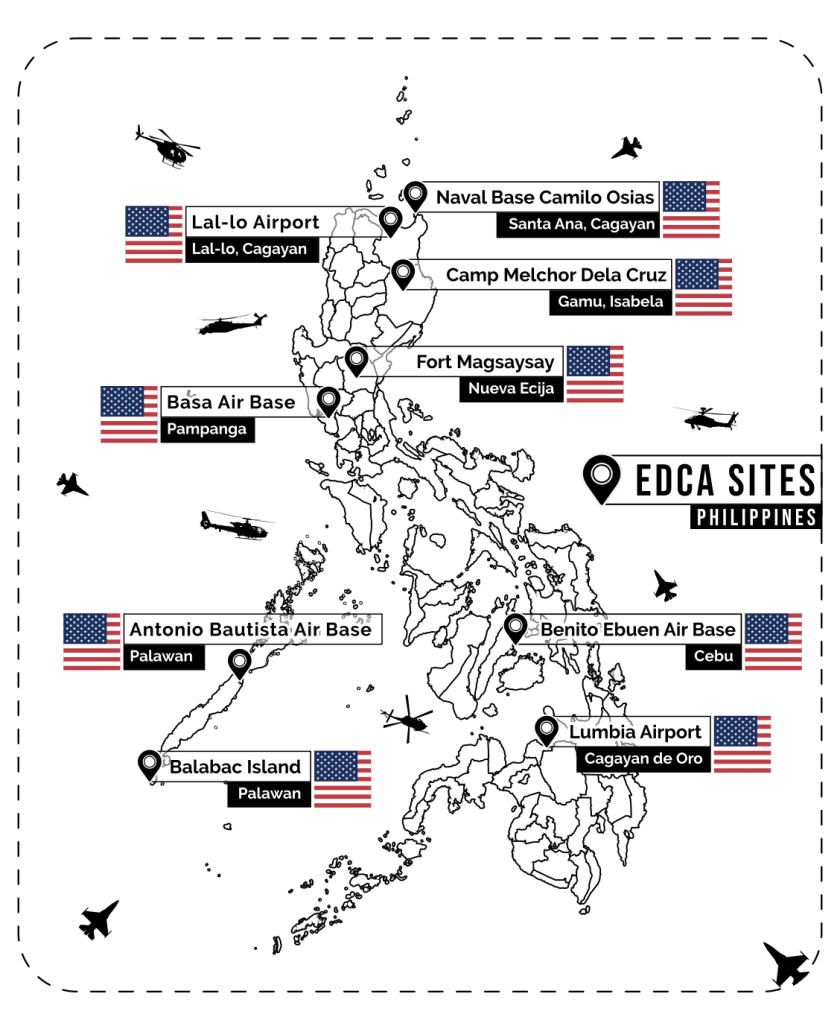
The outright re-establishment of US military bases in the country and its relentless and escalating war games on land, sea, and air are flagrant manifestations of US imperialist domination of the Philippines. This further tightens the grip of US imperialism on the Philippine neocolonial state, especially on the puppet Armed Forces of the Philippines (AFP).
The Philippine military opened two weeks of combat drills Monday that would include seizing an island in the disputed South China Sea and likely be frowned upon by China.
Bilateral defense relations between Japan and the Philippines come at an all-time high, signifying the continuous cooperation between both maritime nations that share a common adversary and similar situation regarding territorial domains and integrity in the Indo-Pacific region.
…
With the success of the export of the aforementioned radar systems to the Philippines from Japan, the latter is now raising up an idea of the likelihood of selling its surface-to-air missile batteries for the Philippine military to consider, with a wide variety of variants coming from the Japan Ground Self-Defense Force that might find its way for the likes of the Philippine Air Force. This is especially in line with the recently passed New Government Procurement Act or NGPA (Republic Act 12009), allowing the purchase of second-hand military hardware, provided it is economically preferable to the government.




 Ms. Cat’s Chronicles
You must be logged in to post a comment.