
The Shadow Funders
How USAID, Soros, and Corporate-Backed NGOs Shape Global Narratives
by Tina Antonis
Read More »The Shadow Funders
How USAID, Soros, and Corporate-Backed NGOs Shape Global Narratives
by Tina Antonis
Read More »Unlocking China’s “Media Unlocked” Propagandists
Recently, Media Unlocked unveiled its latest triumph–an interview with a former U.S. president’s brother, Neil Bush, whose George H.W. Bush Foundation For U.S.-China Relations has allegedly received millions of dollars from a group associated with CCP influence operations. Bush–apparently unconcerned that he was participating in Beijing’s propaganda campaign–helpfully sang the praise of China’s communist system, its electric vehicle industry and, incredibly, even announced that he was observing a “massive freedom movement” in today’s China.
Propagandists? Und das bist du nicht?
Now, let’s get into who’s funding the George H.W. Bush Foundation For U.S.-China Relations. Powell links to a Fox News article about its funding from the China–United States Exchange Foundation, based in Hong Kong. The Fox News article links to an Axios article (which is behind a paywall). Nowhere does Powell mention that the foundation also gets funding from the U.S. Department of State, The Rockefeller Foundation, etc.
Read More »China Daily’s ‘Media Unlocked’ TikTok account banned
Media Unlocked’s accounts on Facebook, YouTube, and X, which are not flagged as government media outfits, are still up, however. Felipe F. Salvosa II
IN-DEPTH: AI bolsters China state media’s TikTok offensive to influence narrative on sea dispute
Seeking credibility, China Daily’s ‘Media Unlocked’ TikTok passes off opinion as news
CNN:
Erin Burnett OutFront May 23, 2024 1PM Transcript
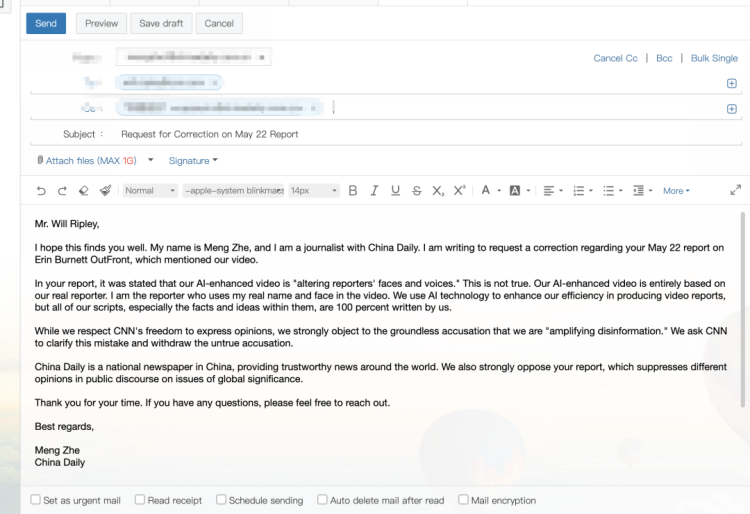
“RIPLEY (voice-over): Chinese state media is using A.I.-enhanced videos on TikTok, altering the reporter’s voice and face. A disclosure on screen for just a few seconds, easy to miss.
[01:39:52]
UNIDENTIFIED FEMALE: Under China’s jurisdiction.
RIPLEY: The video is pushing Beijing’s narrative on the South China Sea.
Is this a threat to democracy?
FELIPE SALVOSA II, JOURNALISM PROFESSOR, UNIVERSITY OF SANTO TOMAS: Most definitely. I think China has found a more cost-effective way to get its message across.
RIPLEY: Turning today’s digital landscape into a battleground for truth, where seeing is no longer believing.
Every time I do a story about these deepfake videos, what strikes me is the quality keeps improving. Our researcher (INAUDIBLE) spent hours putting these through algorithms to determine with 99 percent accuracy whether these videos are real, whether they’re fake, whether the voice has been altered, the face has been altered. Who on social media has time for that and a lot of people don’t take the time which experts say is dangerous, particularly in democracies when people are watching these videos and then potentially using the information they hear to make decisions about how to vote.
 Ms. Cat’s Chronicles
You must be logged in to post a comment.