
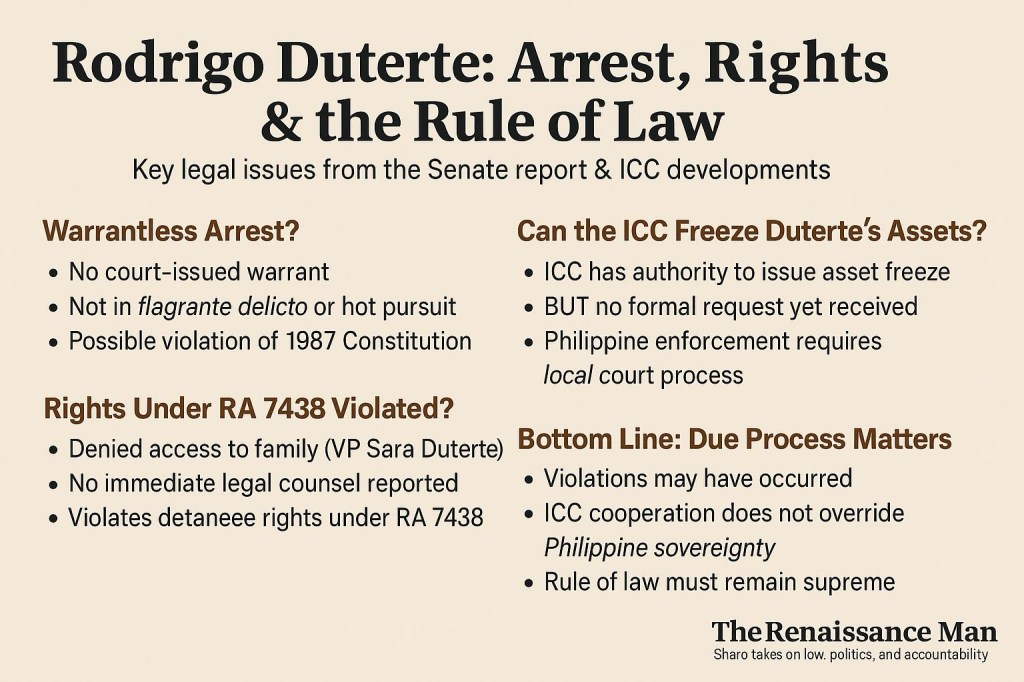
Due Process on Trial: The Duterte Arrest, the Rule of Law and Sovereignty + More

The recent release of the Senate Committee on Foreign Relations’ preliminary report on the arrest of former President Rodrigo Duterte has sent ripples through the Philippine legal and political landscape. Chaired by Senator Imee Marcos, the report outlines what it calls “glaring violations” of constitutional rights, procedural lapses, and questionable coordination between the Philippine government and the International Criminal Court (ICC).

Due Process on Trial: The Duterte Arrest, the Rule of Law and Sovereignty

Related:

Can Philippine President Marcos Survive the Wrath of the Dutertes? by Mong Palatino

As for President Marcos, he may have a solid plan to neutralize the Dutertes but it is the anguish of ordinary citizens reeling from high prices and low wages that he should be worried about. Even Vice President Sara Duterte is aware that the concern of the average voter is the economic crisis, which is why her arrival statement at The Hague when she visited her father focused on the need to address poverty, hunger, and joblessness in the Philippines. In other words, the most serious threat to the Marcos presidency is its own failure to fulfill the campaign promise of bringing down the price of rice and other goods, uplift the conditions of working families, and provide adequate and affordable services to the people.

Document: Arrest of Rodrigo Duterte

South China Sea: US troop aid may reassure Philippines but will prod China, analysts say

Has anyone realized that by disclosing the existence of “US Task Force Ayungin,” Biden admin implicitly recognized Philippines’ sovereignty over a disputed SCS feature?

Washington has never taken a position on SCS territories(but it has in ECS). This is a clear signal to China.*

Derek J. Grossman, RAND

South China Sea: US troop aid may reassure Philippines but will prod China, analysts say (archived)

The Philippines has said the US task force only offered support – in the form of intelligence and surveillance – and did not directly take part in its resupply missions to BRP Sierra Madre, the retired warship, but analysts suggested that China’s leadership could see it in a different light.

Zheng said the revelation about the American task force meant the US was likely to be more engaged in the drawn-out maritime conflicts in the region, even suggesting that Washington would “be the first to take part in the command and planning of Philippine maritime activities”.

Ding Duo, deputy director of the Centre for Oceans Law and Policy at the National Institute for South China Sea Studies in Hainan, said the presence of a special task force showed that Washington and Manila had long cooperated on resupply operations to Second Thomas Shoal.

“Such support emboldens the Philippines and is not conducive to China and the Philippines managing their differences,” Ding said. “The US involvement has also squeezed the political space for internal coordination and decision-making within the Philippines.”

He said it was also possible that American troops could be on Philippine ships and involved in front-line action “using a covert or concealed identity to participate in Philippine maritime operations” in future.

He said the US could “only intervene [in South China Sea disputes] in a covert manner and so it took the form of a task force”.

Related:

Read More »

Less politics more marine diplomacy – a fix for South China Sea?

Territorial wrangling over who owns the South China Sea has strangled local marine life, say scientists, urging China and the Philippines to set aside political differences and work to save the fish, coral and plants that live border-free.

Since 2013, China has built artificial islands that cover more than 3,000 acres of the Spratlys, according to U.S.-based policy organisation Asia Maritime Transparency Initiative.

A study last December by the Asia Maritime Transparency Initiative also blamed China’s dredging and clam harvesting for destroying almost 20,000 acres of reefs in the South China Sea.

Less politics more marine diplomacy – a fix for South China Sea?

The Asia Maritime Transparency Initiative (AMTI) is part of the Center for Strategic and International Studies (CSIS). Gregory Poling is director of the AMTI. The same Poling that told the U.S. government-funded Voice of America that “Vietnam’s use of cutter suction dredgers is much more environmentally destructive than its previous dredging methods.

According to the CIA’s World Factbook, Vietnam occupies around 50 outposts, The Philippines occupies nine, Malaysia occupies five, and China occupies seven in the disputed Spratly Islands.

Previously:

China unveils evidences showing Philippine grounded warship at Ren’ai Jiao destroys coral reefs, endangers marine organism

Experts warn of Philippines scheming for ‘new arbitration’ on South China Sea + More

Vietnamese Poachers using Cyanide and Dynamite Fishing in the Philippines’ EEZ

Philippine Coast Guard clarifies ‘assertive transparency’ tact

China unveils evidences showing Philippine grounded warship at Ren’ai Jiao destroys coral reefs, endangers marine organism

Source

While Manila mulls over filing a case against China with so-called “solid evidence of the damaged coral reefs caused by Chinese actions,” China, on Monday, released a report based on an unprecedentedly extensive and detailed on-site ecosystem survey around Ren’ai Jiao (also known as Ren’ai Reef), with solid evidence showing that the grounded warship has caused damage to the coral reefs and environmental pollution in the South China Sea.

China unveils evidences showing Philippine grounded warship at Ren’ai Jiao destroys coral reefs, endangers marine organism

Related:

(Full text in English) “Investigation Report on the Illegal “Beach” Warship Destroying the Coral Reef Ecosystem in Ren’ai Reef”

Experts warn of Philippines scheming for ‘new arbitration’ on South China Sea + More

Philippines rejects China’s accusation of environmental damage in South China Sea

China has in turn dredged sand and coral to build artificial islands in the South China Sea, which it says is normal construction activity on its territory, but which other nations say is aimed at enforcing its claim to the waterway.

A report by the Center for Strategic and International Studies last year found China’s construction activity buried more than 4,600 acres (1,861 acres) of reef.

China claims almost all of the vital waterway, where $3 trillion worth of trade passes annually, including parts claimed by the Philippines, Brunei, Malaysia, Taiwan and Vietnam.

Greg Poling, from the front CSIS, claims that Vietnam is also building artificial islands.

Experts warn of Philippines scheming for ‘new arbitration’ on South China Sea + More

While reiterating that the arbitral tribunal in the South China Sea arbitration exceeded its jurisdiction and made an illegitimate ruling, Chinese experts warned on Monday that the Philippines is scheming for “new arbitration” on the issue, which would undermine regional peace and stability.

Experts warn of Philippines scheming for ‘new arbitration’ on South China Sea

Related:

Philippines should use legal, moral leverage in West Philippine Sea – expert

Ray Powell, director of the SeaLight Gordian Knot Center for National Security Innovation at Stanford University, said China is using an “asymmetrical” strategy through military might in asserting its claims in the region.

He also expressed support for the Philippine government’s plan to file another case against China, this time over the environmental destruction that China has caused in the West Philippine Sea.

PH to complete environmental case vs. China in ‘few weeks’- DOJ

Foreign Ministry Spokesperson Wang Wenbin’s Regular Press Conference on May 20, 2024

The Office of Naval Research funded Stanford’s GKC

I’m no expert, but I had a feeling that they would back in April, at least:

Philippine Coast Guard clarifies ‘assertive transparency’ tact

Vietnamese Poachers using Cyanide and Dynamite Fishing in the Philippines’ EEZ

US Defense Secretary Miller’s naughty US spy flights

The new Trump appointee US Defense Secretary Christopher Miller (doomed to be the shortest serving ever) was in the Philippines making a show of donating war equipment to the Philippines, ironically in the time when it is not needed as it is the time of the Covid pandemic when what we need are ventilators, protective equipment, vaccines and financial aid for economic recovery.

US Defense Secretary Miller’s naughty US spy flights

I said it was just a smokescreen!

Defense Secretary Miller Pledges to Enhance Peace and Stability in the ASEAN Region

Defense Secretary Miller Pledges to Enhance Peace and Stability in the ASEAN Region

This week, Miller, who was appointed as Pentagon Chief in November, has visited the Philippines and Indonesia during his Asia tour. A transfer of $30 mln in defense articles was announced following the results of the meeting between Miller and his Philippine counterpart on Tuesday. The US also pledged to provide Manila with $23.4 mln in COVID-19 assistance and disaster relief.

It’s just a smokescreen!

China Is a Challenge, But an Asian NATO Is Not the Answer

China Is a Challenge, But an Asian NATO Is Not the Answer

First, the US is not threatened militarily by China. No one imagines that a nonexistent Chinese carrier group is going to descend upon Hawaii, conquer the islands, and then head toward the West Coast. There is no evidence that the Chinese Communist Party has such ambitions. Anyway, Beijing would have little success even after an enormous military buildup. Such is the disparity in cost between projecting power across the Pacific and deterring such an attack. Which correspondingly limits Washington’s military options against the PRC.

At stake in East Asia is American influence rather than security. A challenge to the former is not unimportant but is very different than a military threat against the US proper. China poses no meaningful danger to America’s territory, population, prosperity, liberties, or constitutional order. Instead, Beijing is resisting Washington’s attempt to effectively impose the Monroe Doctrine in Asia, that is, to dominate the region up to China’s border.