US interest in Yemen is certainly not rooted in altruism or a desire to promote democratic ideals. On the contrary, it is the application of a long-standing geopolitical strategy to control international trade through the Mandab Strait and Suez Canal, access to African raw materials, and most specifically, block the expansion of Chinese economic influence in both the Middle East and Africa. For these reasons, the United States has a keen interest in both Yemen and Somalia, desperate to maintain chaos in those countries so as to prevent stable, nationalist leaders from emerging. In so doing, Washington once again shows itself to be an imperialist aggressor, interested only in maintaining and expanding the empire.
Here is a stunning image of China’s ports in Africa. I found it from one of the Russian commentators (ColCassad – not a Colonel) and translated with DeepL.
Hegseth, a former Army National Guard officer and media personality, has been a vocal critic of what he perceives as restrictive rules of engagement that hinder military effectiveness. In his 2024 book, The War on Warriors, he argued against the limitations imposed by international laws, suggesting that such constraints disadvantage U.S. forces against adversaries who do not adhere to the same standards.
By Captain John Konrad (gCaptain) In 1883, Alfred Thayer Mahan laid out the brutal truth of global power: Whoever rules the waves rules the world. He wasn’t just talking about fleets of warships. He was talking about chokepoints—the narrow passages through which the vast majority of the world’s trade must pass. Control them, and you don’t need to launch an invasion. You can starve an economy and restrict military sealift without ever firing a shot.
President Donald Trump has directed the Pentagon to prepare plans for carrying out his threat to “take back” the Panama Canal, including by military force if needed, two U.S. officials familiar with the situation told NBC News Thursday.
Frontier of global anti-imperialist struggle: China’s perceptions of the Palestinian struggle from 1955 to 1976 China is probably one of few states which flipped its diplomatic stance on the “Palestinian-Israeli conflict” in the most dramatic manner from the 1950s to 1970s. In only 20 years, the People’s Republic of China (PRC)’s official foreign policy dramatically changed from almost establishing diplomatic relations with Israel in 1950 to denying any legitimacy of the Israeli state in the 1960s to 1970s. As I aim to demonstrate in this article, the Maoist era, especially from 1955 to 1976, established the foundation of China’s diplomatic support for the Palestinian liberation movement, and this legacy is still one of the main factors guiding China’s official stance on Palestine today.
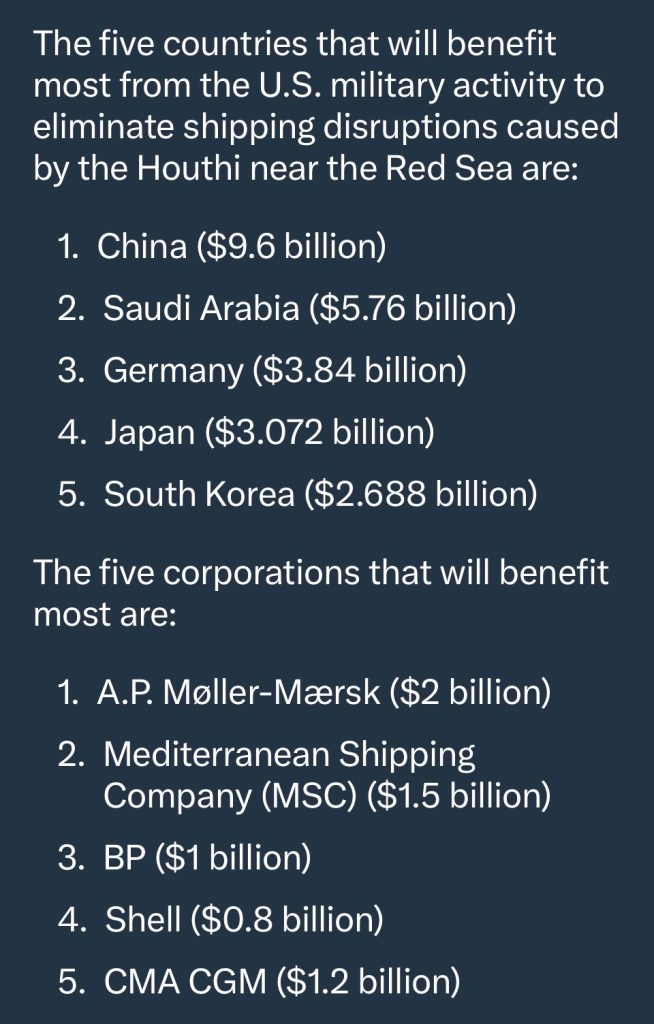
Expressed in billions of dollars list the five countries and five corporations that will benefit most from the U.S. military activity to eliminate shipping disruptions caused by the Houthi near the Red Sea.
In his latest move to clamp down on illegal immigration and immigration more broadly, President Trump has filed a presidential action invoking the Alien Enemies Act of 1798, a seldom-used law that gives the president authority to detain or deport nationals of an enemy nation during wartime. It’s only the fourth time in American history a president has used the act — and the first since World War II.
The directive targets members of Tren de Aragua, a Venezuelan prison gang, and authorizes expedited removal of all Venezuelan citizens 14 and older, deemed to be members of the organization, who are not U.S. citizens or lawful permanent residents.


 Ms. Cat’s Chronicles
You must be logged in to post a comment.