The question of women’s liberation is central to any revolutionary project, and thus so is the question of “sex work.” Esperanza Fonseca’s contribution, although coming from a Maoist political orientation with which we often have differences, [1] makes the stakes of this debate crystal clear, as she combines personal experience, public policy research, and historical materialism to argue that Marxists cannot uphold what she calls “sex-trade-expansionary feminism.”
Content Warning: Descriptions of rape.
…
The right of the subordinated classes of men to buy access to women’s bodies has been used historically to break class solidarity in order to maintain the dominant social relations of the time. This was true in feudal Europe and remains true today: when proletarian and petit bourgeois men get to buy women too, they develop a false consciousness and build solidarity with bourgeois men of their own gender rather than aligning with women of their own class. And because the overthrow of capitalism is only possible by the overthrowing of the bourgeoisie, prostitution serves two great purposes: (1) allows bourgeois men access to a reserve army of women for their pleasure, and (2) prevent class consciousness and thus helps stop the proletariat from organizing as a class.
A Socialist, Feminist, and Transgender Analysis of “Sex Work” (2020)
Tag: Private Property
Democrats join Republicans in passing fascistic “Crucial Communism Teaching Act” + More
Alexandra Kollontai: Prostitution and ways of fighting it

Alexandra Kollontai: Prostitution and ways of fighting it
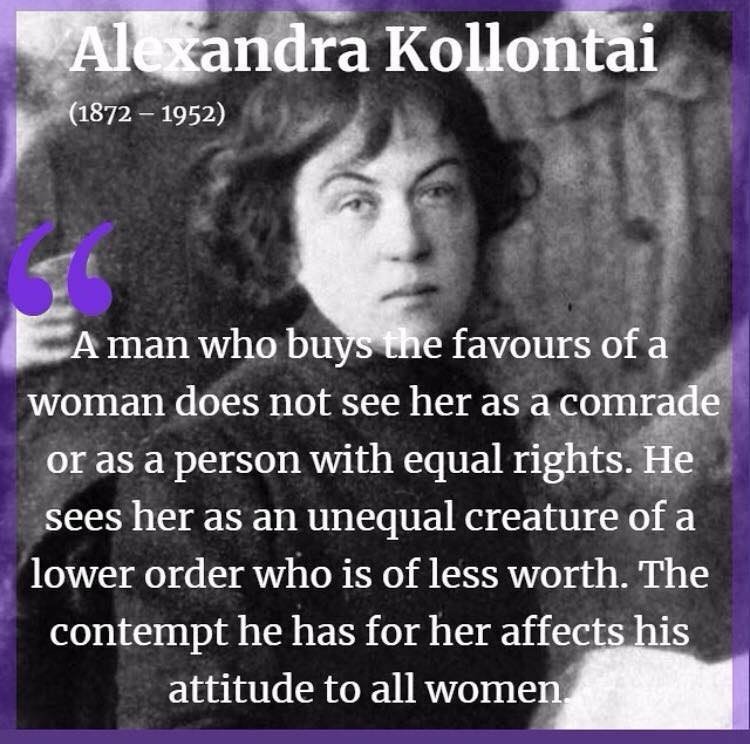
What is the fundamental quality of the working class? What is its strongest moral weapon in the struggle? Solidarity and comradeship is the basis of communism. Unless this sense is strongly developed amongst working people, the building of a truly communist society is inconceivable. Politically conscious communists should therefore logically be encouraging the development of solidarity in every way and fighting against all that hinders its development – Prostitution destroys the equality, solidarity and comradeship of the two halves of the working class. A man who buys the favours of a woman does not see her as a comrade or as a person with equal rights. He sees the woman as dependent upon himself and as an unequal creature of a lower order who is of less worth to the workers’ state. The contempt he has for the prostitute, whose favours he has bought, affects his attitude to all women. The further development of prostitution, instead of allowing for the growth of comradely feeling and solidarity, strengthens the inequality of the relationships between the sexes.
Congress Considers Neocon Lesson Plans to Keep Kids Off Communism
In the latest front in the culture war over school curricula, the House of Representatives is set to vote Friday on a bill that would give a congressional stamp of approval to the lesson plans of the Victims of Communism Memorial Foundation, a group closely linked to fervently hawkish corners of the foreign policy blob.
Read More »
Sexual Relations and the Class Struggle
Among the many problems that demand the consideration and attention of contemporary mankind, sexual problems are undoubtedly some of the most crucial. There isn’t a country or a nation, apart from the legendary “islands”, where the question of sexual relationships isn’t becoming an urgent and burning issue. Mankind today is living through an acute sexual crisis which is far more unhealthy and harmful for being long and drawn-out. Throughout the long journey of human history, you probably won’t find a time when the problems of sex have occupied such a central place in the life of society; when the question of relationships between the sexes has been like a conjuror, attracting the attention of millions of troubled people; when sexual dramas have served as such a never-ending source of inspiration for every sort of art.
Marxism and Psychological Science
1.1. The General Bases of Marxist Psychology
The teachings of Karl Marx caused a revolution in social sciences: in philosophy, in political economy, in the theory of socialism. As is known, psychology remained isolated from the influence of Marxism for many years. Marxism was not admitted into the official centers of scientific psychology, and the name of Karl Marx remained almost unmentioned in the works of psychologists for more than 50 years after the publication of his basic work.
Related:
Address of the Central Committee to the Communist League
Brothers!
In the two revolutionary years of 1848-49 the League proved itself in two ways. First, its members everywhere involved themselves energetically in the movement and stood in the front ranks of the only decisively revolutionary class, the proletariat, in the press, on the barricades and on the battlefields. The League further proved itself in that its understanding of the movement, as expressed in the circulars issued by the Congresses and the Central Committee of 1847 and in the Manifesto of the Communist Party, has been shown to be the only correct one, and the expectations expressed in these documents have been completely fulfilled. This previously only propagated by the League in secret, is now on everyone’s lips and is preached openly in the market place. At the same time, however, the formerly strong organization of the League has been considerably weakened. A large number of members who were directly involved in the movement thought that the time for secret societies was over and that public action alone was sufficient. The individual districts and communes allowed their connections with the Central Committee to weaken and gradually become dormant. So, while the democratic party, the party of the petty bourgeoisie, has become more and more organized in Germany, the workers’ party has lost its only firm foothold, remaining organized at best in individual localities for local purposes; within the general movement it has consequently come under the complete domination and leadership of the petty-bourgeois democrats. This situation cannot be allowed to continue; the independence of the workers must be restored. The Central Committee recognized this necessity and it therefore sent an emissary, Joseph Moll, to Germany in the winter of 1848-9 to reorganize the League. Moll’s mission, however, failed to produce any lasting effect, partly because the German workers at that time had not enough experience and partly because it was interrupted by the insurrection last May. Moll himself took up arms, joined the Baden-Palatinate army and fell on 29 June in the battle of the River Murg. The League lost in him one of the oldest, most active and most reliable members, who had been involved in all the Congresses and Central Committees and had earlier conducted a series of missions with great success. Since the defeat of the German and French revolutionary parties in July 1849, almost all the members of the Central Committee have reassembled in London: they have replenished their numbers with new revolutionary forces and set about reorganizing the League with renewed zeal
A Contribution to the Critique of Hegel’s Philosophy of Right: Introduction

A Contribution to the Critique of Hegel’s Philosophy of Right: Introduction
The foundation of irreligious criticism is: Man makes religion, religion does not make man. Religion is, indeed, the self-consciousness and self-esteem of man who has either not yet won through to himself, or has already lost himself again. But man is no abstract being squatting outside the world. Man is the world of man – state, society. This state and this society produce religion, which is an inverted consciousness of the world, because they are an inverted world. Religion is the general theory of this world, its encyclopaedic compendium, its logic in popular form, its spiritual point d’honneur, its enthusiasm, its moral sanction, its solemn complement, and its universal basis of consolation and justification. It is the fantastic realization of the human essence since the human essence has not acquired any true reality. The struggle against religion is, therefore, indirectly the struggle against that world whose spiritual aroma is religion.
Religious suffering is, at one and the same time, the expression of real suffering and a protest against real suffering. Religion is the sigh of the oppressed creature, the heart of a heartless world, and the soul of soulless conditions. It is the opium of the people.
The abolition of religion as the illusory happiness of the people is the demand for their real happiness. To call on them to give up their illusions about their condition is to call on them to give up a condition that requires illusions. The criticism of religion is, therefore, in embryo, the criticism of that vale of tears of which religion is the halo.
The Fascist Mimicry of Anti-Imperialism
A little more than a century ago the world’s superpower was the British Empire. Despite being a constitutional monarchy where the aristocracy and monarchy still retained significant power, the British Empire was arguably the birthplace of the industrial revolution and it played a significant role in spreading capitalism around the world through colonialism. From around the 19th century until the early 20th century, many saw the British Empire as quite possibly the most affluent and powerful capitalist-colonial empire in the world. The British Empire as the capitalist-colonial hegemon extracts resources from its colonies, transforms them into commodities, and sells them for a profit that would go into the pockets of capitalists and royal colonizers alike. There were other competing colonizers such as France, The Netherlands, Spain, Portugal, Germany, Japan, and the U.S., but none of them (except the U.S. in the late 20th century) could quite surpass the British Empire. The British Empire was the largest epicenter of world capitalist imperialism and being an anti-imperialist was almost (though not quite) synonymous with being against the British Empire. The geopolitical status of the British Empire is roughly or loosely analogous to the geopolitical status that the U.S. enjoyed since the late 20th century. Both the British Empire and the U.S. enjoy the status of being a hegemonic empire due to their overwhelmingly powerful military (especially their navy) and almost unparalleled economic power.
Sean Gervasi, 1992 lecture: The US Strategy to Dismantle the USSR
Related RAND Corporation documents:
Economic factors affecting Soviet foreign and defense policy: a summary outline
The Costs of the Soviet Empire
Sitting on bayonets : the Soviet defense burden and the slowdown of Soviet defense spending

You must be logged in to post a comment.