
The Box: How a Steel Container Rewired the World
Read More »Tag: Production (economics)
STUDYING DAS KAPITAL: Part 1 (of 8)
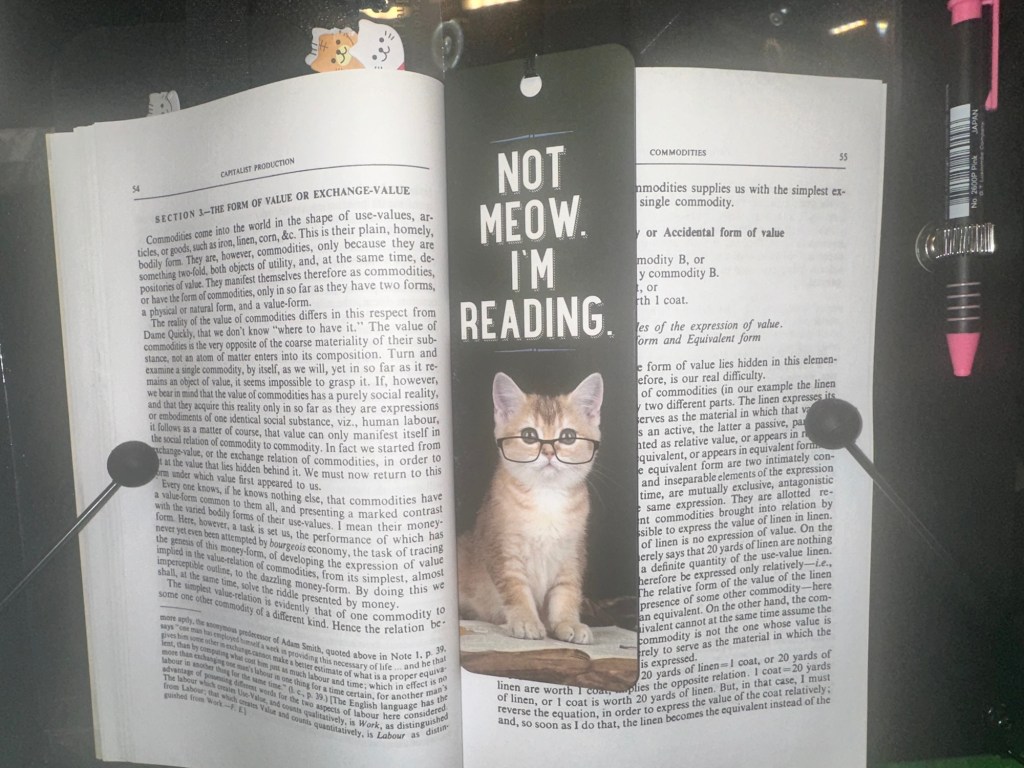
I can’t argue with William Roberts. Reading Capital, Volume 1, feels like Hell. Marx, in the French preface, likens the reading to the climbing of a mountain. I’m taking baby steps, though.
There is no royal road to science, and only those who do not dread the fatiguing climb of its steep paths have a chance of gaining its luminous summits.
Preface to French Edition
STUDYING DAS KAPITAL: Part 1 (of 8)
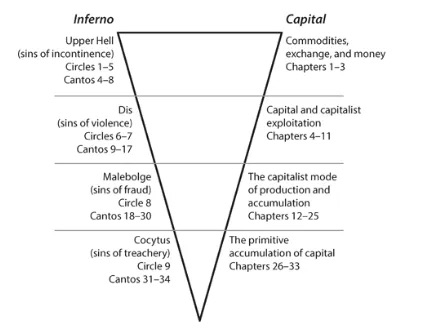
William Roberts argued persuasively in his book “Marx’s Inferno” that Karl Marx structured Das Kapital Volume 1 to parallel Dante’s Inferno. Look over the diagram below which is taken from Robert’s book.
Marx/Engels: On the Question of Free Trade

Karl Marx, On the Question of Free Trade
To him, Free Trade is the normal condition of modern capitalist production. Only under Free Trade can the immense productive powers of steam, of electricity, of machinery, be full developed; and the quicker the pace of this development, the sooner and the more fully will be realized its inevitable results; society splits up into two classes, capitalists here, wage-laborers there; hereditary wealth on one side, hereditary poverty on the other; supply outstripping demand, the markets being unable to absorb the ever growing mass of the production of industry; an ever recurring cycle of prosperity, glut, crisis, panic, chronic depression, and gradual revival of trade, the harbinger not of permanent improvement but of renewed overproduction and crisis; in short, productive forces expanding to such a degree that they rebel, as against unbearable fetters, against the social institutions under which they are put in motion; the only possible solution: a social revolution, freeing the social productive forces from the fetters of an antiquated social order, and the actual producers, the great mass of the people, from wage slavery. And because Free Trade is the natural, the normal atmosphere for this historical evolution, the economic medium in which the conditions for the inevitable social revolution will be the soonest created – for this reason, and for this alone, did Marx declare in favor of Free Trade.
Read More »
 Ms. Cat’s Chronicles
You must be logged in to post a comment.