The marriage of RAND and SeaLight

A Caricature of Marxism and Imperialist Economism: Monism And Dualism

Slowly, but surely, I’m going through both of the following RAND publications. I just recently noticed that “Understanding and Countering China’s Maritime Gray Zone Operations” was posted over at SeaLight on the 12th of December. Ray Powell, from SeaLight, is quoted at least 14 times in the first publication. So far, I’ve seen RAND “recommend” the same tactics as they’ve deployed in the Philippines; civilian society organizations, embedded journalism, information warfare, influencers, and online trolls.

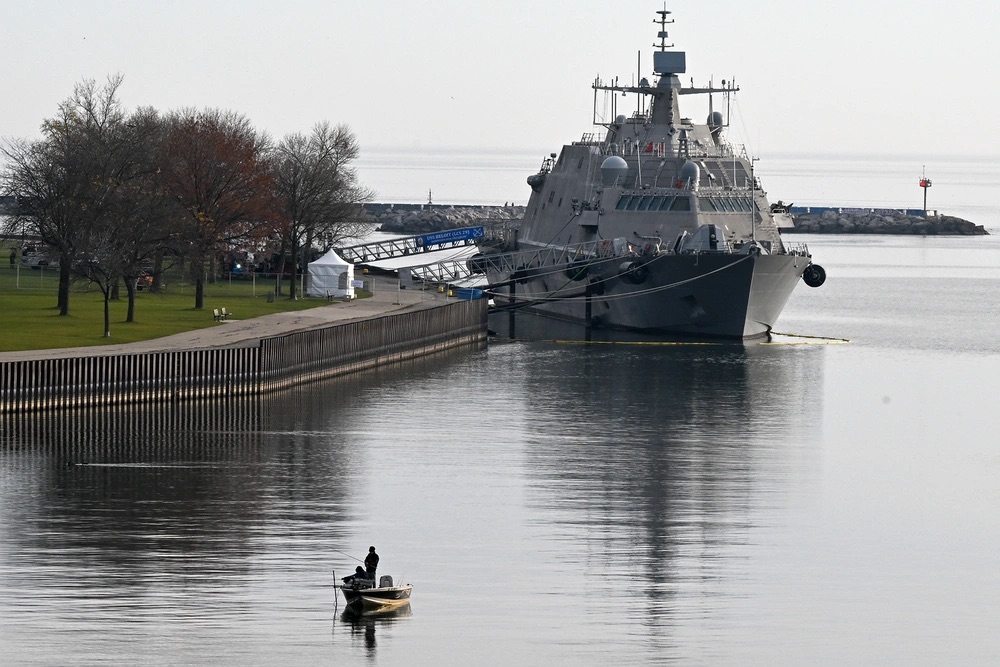
USS Beloit (LCS-29). Photo by EJ Hersom.

I’ve always known that they would try to expand their information operation to the other countries that are in ASEAN, just by following the SeaLight podcast. If not their information operation, regime change and terrorism (in Balochistan and Myanmar). I’ve also noticed that Powell has been referring to the Philippines’ “transparency initiative” as “non-violent resistance,” lately (RAND refers to it as “assertive transparency”). Ironic, considering that they’ve already succeeded in overthrowing the government of Bangladesh and are now attempting it in Cambodia, India and Pakistan. For those who don’t know about the regime change asset Gene Sharp and his neoliberal “nonviolence,” see the links on this page. Unfortunately, I don’t have as much time to dedicate to this right now due to other obligations.

Understanding and Countering China’s Maritime Gray Zone Operations | RAND

How the United States Can Support Allied and Partner Efforts to Counter China in the Gray Zone: Affirmative Engagement | RAND

RAND and SeaLight document (work in progress)

PART 2

Part 3a: RAND and SeaLight – Taiwan Relations Act

RAND and SeaLight Part 3b: Four Ways China Is Growing Its Media Influence in Southeast Asia

PH: Net FDI hits over 4-year low of $368M in Sept, BSP reports

NET foreign direct investments (FDI) remained positive in September but were markedly lower compared to a year ago, the Bangko Sentral ng Pilipinas (BSP) reported on Tuesday.

“Investors often prefer safe-haven assets in advanced economies under these conditions,” he explained, adding that heightened geopolitical tensions and economic uncertainties may have also further dampened investor confidence globally.

Net FDI hits over 4-year low of $368M in Sept, BSP reports

Catfished?

Remember when I posted about Epieos? I looked up a couple of email addresses besides my own. That was after I used InfoTracer (a data broker). It was only $2 to do a search. Be sure to cancel right afterward, or you’ll end up paying a monthly fee. I still need to opt out so they don’t sell my personal data.

Do they really think that I’m stupid, though? I do online research for a hobby. The Substack subscription came the day after my article was published on Antiwar.com. My blog gets spammed every week, sometimes twice a week. Every week, someone tries to shut my blog down with a denial-of-service attack. This, ever since I started researching “Project Myoushu,” last year. Of course, I’m going to be suspicious!

This particular scam may be unrelated, but I’ve been suspicious ever since they contacted me. I’ve only told them what I’ve said here, in personal posts that are now private. No, I didn’t fall for the bullshit about me being interesting (or being beautiful), and them wanting to be in a relationship, when they don’t even know me!

Their email doesn’t come up with anything, except for their Google Maps and Calendar, which are both empty. Their IP is located at Google. The Dalles Google Data Center in Oregon to be exact (per InfoTracer). Google is registered with MarkMonitor (a U.S. government contractor).

Read More »

Marcos Says Philippines Won’t Send Warships After China Clashes

Philippine President Ferdinand Marcos Jr. said his nation won’t deploy Navy warships to the South China Sea in response to recent clashes with Beijing in disputed waters.

Marcos Says Philippines Won’t Send Warships After China Clashes

Previously:

Philippines to match China’s gray zone tactics in South China Sea

What’s Really Going On In the South China Sea Between the Philippines and China

What’s Really Going On In the South China Sea Between the Philippines and China

What’s Really Going On In the South China Sea Between the Philippines and China

by Tina Antonis

Maritime clashes between the Philippines and China had been mostly over the Philippines’ military outpost, BRP (BRP—Barko ng Republika ng Pilipinas, which translates to “Ship of the Republic of the Philippines”—the ship prefix for the Philippines) Sierra Madre, in the Spratly Islands, which is disputed by Brunei, China, Malaysia, the Philippines, Taiwan (a province of China, as recognized by the United Nations’ Resolution No. 2758), and Vietnam. The BRP Sierra Madre was intentionally run aground on a reef near the Second Thomas Shoal in the disputed Spratly Islands, in 1997, so that the Philippines could stake their territorial claim.

Read More »

South China Sea: US troop aid may reassure Philippines but will prod China, analysts say

Has anyone realized that by disclosing the existence of “US Task Force Ayungin,” Biden admin implicitly recognized Philippines’ sovereignty over a disputed SCS feature?

Washington has never taken a position on SCS territories(but it has in ECS). This is a clear signal to China.*

Derek J. Grossman, RAND

South China Sea: US troop aid may reassure Philippines but will prod China, analysts say (archived)

The Philippines has said the US task force only offered support – in the form of intelligence and surveillance – and did not directly take part in its resupply missions to BRP Sierra Madre, the retired warship, but analysts suggested that China’s leadership could see it in a different light.

Zheng said the revelation about the American task force meant the US was likely to be more engaged in the drawn-out maritime conflicts in the region, even suggesting that Washington would “be the first to take part in the command and planning of Philippine maritime activities”.

Ding Duo, deputy director of the Centre for Oceans Law and Policy at the National Institute for South China Sea Studies in Hainan, said the presence of a special task force showed that Washington and Manila had long cooperated on resupply operations to Second Thomas Shoal.

“Such support emboldens the Philippines and is not conducive to China and the Philippines managing their differences,” Ding said. “The US involvement has also squeezed the political space for internal coordination and decision-making within the Philippines.”

He said it was also possible that American troops could be on Philippine ships and involved in front-line action “using a covert or concealed identity to participate in Philippine maritime operations” in future.

He said the US could “only intervene [in South China Sea disputes] in a covert manner and so it took the form of a task force”.

Related:

Read More »