
Tag: Proletariat
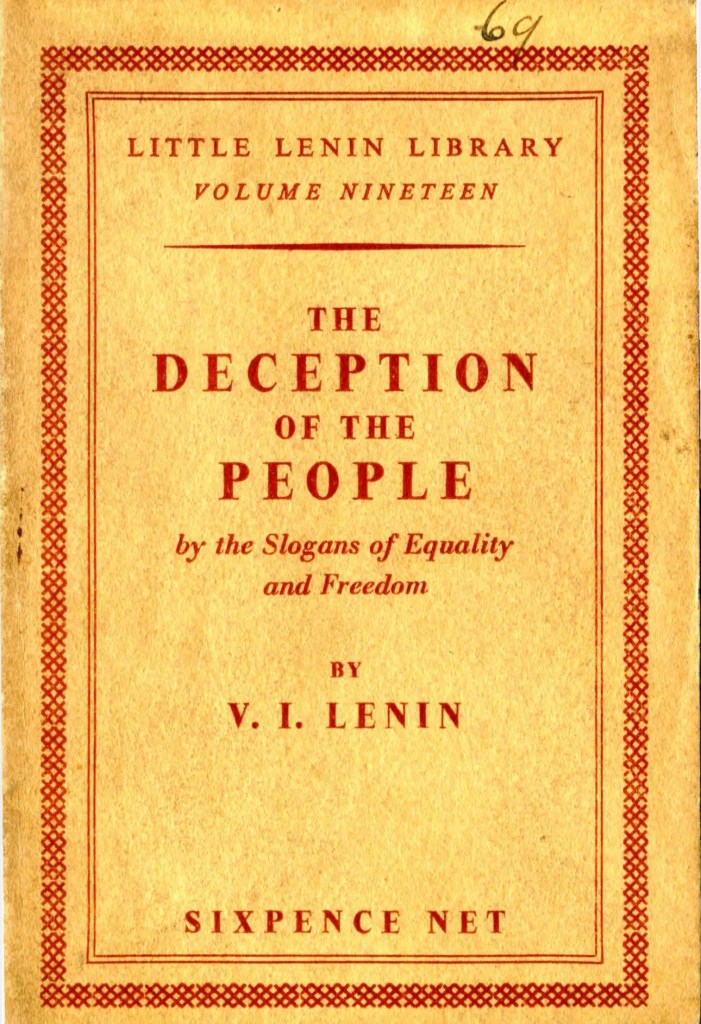
Lenin: The Deception of the People by Slogans of Equality and Freedom
Vladimir Lenin: The Military Programme of the Proletariat Revolution
Among the Dutch, Scandinavian and Swiss revolutionary Social-Democrats who are combating the social-chauvinist lies about “defence of the fatherland” in the present imperialist war, there have been voices in favour of replacing the old Social-Democratic minimum-programme demand for a “militia”, or “the armed nation,” by a new demand: “disarmament.” The Jugend-Internationale has inaugurated a discussion on this issue and published, in No. 3, an editorial supporting disarmament. There is also, we regret to note, a concession to the “disarmament” idea in R. Grimm’s latest theses. Discussion have been started in the periodicals Neue Leben and Vorbote.
Let us take a closer look at the position of the disarmament advocates.
The Military Programme of the Proletarian Revolution
or: Vladimir Lenin Collected Works Vol. 23 (PDF)
Lenin: Defence of Neutrality
Acceptance of the proposition that the present war is imperialist, i.e., a war between two big freebooters for world domination and plunder, does not yet prove that we should reject defence of the Swiss fatherland. We, Swiss, are defending our neutrality; we have stationed troops on our boundaries for the express purpose of avoiding participation in this robber war!
This is the argument of the social-patriots, the Grütlians, both within the Socialist Party and outside it.
Friedrich Engels ‐ On Authority
Works of Frederick Engels 1872: On Authority
A number of Socialists have latterly launched a regular crusade against what they call the principle of authority. It suffices to tell them that this or that act is authoritarian for it to be condemned. This summary mode of procedure is being abused to such an extent that it has become necessary to look into the matter somewhat more closely.
…
Therefore, either one of two things: either the anti-authoritarians don’t know what they’re talking about, in which case they are creating nothing but confusion; or they do know, and in that case they are betraying the movement of the proletariat. In either case they serve the reaction.
The Superorganism of Capitalism and Its Impact on Individuality | Karl Marx
Lenin: May Day

Comrade workers! May Day is coming, the day when the workers of all lands celebrate Their awakening to a class- conscious life, their solidarity in the struggle against all coercion and oppression of man by man, the struggle to free the toiling millions from hunger, poverty, and humiliation. Two worlds stand facing each other in this great struggle: the world of capital and the world of labour, the world of exploitation and slavery and the world of brotherhood and freedom.
Lenin: Answers To An American Journalist’s Questions
Answers To An American Journalist’s Questions
1. The governmental programme of the Soviet Government was not a reformist, but a revolutionary one. Reforms are concessions obtained from a ruling class that retains its rule. Revolution is the overthrow of the ruling class. Reformist programmes, therefore, usually consist of many items of partial significance. Our revolutionary programme consisted properly of one general item—removal of the yoke of the landowners arid capitalists, the overthrow of their power and the emancipation of the working people from those exploiters. This programme we have never changed. Some partial measures aimed at the realisation of the programme have often been subjected to change; their enumeration would require a whole volume. I will only mention that there is one other general point in our governmental programme which has, perhaps, given rise to the greatest number of changes of partial measures. That point is—the suppression of the exploiters’ resistance. After the Revolution of October 25 (November 7), 1917 we did not close down even the bourgeois newspapers and there was no mention of terror at all. We released not only many of Kerensky’s ministers, but even Krasnov who had made war onus. It was only after the exploiters, i.e., the capitalists, had begun developing their resistance that we began to crush that resistance systematically, applying even terror. This was the proletariat’s response to such actions of the bourgeoisie as the conspiracy with the capitalists of Germany, Britain, Japan, America and France to restore the rule of the exploiters in Russia, the bribery of the Czechoslovaks with Anglo-French money, the bribery of Mannerheirn, Denikin and others with German and French money, etc. One of the latest conspiracies leading to “a change”—to put it precisely, leading to increased terror against the bourgeoisie in Petrograd—was that of the bourgeoisie, acting jointly with the Mensheviks and Socialist-Revolutionaries; their conspiracy concerned the surrender of Petrograd, the seizure of Krasnaya Gorka by officer-conspirators, the bribing by British and French capitalists of employees of the Swiss Embassy and of many Russian employees, etc.
Read More »
Trotsky: The Formalist School of Poetry and Marxism
LEAVING out of account the weak echoes of pre-Revolutionary ideologic systems, the only theory which has opposed Marxism in Soviet Russia these years is the Formalist theory of Art. The paradox consists in the fact that Russian Formalism connected itself closely with Russian Futurism, and that while the latter was capitulating politically before Communism, Formalism opposed Marxism with all its might theoretically.
Literature and Revolution: The Formalist School of Poetry and Marxism
 Ms. Cat’s Chronicles
You must be logged in to post a comment.