Penny’s post, “Turkey will not receive F-35s unless they eliminate the S-400s,” reminded me of this video that recently appeared in my YouTube feed. The video is from the World Liberty Congress, an organization that advocates for regime change. Turkish opposition figure Oğuzhan Albayrak talks about the failed 2016 coup attempt, the Saturday Mothers, and draws comparisons between Turkey and Iran and China, both of which are in the sights of the U.S. Empire. In his article on the WLC website, he also mentions Ekrem İmamoğlu, another opposition figure with connections to European and U.S. front organizations.
Sources are provided below my unfinished article on Turkey’s significance in The Grand Chessboard.
On Monday, Le Monde reported on one of Ukraine’s flagship construction projects, very much in line with the limited possibilities for reconstruction under wartime conditions and the needs of the moment: a large military cemetery. According to the French outlet, the site will have a bunker to protect against possible bombing—although the dead have not been a specific target of Russian troops, as they have been of Israeli troops in Gaza—places to pay tribute to fallen warriors, and more space to bury soldiers now that existing cemeteries are overflowing. Without even minimally realistic data on casualties in either army, the warnings from sympathetic journalists are indicative when they state, as one Ukrainian blogger recently did, that “currently, the Ukrainian Armed Forces lack infantry. Completely. The infantry has fled, is in the hospital, or in the cemetery.” The growth of cemeteries is undoubtedly another important indicator. According to Le Monde , the new facilities will initially house graves, although the number could reach 130,000 or 160,000 in the future, indicating the current very high level of casualties and the possibility that such losses will continue in the future.
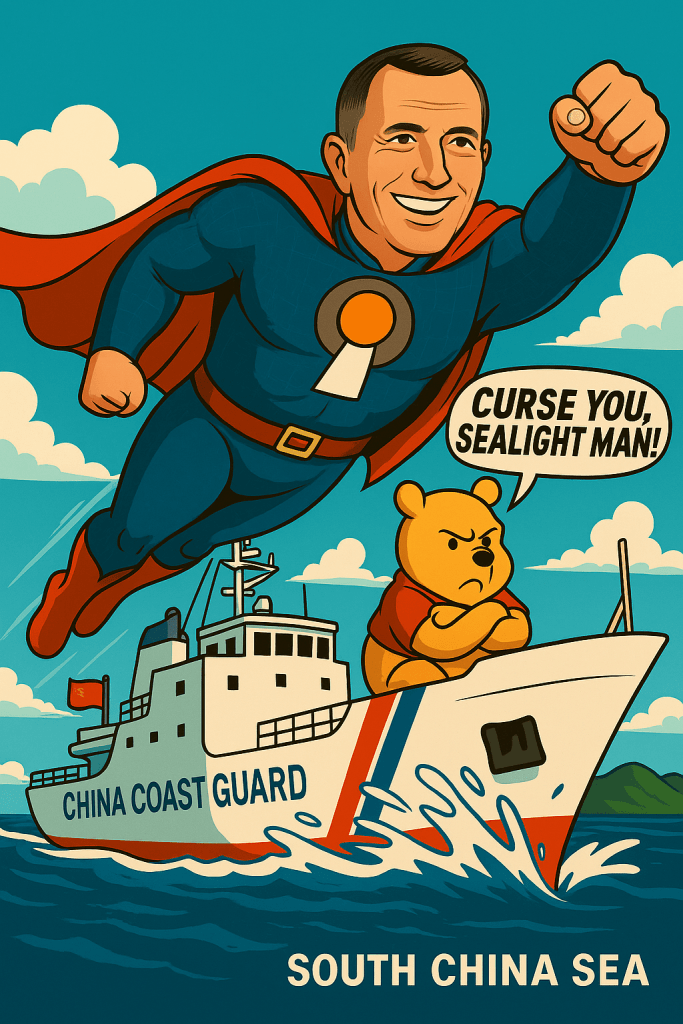
Capes, Cameras, and the Cult of Visibility: The SeaLight Crusade as White Savior Theater
By Tina Antonis
The South China Sea is more than a maritime dispute—it’s a theater of narrative warfare. While headlines focus on Chinese aggression and Philippine resistance, a quieter campaign unfolds in the background: one of satellite feeds, curated imagery, and Pentagon-backed storytelling. At the center of this effort is SeaLight, a project that claims to illuminate truth but often casts shadows of its own.
As explored in my article at Antiwar.com, SeaLight doesn’t just document—it performs. It reframes geopolitical tension through moral spectacle, positioning its creators as heroic arbiters of transparency. But when the messenger wears a cape and the funding flows from defense budgets, we must ask: is this clarity, or choreography?
Stage Left: The White Savior Enters
In the comic-strip cosmology of Ray Powell’s SeaLight project, transparency wears a cape. Clad in heroic postures and backed by satellite imagery, Powell casts himself as the guardian of maritime morality—unarmed, except with satellite feeds, theatrical flair, and strategic messaging.
Yet beneath the cartoon and Pentagon-funded optics lies a familiar archetype: the white savior, rebranded for the South China Sea.
China Is Imperialist? Says Who?
Calling China a “maritime occupier,” Powell positions himself as a bulwark against aggression. But that moral pose collapses under scrutiny. He speaks for a country with over 800 foreign military installations and a documented history of over 250 military interventions since 1991—wars in Iraq, Afghanistan, Libya, Syria, Somalia, and dozens more, all under the banner of peace, freedom, or preemption.
By comparison, China’s post–Cold War footprint includes no sustained foreign occupations and only scattered border conflicts and peacekeeping missions. The imbalance is staggering. And Powell’s framing doesn’t just ignore it—it performs around it.
As David Vine argues in The United States of War, this vast base empire is not a passive network—it’s an architecture of perpetual war. These outposts make military engagement not an exception but a structural habit, cloaked in strategic necessity and sold as global stewardship.
Powell’s cartoon rhetoric—calling China an occupier—obscures the scale of U.S. militarism. The term “occupation” is deployed not to analyze, but to project. When adversaries hold territory, it’s a crisis; when the U.S. spans the globe with armed installations, it’s policy.
Framing Conflict: The Optics of Consent
This isn’t irony. It’s performance. Powell’s language manufactures a moral frame for confrontation—costumed in transparency, but driven by escalation. The cape is literal. The conditioning is deliberate. And the stage is set for war.
SeaLight’s mission is not just visual documentation—it’s narrative warfare. As the Japan Times openly notes, its “chief weapon is photography, applied purposefully, generously and consistently over time.” These images—enhanced, curated, and distributed across media—are not neutral. They’re constructed to shape public perception, sway international opinion, and ultimately manufacture consent for confrontation.
Assertive transparency becomes a kind of ideological scaffolding—a stage on which geopolitical tension is dramatized, simplified, and morally polarized. The goal isn’t simply to reveal conflict; it’s to condition audiences for escalation.
And when the messenger dons a superhero’s cape, the spectacle transforms into something deeper: a story of rescue, of virtue, of intervention. This is not analysis—it’s soft propaganda dressed in heroic metaphor.
Consent for war doesn’t begin with missiles. It begins with mythmaking.
After briefly presenting his Victory Plan at the seat of Ukraine’s national sovereignty, the Verkhovna Rada, Volodymyr Zelensky has continued his tour to try to win the support of the people and institutions that really matter – his foreign partners. In Brussels, the Ukrainian president sought to curry favour with one of his main suppliers, the current support of the Ukrainian state, the European Union, whose Parliament once again welcomed him as a hero. “The last time you were here,” wrote Roberta Metsola, “I promised you our unwavering support on your country’s path to EU membership. Today I am proud to welcome you to the House of European Democracy as the leader of a candidate country for EU membership.” “Ukraine is Europe,” she said, deliberately confusing the continent with the political bloc. However, with EU entry long understood as a decision that has been made and that it is simply a matter of time, Zelensky’s speech did not focus on the benefits of the Union or the enormous benefit that will be obtained by admitting Ukraine into the European family, but on the continuation of his campaign to formalize the Victory Plan as a possible way out of the war. Kiev is acting in the same way that in the last decade it has managed to institutionalize the nationalist discourse, previously only characteristic of a part of the country, as the only possible national discourse. Ukraine is working to achieve the same objective and to make its plan – in reality a wish list that its allies must help it to fulfill and not a roadmap to achieve them – appear as a path to a just peace.
ASPI funding (Australia, Canada, Europe, Japan, United Kingdom, United States, Netherlands, New Zealand, Amazon, Microsoft, Twitter, Facebook, Google, Boeing, Lockheed Martin, Northrop Grumman, Raytheon, Thales Australia, American Chamber of Commerce, Center for Strategic and International Studies, German Marshall Fund, Carnegie Endowment for International Peace)
The UN General Assembly will soon be presented with a draft resolution declaring July 11 the “International Day of Remembrance for the victims of the Srebrenica genocide,” referring to events that allegedly took place in 1995.

 Ms. Cat’s Chronicles
You must be logged in to post a comment.