Prescribing the American Dream

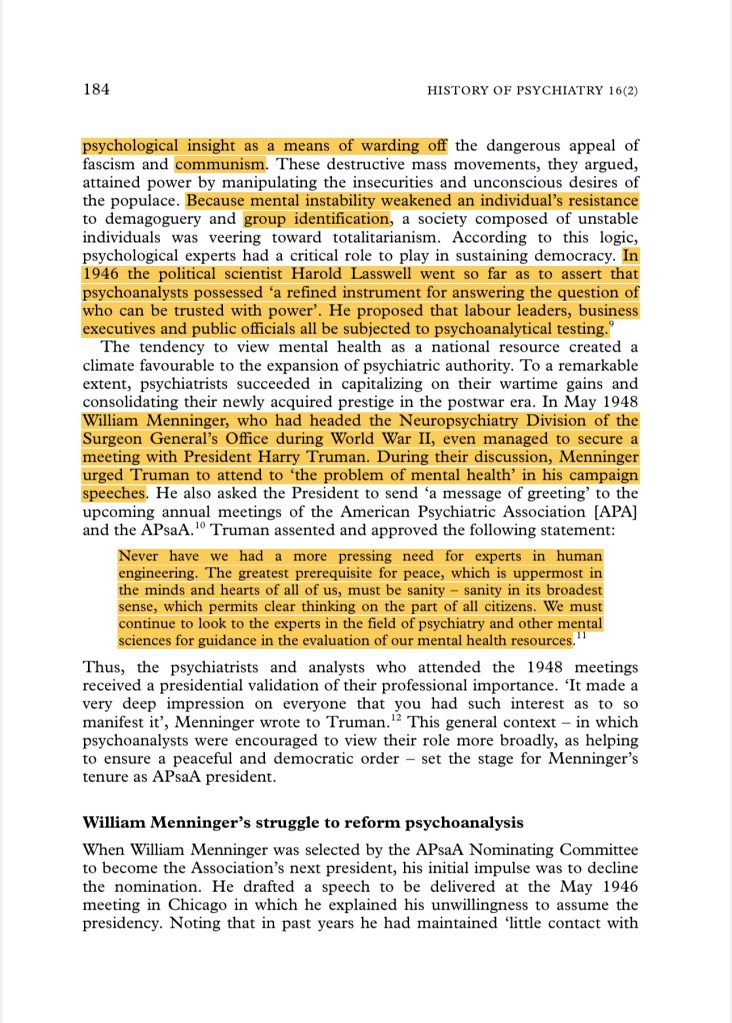
This is from something that I’ve been working on regarding Freudian psychology and social conditioning. Unfortunately, one of the author’s sources is Hannah Arendt’s Origins of Totalitarianism, which falsely equates Communism with Nazism. To be honest, I haven’t found any “perfect” sources for my project. Even Michael Parenti’s Against Psychopolitics quotes problematic sources (Harold Lasswell was involved with the RAND Corporation). While Karl Korsch had worked for the University of Frankfurt Institute for Social Research, which was home to the CIA front Frankfurt School, I like the above quote. I’ll probably end up using a different one when it’s all said and done, though.

Prescribing the American Dream: Psychoanalysts, Mass Media, and the Construction of Social and Political Norms in the 1950’s

Read More »

How Henry R. Luce and Clare Boothe Luce helped turn America on to LSD + Some Notes

The Time and Life Acid Trip: How Henry R. Luce and Clare Boothe Luce helped turn America on to LSD. (archived)

I accidentally came across this when I was looking into Henry Luce, some more. It doesn’t mention Luce’s ties to the CIA, i.e. Operation Mockingbird. The notes are from another project that I’ve been slowly working on. That one I won’t be publicizing until I’m finished with it.

Related & Notes:

Stephen Siff: Henry Luce’s Strange Trip: Coverage of LSD in Time and Life, 1954-68

Read More »

Gender and Psychiatry: Pathologized Emotions

As Phyllis Chesler warned us in 1974, gender bias has accompanied psychiatric power throughout its history. Years later, in 2005, in the last annotated edition of Women and Madness , the author insisted on the persistence of this bias, which even today, 50 years later, seems to remain unchanged. Authors such as Ussher, Caplan, Margot Pujal and many others were situated in that same space. With their differences and nuances, they all converge on the same point: gender problems and discomforts produce deep suffering. This suffering leaves marks on our bodies and our behavior.

Gender and Psychiatry: Pathologized Emotions

A brief, weird history of brainwashing

On an early spring day in 1959, Edward Hunter testified before a US Senate subcommittee investigating “the effect of Red China Communes on the United States.” It was the kind of opportunity he relished. A war correspondent who had spent considerable time in Asia, Hunter had achieved brief media stardom in 1951 after his book Brain-Washing in Red China introduced a new concept to the American public: a supposedly scientific system for changing people’s minds, even making them love things they once hated.

But Hunter wasn’t just a reporter, objectively chronicling conditions in China. As he told the assembled senators, he was also an anticommunist activist who served as a propagandist for the OSS, or Office of Strategic Services — something that was considered normal and patriotic at the time. His reporting blurred the line between fact and political mythology.

A brief, weird history of brainwashing

Related:

Read More »

Marxism and Psychological Science

1.1. The General Bases of Marxist Psychology

The teachings of Karl Marx caused a revolution in social sciences: in philosophy, in political economy, in the theory of socialism. As is known, psychology remained isolated from the influence of Marxism for many years. Marxism was not admitted into the official centers of scientific psychology, and the name of Karl Marx remained almost unmentioned in the works of psychologists for more than 50 years after the publication of his basic work.

Marxism and Psychological Science

Related:

Activity and Consciousness (PDF)

Be Careful What You Say

How honesty leads to the trauma of unnecessary psychiatric hospitalization

Picture a soul in turmoil, wrapped in the suffocating embrace of despair. In the sanctuary of a therapist’s office, they finally find the courage to voice the unspeakable: 

“Sometimes, I think about not being here anymore.” 

The words hang heavy in the air, a testament to the crushing weight of their pain, loneliness, and emptiness. This confession, born from a place of vulnerability and trust, should be the beginning of a deeper healing journey.

During these intense emotional struggles, it’s important to understand that thoughts of escape, including suicide, are a common human response to overwhelming pain. There’s a vast chasm between contemplating an end to suffering and actively planning to end one’s life.

Be Careful What You Say