
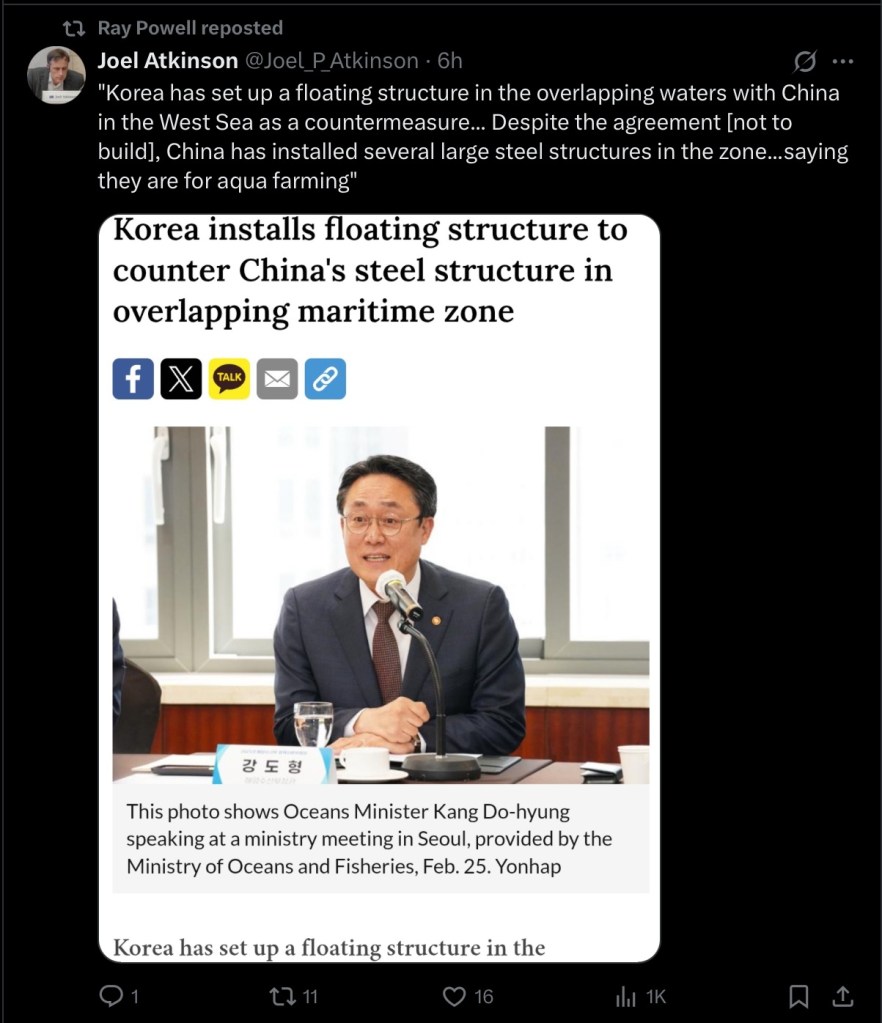
South Korea installs platform to monitor Chinese presence in disputed sea
Read More »South Korea installs platform to monitor Chinese presence in disputed sea
Read More »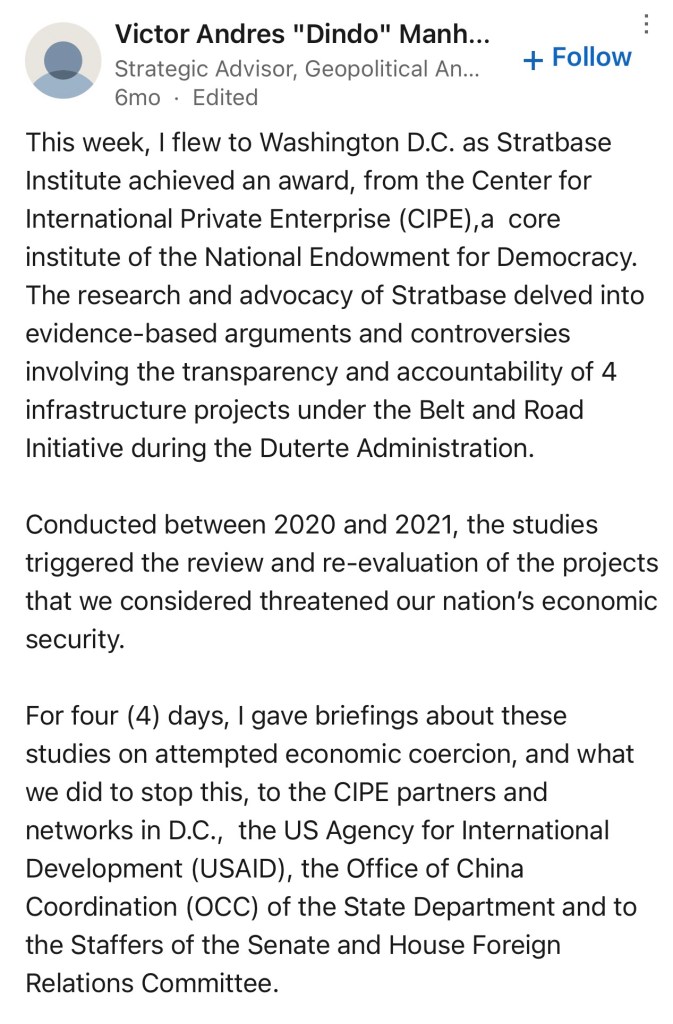

07-31-2024: If it’s bad business, it’s bad for the Philippines (archived)
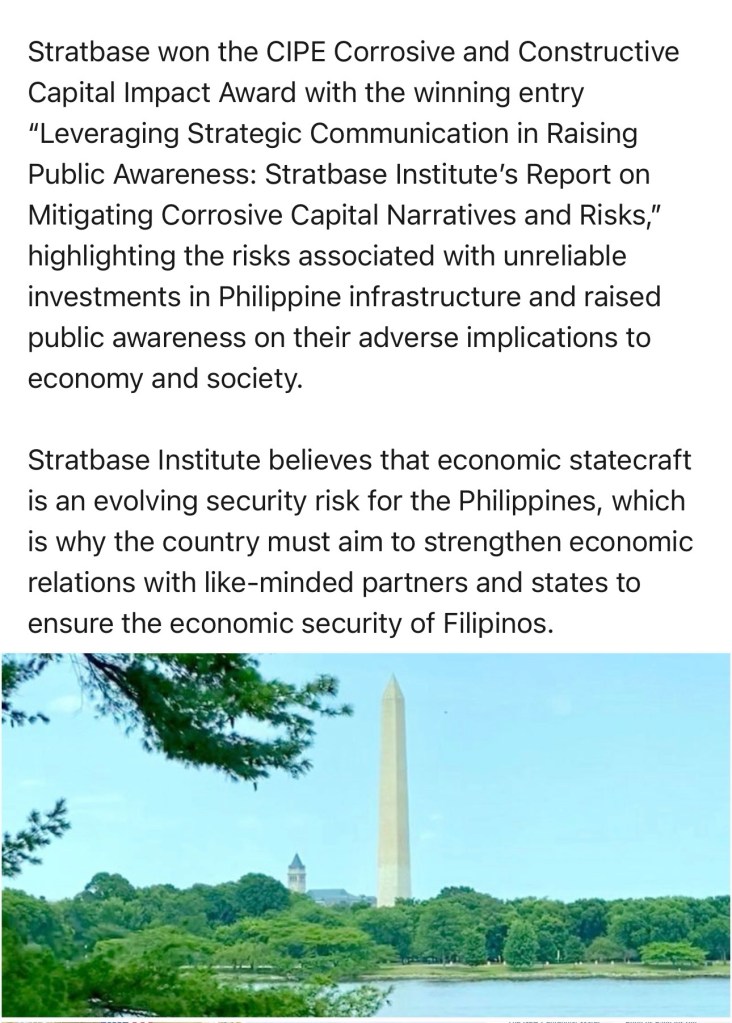
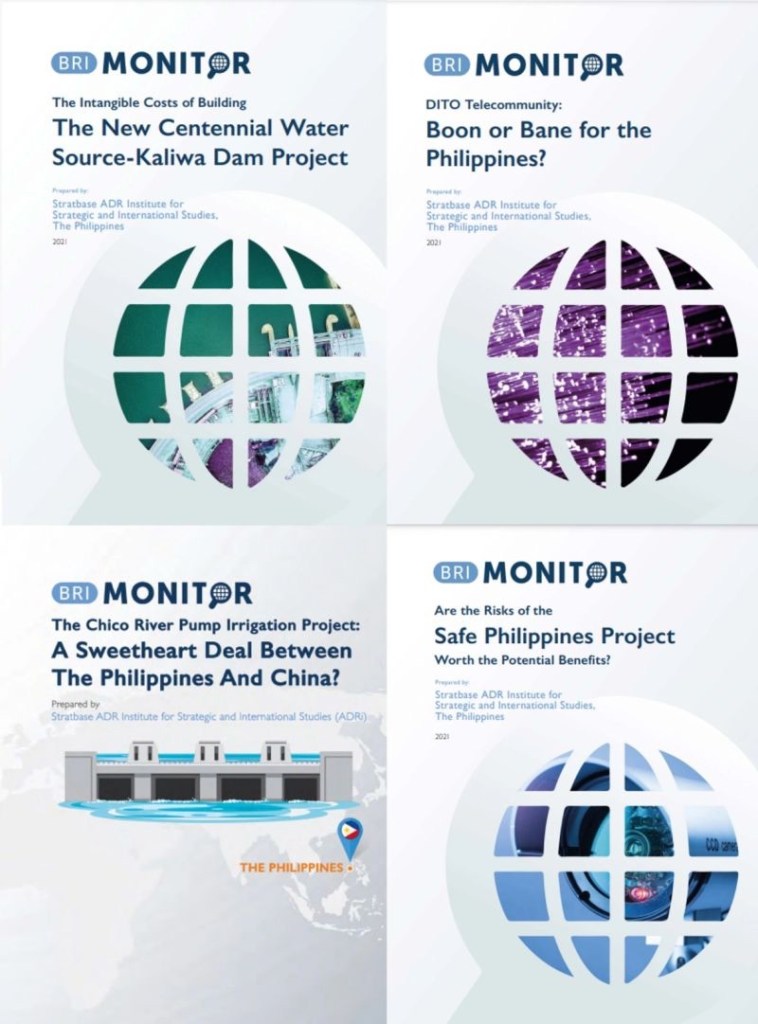
Our organization, the Stratbase ADR Institute, received an award from the prestigious Center for International Private Enterprise (CIPE), one of the four core institutes of the National Endowment for Democracy in Washington, DC. We were recognized for our research, advocacy, and strategic communication on four infrastructure projects entered into by the Philippines, during the administration of former President Rodrigo Duterte, under the Belt and Road Initiative of China.
…
The Philippines has currently withdrawn from the Belt and Road Initiative and the current administration has been careful to consider other partners aside from China.
…
Victor Andres “Dindo” C. Manhit is the president of the Stratbase ADR Institute.
Just like the National Endowment for Democracy, CIPE has been scrubbing their website. Search for the Philippines and click on the results. Most of the links are missing.
Related:
Read More »Israel’s foreign minister is looking for a way to spend $150 million on hasbara
Sa’ar insisted on the major budget increase when he and his United Right Party joined the governing coalition last month and he became foreign minister. At the time, Sa’ar said the budget will go towards “media campaigns abroad, in the foreign press, on social media, and more,” including “concentrated activity on U.S. campuses to change their attitude towards Israel and its policies.”
Read More »
A spook’s guide to the psychology of deception (archived)
Related:
How Covert Agents Infiltrate the Internet to Manipulate, Deceive, and Destroy Reputations
The Art of Deception: Training for Online Covert Operations
Military Report: Secretly ‘Recruit or Hire Bloggers’
CENTCOM Team Engages ‘Bloggers’
That commenter on your blog may actually be working for the Israeli government

Understanding and Countering China’s Maritime Gray Zone Operations | RAND
As noted, there appear to be real challenges working through the necessary technologies to support command messaging efforts from being able to acquire simple programs, such as Adobe [1], that can help improve image quality of released content to access to social media. It would seem prudent that an assessment of such issues should be conducted by the command with necessary remediation actions undertaken when the new commander comes into USINDOPACOM.
…
The Global Engagement Center (GEC) at the U.S. Department of State [2], for example, partially funds the Asia Maritime Transparency Initiative [Center for Strategic and International Studies]. The GEC, the State Department, or DoD should seek to identify other voices that can support and that can more credibly communicate key messages.
Read More »

A Caricature of Marxism and Imperialist Economism: Monism And Dualism
Slowly, but surely, I’m going through both of the following RAND publications. I just recently noticed that “Understanding and Countering China’s Maritime Gray Zone Operations” was posted over at SeaLight on the 12th of December. Ray Powell, from SeaLight, is quoted at least 14 times in the first publication. So far, I’ve seen RAND “recommend” the same tactics as they’ve deployed in the Philippines; civilian society organizations, embedded journalism, information warfare, influencers, and online trolls.
I’ve always known that they would try to expand their information operation to the other countries that are in ASEAN, just by following the SeaLight podcast. If not their information operation, regime change and terrorism (in Balochistan and Myanmar). I’ve also noticed that Powell has been referring to the Philippines’ “transparency initiative” as “non-violent resistance,” lately (RAND refers to it as “assertive transparency”). Ironic, considering that they’ve already succeeded in overthrowing the government of Bangladesh and are now attempting it in Cambodia, India and Pakistan. For those who don’t know about the regime change asset Gene Sharp and his neoliberal “nonviolence,” see the links on this page. Unfortunately, I don’t have as much time to dedicate to this right now due to other obligations.
Understanding and Countering China’s Maritime Gray Zone Operations | RAND
RAND and SeaLight document (work in progress)
Part 3a: RAND and SeaLight – Taiwan Relations Act
RAND and SeaLight Part 3b: Four Ways China Is Growing Its Media Influence in Southeast Asia
Philippine President Ferdinand Marcos Jr. said his nation won’t deploy Navy warships to the South China Sea in response to recent clashes with Beijing in disputed waters.
Marcos Says Philippines Won’t Send Warships After China Clashes
Previously:
Philippines to match China’s gray zone tactics in South China Sea
What’s Really Going On In the South China Sea Between the Philippines and China
How I Learned to Stop Worrying and Love 5GW
We type these words travelling through the Swiss Alps on high-speed rail. As the world becomes smaller, we at The Radio Research Group have witnessed firsthand how nearly everything we knew about modern conflict is changing, under the shadow of Fifth Generation Warfare. The incredible, exponential, accelerating pace of technology has overturned centuries of standard operating procedure. Diplomats and military leaders alike have been thrust into uncharted domains, disrupted by an invisible enemy that makes us question our reality.
Related:
5GW: 2012 NDAA – Propaganda – MISO – InfoOps – PsyOps
Cambridge Analytica and the Right-Wing Populist Movements
What’s Really Going On In the South China Sea Between the Philippines and China
by Tina Antonis
Maritime clashes between the Philippines and China had been mostly over the Philippines’ military outpost, BRP (BRP—Barko ng Republika ng Pilipinas, which translates to “Ship of the Republic of the Philippines”—the ship prefix for the Philippines) Sierra Madre, in the Spratly Islands, which is disputed by Brunei, China, Malaysia, the Philippines, Taiwan (a province of China, as recognized by the United Nations’ Resolution No. 2758), and Vietnam. The BRP Sierra Madre was intentionally run aground on a reef near the Second Thomas Shoal in the disputed Spratly Islands, in 1997, so that the Philippines could stake their territorial claim.
Read More » Ms. Cat’s Chronicles
You must be logged in to post a comment.