Capes, Cameras, and the Cult of Visibility

Capes, Cameras, and the Cult of Visibility: The SeaLight Crusade as White Savior Theater

By Tina Antonis

The South China Sea is more than a maritime dispute—it’s a theater of narrative warfare. While headlines focus on Chinese aggression and Philippine resistance, a quieter campaign unfolds in the background: one of satellite feeds, curated imagery, and Pentagon-backed storytelling. At the center of this effort is SeaLight, a project that claims to illuminate truth but often casts shadows of its own.

As explored in my article at Antiwar.com, SeaLight doesn’t just document—it performs. It reframes geopolitical tension through moral spectacle, positioning its creators as heroic arbiters of transparency. But when the messenger wears a cape and the funding flows from defense budgets, we must ask: is this clarity, or choreography?

Stage Left: The White Savior Enters

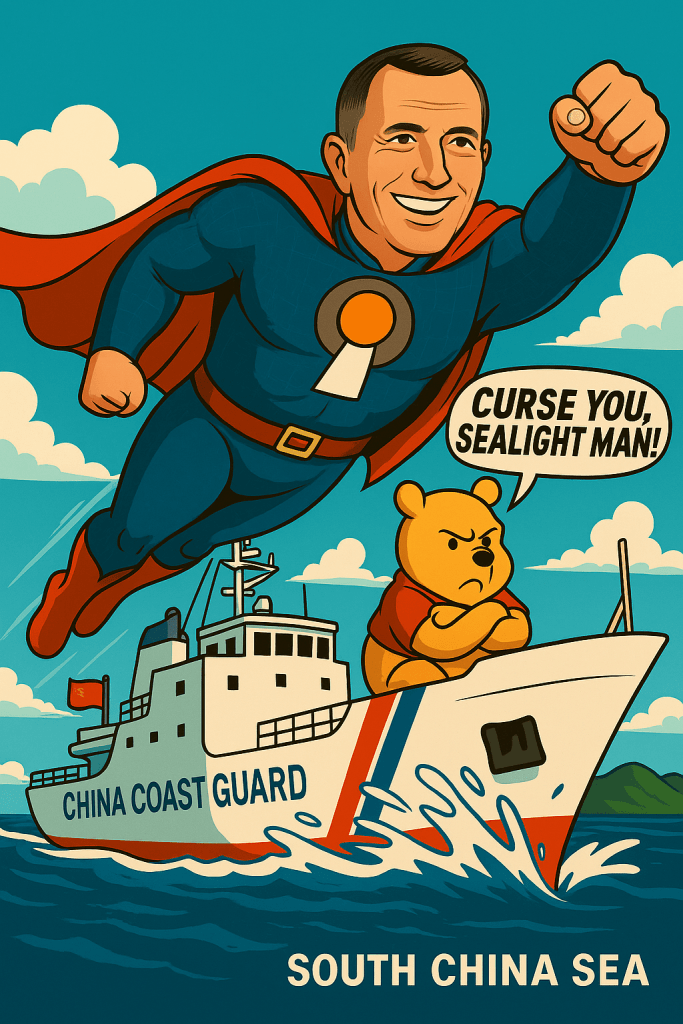
In the comic-strip cosmology of Ray Powell’s SeaLight project, transparency wears a cape. Clad in heroic postures and backed by satellite imagery, Powell casts himself as the guardian of maritime morality—unarmed, except with satellite feeds, theatrical flair, and strategic messaging. 

Yet beneath the cartoon and Pentagon-funded optics lies a familiar archetype: the white savior, rebranded for the South China Sea.

China Is Imperialist? Says Who?

Calling China a “maritime occupier,” Powell positions himself as a bulwark against aggression. But that moral pose collapses under scrutiny. He speaks for a country with over 800 foreign military installations and a documented history of over 250 military interventions since 1991—wars in Iraq, Afghanistan, Libya, Syria, Somalia, and dozens more, all under the banner of peace, freedom, or preemption.

By comparison, China’s post–Cold War footprint includes no sustained foreign occupations and only scattered border conflicts and peacekeeping missions. The imbalance is staggering. And Powell’s framing doesn’t just ignore it—it performs around it.

As David Vine argues in The United States of War, this vast base empire is not a passive network—it’s an architecture of perpetual war. These outposts make military engagement not an exception but a structural habit, cloaked in strategic necessity and sold as global stewardship.

Powell’s cartoon rhetoric—calling China an occupier—obscures the scale of U.S. militarism. The term “occupation” is deployed not to analyze, but to project. When adversaries hold territory, it’s a crisis; when the U.S. spans the globe with armed installations, it’s policy.

Framing Conflict: The Optics of Consent

This isn’t irony. It’s performance. Powell’s language manufactures a moral frame for confrontation—costumed in transparency, but driven by escalation. The cape is literal. The conditioning is deliberate. And the stage is set for war.

SeaLight’s mission is not just visual documentation—it’s narrative warfare. As the Japan Times openly notes, its “chief weapon is photography, applied purposefully, generously and consistently over time.” These images—enhanced, curated, and distributed across media—are not neutral. They’re constructed to shape public perception, sway international opinion, and ultimately manufacture consent for confrontation.

Assertive transparency becomes a kind of ideological scaffolding—a stage on which geopolitical tension is dramatized, simplified, and morally polarized. The goal isn’t simply to reveal conflict; it’s to condition audiences for escalation.

And when the messenger dons a superhero’s cape, the spectacle transforms into something deeper: a story of rescue, of virtue, of intervention. This is not analysis—it’s soft propaganda dressed in heroic metaphor.

Consent for war doesn’t begin with missiles. It begins with mythmaking.

Palantir Goes to the Frankfurt School

Since the election of Donald Trump, a growing body of research has examined the role of digital technologies in new right wing movements (Lewis 2018; Hawley 2017; Neiwert 2017; Nagle 2017). This article will explore a distinct, but related, subject: new right wing tendencies within the tech industry itself. Our point of entry will be an improbable document: a German language dissertation submitted by an American to the faculty of social sciences at J. W. Goethe University of Frankfurt in 2002. Entitled Aggression in the Life-World, the dissertation aims to describe the role that aggression plays in social integration, or the set of processes that lead individuals in a given society to feel bound to one another. To that end, it offers a “systematic” reinterpretation of Theodor Adorno’s Jargon of Authenticity (1973). It is of interest primarily because of its author: Alexander C. Karp.

Moira Weigel — Palantir Goes to the Frankfurt School

Related:

Read More »

Bangladesh’s Constitution reform: Sweeping changes in the constitution

Source

Constitution reform: Sweeping changes in constitution

Expanding the fundamental rights to include food, clothing, shelter, education, internet, and vote, the Constitution Reform Commission proposes replacing nationalism, socialism, and secularism with equality, human dignity, social justice and pluralism as fundamental principles of state policy.

Modifying, the much discussed article 70, the commission recommends that parliamentarians be allowed to vote against party line except finance bills.

The constitution commission recommends deletion of the constitutional provision that stipulates inclusion of Bangabandhu Sheikh Mujibur Rahman’s speech of March 7, 1971, his declaration of independence and the proclamation of independence, which are included in the 5th, 6th and 7th schedules respectively.

FYI, it was written by International IDEA, which is funded by USAID, Open Society Foundations, and several Western governments.

Related:

Leaked files expose covert US government plot to ‘destabilize Bangladesh’s politics’

Atlantic Council’s Ali Riaz to lead commission on constitutional reforms for Bangladesh

Bangladesh and Kenya document

PH: Stratbase, CIPE (NED), and the Belt and Road Initiative

07-31-2024: If it’s bad business, it’s bad for the Philippines (archived)

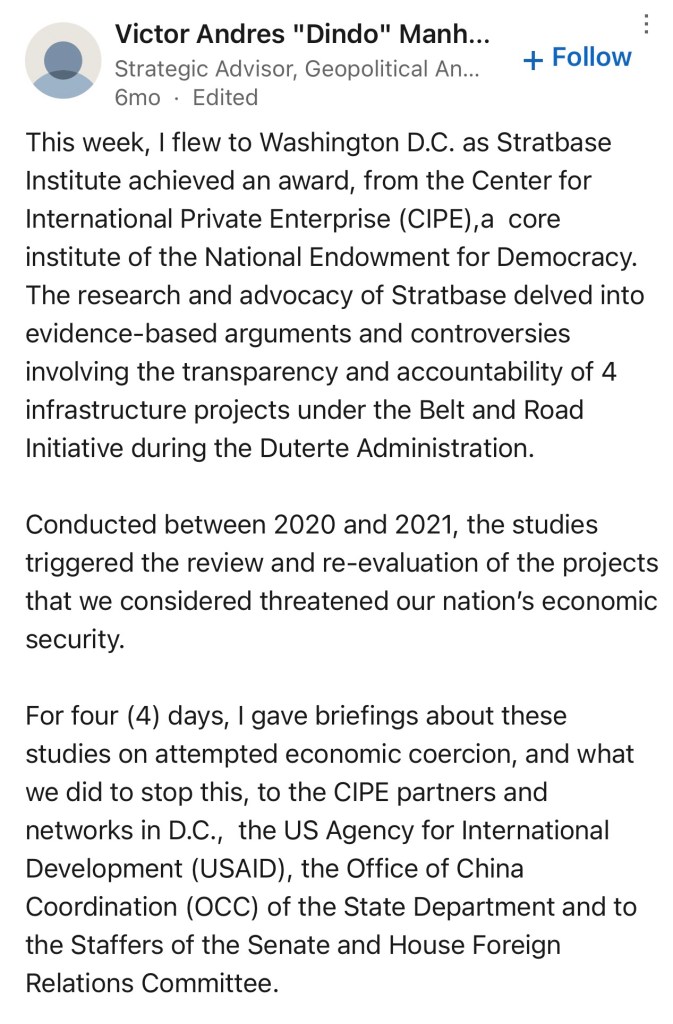
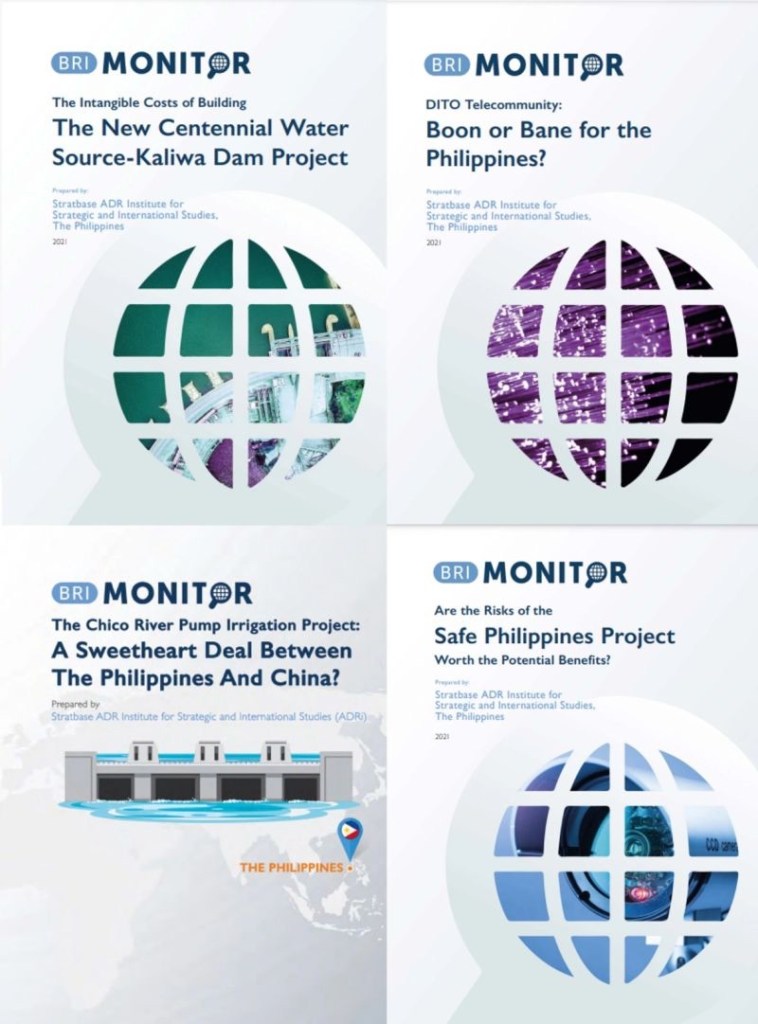
Our organization, the Stratbase ADR Institute, received an award from the prestigious Center for International Private Enterprise (CIPE), one of the four core institutes of the National Endowment for Democracy in Washington, DC. We were recognized for our research, advocacy, and strategic communication on four infrastructure projects entered into by the Philippines, during the administration of former President Rodrigo Duterte, under the Belt and Road Initiative of China.

The Philippines has currently withdrawn from the Belt and Road Initiative and the current administration has been careful to consider other partners aside from China.

Victor Andres “Dindo” C. Manhit is the president of the Stratbase ADR Institute.

Just like the National Endowment for Democracy, CIPE has been scrubbing their website. Search for the Philippines and click on the results. Most of the links are missing.

Related:

Read More »

RAND and SeaLight Part 3b: Four Ways China Is Growing Its Media Influence in Southeast Asia

05-10-2022: Four Ways China Is Growing Its Media Influence in Southeast Asia

China’s most straightforward method of media outreach is directly broadcasting or publishing its state media content in target ASEAN countries. Xinhua, China’s official state media agency, has print bureaus in every Southeast Asian country. TV news channels CCTV-4 and the English-language CGTN likewise operate in nearly every country in the region, while China Radio International airs multilingual content in Vietnam, Laos, Cambodia, Thailand, and Myanmar. Xinhua is a ministry-level agency directly under the State Council, while the other media organizations all operate under the Chinese Communist Party Publicity Department. 

Read More »

Israel’s foreign minister is looking for a way to spend $150 million on hasbara

Israel’s foreign minister is looking for a way to spend $150 million on hasbara

Sa’ar insisted on the major budget increase when he and his United Right Party joined the governing coalition last month and he became foreign minister. At the time, Sa’ar said the budget will go towards “media campaigns abroad, in the foreign press, on social media, and more,” including “concentrated activity on U.S. campuses to change their attitude towards Israel and its policies.”

Read More »