
Senior Col. Wu Qian, a spokesman for China’s Ministry of National Defense, accused the Philippines of causing disturbances in various areas with the support and encouragement of the United States.
“From Ren’ai Jiao (Ayungin Shoal) to Xianbin Jiao (Sabina Shoal) and from Houteng Jiao to Huangyan Dao (Scarborough Shoal), such repeated provocations have allowed the international community to see clearly who is undermining peace and stability in the South China Sea and who is fabricating and spreading lies,” Wu said.
Read More »
Tag: Ray Powell
The marriage of RAND and SeaLight

A Caricature of Marxism and Imperialist Economism: Monism And Dualism
Slowly, but surely, I’m going through both of the following RAND publications. I just recently noticed that “Understanding and Countering China’s Maritime Gray Zone Operations” was posted over at SeaLight on the 12th of December. Ray Powell, from SeaLight, is quoted at least 14 times in the first publication. So far, I’ve seen RAND “recommend” the same tactics as they’ve deployed in the Philippines; civilian society organizations, embedded journalism, information warfare, influencers, and online trolls.
I’ve always known that they would try to expand their information operation to the other countries that are in ASEAN, just by following the SeaLight podcast. If not their information operation, regime change and terrorism (in Balochistan and Myanmar). I’ve also noticed that Powell has been referring to the Philippines’ “transparency initiative” as “non-violent resistance,” lately (RAND refers to it as “assertive transparency”). Ironic, considering that they’ve already succeeded in overthrowing the government of Bangladesh and are now attempting it in Cambodia, India and Pakistan. For those who don’t know about the regime change asset Gene Sharp and his neoliberal “nonviolence,” see the links on this page. Unfortunately, I don’t have as much time to dedicate to this right now due to other obligations.
Understanding and Countering China’s Maritime Gray Zone Operations | RAND
RAND and SeaLight document (work in progress)
Part 3a: RAND and SeaLight – Taiwan Relations Act
RAND and SeaLight Part 3b: Four Ways China Is Growing Its Media Influence in Southeast Asia
Philippine laws up tension on South China Sea
New laws specifying Manila’s claims have also angered smaller countries such as Malaysia, which could hamper unified resistance to China’s attempts at regional dominance.
Related:
What’s Really Going On In the South China Sea Between the Philippines and China
Read More »What’s Really Going On In the South China Sea Between the Philippines and China
What’s Really Going On In the South China Sea Between the Philippines and China
by Tina Antonis
Maritime clashes between the Philippines and China had been mostly over the Philippines’ military outpost, BRP (BRP—Barko ng Republika ng Pilipinas, which translates to “Ship of the Republic of the Philippines”—the ship prefix for the Philippines) Sierra Madre, in the Spratly Islands, which is disputed by Brunei, China, Malaysia, the Philippines, Taiwan (a province of China, as recognized by the United Nations’ Resolution No. 2758), and Vietnam. The BRP Sierra Madre was intentionally run aground on a reef near the Second Thomas Shoal in the disputed Spratly Islands, in 1997, so that the Philippines could stake their territorial claim.
Read More »South China Sea: US troop aid may reassure Philippines but will prod China, analysts say
Has anyone realized that by disclosing the existence of “US Task Force Ayungin,” Biden admin implicitly recognized Philippines’ sovereignty over a disputed SCS feature?
Washington has never taken a position on SCS territories(but it has in ECS). This is a clear signal to China.*
South China Sea: US troop aid may reassure Philippines but will prod China, analysts say (archived)
The Philippines has said the US task force only offered support – in the form of intelligence and surveillance – and did not directly take part in its resupply missions to BRP Sierra Madre, the retired warship, but analysts suggested that China’s leadership could see it in a different light.
…
Zheng said the revelation about the American task force meant the US was likely to be more engaged in the drawn-out maritime conflicts in the region, even suggesting that Washington would “be the first to take part in the command and planning of Philippine maritime activities”.
…
Ding Duo, deputy director of the Centre for Oceans Law and Policy at the National Institute for South China Sea Studies in Hainan, said the presence of a special task force showed that Washington and Manila had long cooperated on resupply operations to Second Thomas Shoal.
…
“Such support emboldens the Philippines and is not conducive to China and the Philippines managing their differences,” Ding said. “The US involvement has also squeezed the political space for internal coordination and decision-making within the Philippines.”
…
He said it was also possible that American troops could be on Philippine ships and involved in front-line action “using a covert or concealed identity to participate in Philippine maritime operations” in future.
He said the US could “only intervene [in South China Sea disputes] in a covert manner and so it took the form of a task force”.
Related:
Read More »It’s officially published!

Read it at Antiwar.com or here with graphics. FYI, the “Ant” in Antonis is pronounced as 🐜.
Philippine military drills to seize an island in the South China Sea
The Philippine military opened two weeks of combat drills Monday that would include seizing an island in the disputed South China Sea and likely be frowned upon by China.
Philippine military drills to seize an island in the South China Sea
Previously:
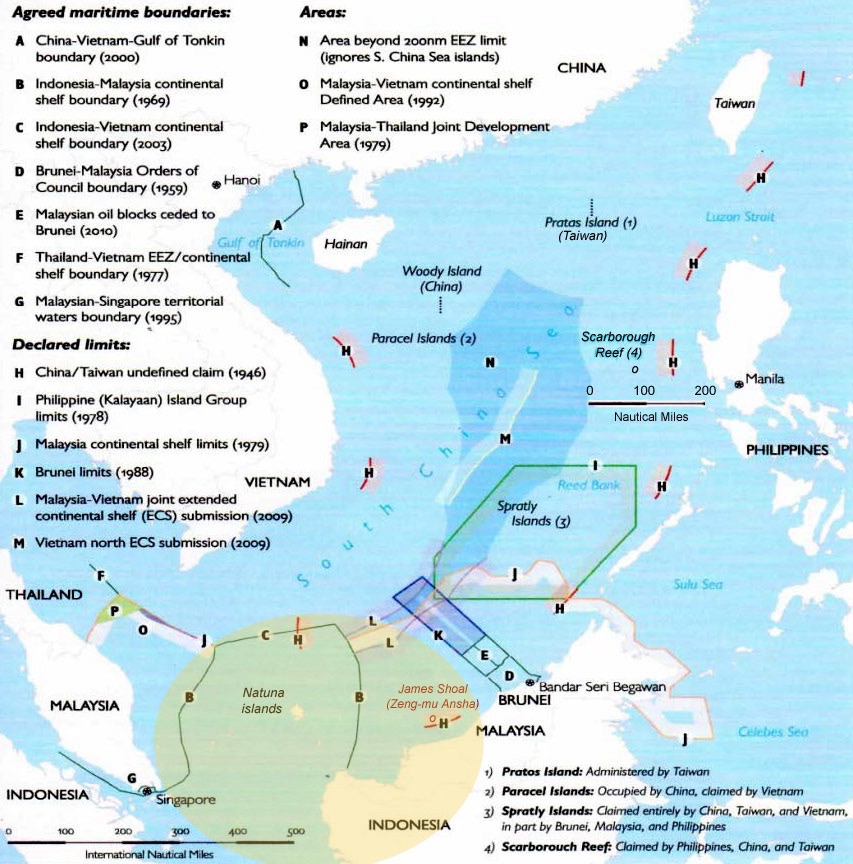
China looks to Indonesia for diplomatic resolution after coastguards’ Natuna encounters + More
China looks to Indonesia for diplomatic resolution after coastguards’ Natuna encounters + More
China looks to Indonesia for diplomatic resolution after coastguards’ Natuna encounters
Related:
[10-23-2024] Indonesian Coast Guard “Drives Out” Chinese Vessel Shadowing Seismic Ship (archived)
Read More »On Monday, Indonesia’s coast guard “drove out” a China Coast Guard cutter that was shadowing a survey vessel in Indonesian waters of the South China Sea. On Tuesday, the Chinese vessel was back again in the same spot, according to maritime security expert Ray Powell.
…
Geo Coral is a Norwegian-owned geophysical vessel flagged in Norway. She is operating under charter to PT Pertamina, Indonesia’s state-owned oil company, to conduct a 3D seismic survey off the Natuna Islands. “Pertamina East Natuna is focusing on oil and gas exploration activities in the East Natuna Working Area [East Natuna gas field], which has great potential to contribute to national energy security,” said a Pertamina spokesman on Tuesday.
Powell’s hit piece on “Media Unlocked”
Unlocking China’s “Media Unlocked” Propagandists
Recently, Media Unlocked unveiled its latest triumph–an interview with a former U.S. president’s brother, Neil Bush, whose George H.W. Bush Foundation For U.S.-China Relations has allegedly received millions of dollars from a group associated with CCP influence operations. Bush–apparently unconcerned that he was participating in Beijing’s propaganda campaign–helpfully sang the praise of China’s communist system, its electric vehicle industry and, incredibly, even announced that he was observing a “massive freedom movement” in today’s China.
Propagandists? Und das bist du nicht?
Now, let’s get into who’s funding the George H.W. Bush Foundation For U.S.-China Relations. Powell links to a Fox News article about its funding from the China–United States Exchange Foundation, based in Hong Kong. The Fox News article links to an Axios article (which is behind a paywall). Nowhere does Powell mention that the foundation also gets funding from the U.S. Department of State, The Rockefeller Foundation, etc.
Read More »Less politics more marine diplomacy – a fix for South China Sea?
Territorial wrangling over who owns the South China Sea has strangled local marine life, say scientists, urging China and the Philippines to set aside political differences and work to save the fish, coral and plants that live border-free.
…
Since 2013, China has built artificial islands that cover more than 3,000 acres of the Spratlys, according to U.S.-based policy organisation Asia Maritime Transparency Initiative.
…
A study last December by the Asia Maritime Transparency Initiative also blamed China’s dredging and clam harvesting for destroying almost 20,000 acres of reefs in the South China Sea.
Less politics more marine diplomacy – a fix for South China Sea?
The Asia Maritime Transparency Initiative (AMTI) is part of the Center for Strategic and International Studies (CSIS). Gregory Poling is director of the AMTI. The same Poling that told the U.S. government-funded Voice of America that “Vietnam’s use of cutter suction dredgers is much more environmentally destructive than its previous dredging methods.”
According to the CIA’s World Factbook, Vietnam occupies around 50 outposts, The Philippines occupies nine, Malaysia occupies five, and China occupies seven in the disputed Spratly Islands.
Previously:
Experts warn of Philippines scheming for ‘new arbitration’ on South China Sea + More
Vietnamese Poachers using Cyanide and Dynamite Fishing in the Philippines’ EEZ
Philippine Coast Guard clarifies ‘assertive transparency’ tact
 Ms. Cat’s Chronicles
You must be logged in to post a comment.