
As global attention focuses on China and Japan, Tokyo and Manila are quietly deepening their economic and “defense” ties.
Tag: Reciprocal Access Agreements
Pentagon Appointee Opposes ‘Belligerent Military Initiatives’ Aimed at China
The Pentagon official tasked with overseeing U.S. defense policy toward Southeast Asia recently advised against pursuing hawkish defense policies and a major trade war against China, a marked contrast with top Trump appointees.
John Andrew Byers, a longtime history professor who oversaw the Charles Koch philanthropic network’s grants promoting libertarian foreign policy stances at universities, was sworn in this week as the deputy assistant secretary of defense for South and Southeast Asia — a role that immediately thrusts him to the center of America’s response to China’s ongoing military pressure campaign targeting the Philippines, with which Washington holds a mutual defense treaty.
Pentagon Appointee Opposes ‘Belligerent Military Initiatives’ Aimed at China
Related:
Lowy Institute: Trump’s grand bargain? The Philippines caught between US and China by Richard Heydarian
CGS non-resident fellow Andrew Byers co-authors article with The American Conservative
Deputy Assistant Secretary of Defense for South and Southeast Asia: Andrew Byers
For Taiwan, Trump’s ‘protection’ money may mean new and early big ticket arms deals
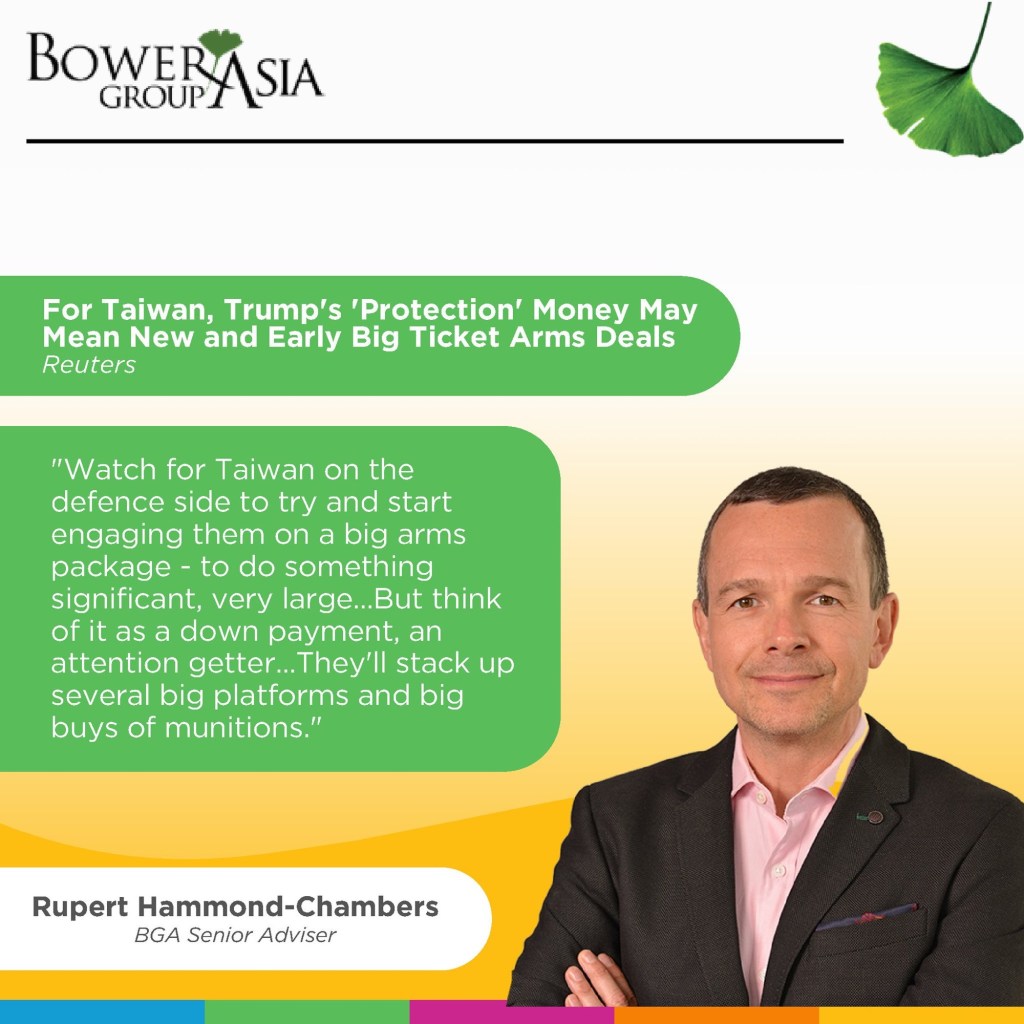
For Taiwan, Trump’s ‘protection’ money may mean new and early big ticket arms deals
“Watch for Taiwan on the defence side to try and start engaging them on a big arms package – to do something significant, very large,” Rupert Hammond-Chambers, president of the U.S.-Taiwan Business Council which helps broker defence exchanges between Washington and Taipei, told Reuters, adding it could come in the first quarter of next year.
“But think of it as a down payment, an attention getter,” he said. “They’ll stack up several big platforms and big buys of munitions.”
The U.S. is already Taiwan’s most important arms supplier, although Taiwan has complained of an order backlog worth some $20 billion. A new order, almost $2 billion of missile systems, was announced last month.
Related:
Profile at BowerGroupAsia: Rupert Hammond-Chambers
Japan’s Ground-Based Air Defense Options to the Philippines
Japan’s Ground-Based Air Defense Options to the Philippines
Bilateral defense relations between Japan and the Philippines come at an all-time high, signifying the continuous cooperation between both maritime nations that share a common adversary and similar situation regarding territorial domains and integrity in the Indo-Pacific region.
…
With the success of the export of the aforementioned radar systems to the Philippines from Japan, the latter is now raising up an idea of the likelihood of selling its surface-to-air missile batteries for the Philippine military to consider, with a wide variety of variants coming from the Japan Ground Self-Defense Force that might find its way for the likes of the Philippine Air Force. This is especially in line with the recently passed New Government Procurement Act or NGPA (Republic Act 12009), allowing the purchase of second-hand military hardware, provided it is economically preferable to the government.
SCS: The Office of Naval Research funded Stanford’s GKC
The Office of Naval Research is an organization within the US Department of Navy. Ray Powell’s Project Myoushu started at Stanford’s GKC. Funny how Powell’s information has disappeared from Stanford’s GKC. The internet never forgets, though!
Lighting Up the Gray Zone: The Philippines-Taiwan Counter-Coercion Toolkit
Perry World House’s Thomas Shattuck and Robin Garcia are out with an important new white paper which recommends the public release of visual information to counter China’s coercive activities, using the Philippines and Taiwan as examples. As the champions of “assertive transparency”, SeaLight enthusiastically welcomes this timely new scholarship!
Lighting Up the Gray Zone: The Philippines-Taiwan Counter-Coercion Toolkit
Perry World House is at the University of Pennsylvania, another university funded by the US government. I’ve updated my Project Myoushu document, to reflect the following:
The origin of Stanford University’s Gordian Knot Center for National Security Innovation. It’s sponsored by the Office of Naval Research, an organization within the Department of Navy. I saw it over at the Asian Century Journal, yesterday.
From a previous post.
Related:
Japan, U.S. and Philippines to discuss stronger military ties & US, Philippines to expand strategic port
Japan, U.S. and Philippines to discuss stronger military ties
The three foreign ministers will discuss ways to strengthen cooperation in the wake of increasing collisions in the South China Sea between ships from the Philippines and China.
…
They agreed to work toward signing a Reciprocal Access Agreement that would make it easier for members of the Self-Defense Forces and the Philippine military to engage in joint training exercises by simplifying procedures to obtain visas and bring weapons and ammunition into each other’s countries.
Japan will also provide funds for the Philippines to acquire a coastal surveillance radar system.
Related:
US, Philippines to expand strategic port
Read More »NATO to expand Asia-Pacific presence by opening office in Japan + What can China do about it?
Last week, news emerged that NATO intends to open a liaison office in Tokyo, Japan next year. The office would be NATO’s first in the Asia-Pacific region and represents the increasing role of the organisation in preparation for a US-led war against China. Both Tokyo and NATO have confirmed the plans.
NATO to expand Asia-Pacific presence by opening office in Japan
Related:
What can China do against NATO’s foray into Asia?
So what can China do to respond to this attempt at ‘alliance encirclement’ against it? First, it can strengthen its ties with Russia and aim to create a deeper balance of power in the Asia-Pacific. Secondly, it can revitalize old alliances and strengthen its ties with North Korea as a military partner. After all, the DPRK is still obligated by the 1961 treaty of mutual assistance to come to China’s aid in a war and can be used to contain Japan and South Korea. Thirdly, it can look to build new military partnerships with regional countries who feel similarly threatened by US expansionism; for example, Laos, Cambodia, and Myanmar. While the rest of ASEAN are likely to stay neutral, including Malaysia, Indonesia, Singapore, Thailand, and Vietnam (excluding the US-aligned Philippines), China should work to improve its relationships with these countries in order to prevent the US from trying to ‘force’ them to choose.
 Ms. Cat’s Chronicles
You must be logged in to post a comment.