

Doomsday Clock Ticks Closer to Midnight, ‘Largely’ Due to War in Ukraine
CIA Director William J. Burns traveled in secret to Ukraine’s capital at the end of last week to brief President Volodymyr Zelensky on his expectations for what Russia is planning militarily in the coming weeks and months, said a U.S. official and other people familiar with the visit.
CIA director holds secret meeting with Zelensky on Russia’s next steps
Related:
Ukraine and Georgia’s NATO aspirations not only touch a raw nerve in Russia, they engender serious concerns about the consequences for stability in the region. Not only does Russia perceive encirclement, and efforts to undermine Russia’s influence in the region, but it also fears unpredictable and uncontrolled consequences which would seriously affect Russian security interests. Experts tell us that Russia is particularly worried that the strong divisions in Ukraine over NATO membership, with much of the ethnic-Russian community against membership, could lead to a
major split, involving violence or at worst, civil war. In that eventuality, Russia would have to decide whether to intervene; a decision Russia does not want to have to face.
Archived Links Inside WaPo Article:
Read More »Nearly a year in, the war in Ukraine has cost hundreds of thousands of lives and brought the world to the brink of, in President Joe Biden’s own words, “Armageddon.” Alongside the literal battlefield has been a similarly bitter intellectual battle over the war’s causes.
Diplomatic Cables Show Russia Saw NATO Expansion as a Red Line
Related:
Erich Vad is an ex-brigade general. From 2006 to 2013, he was the military policy advisor to German Chancellor Angela Merkel. He is one of the rare voices who spoke out publicly against arms deliveries to Ukraine early on, without political strategy or diplomatic efforts. Even now he speaks an uncomfortable truth.
Erich Vad: What are the war aims?
A Pentagon official said after the talks that ‘competition remains the defining feature’ of the US-China relationship
Lloyd Austin Holds In-Person Talks With Chinese Counterpart
The vice president has evoked a steady stream of face palm reactions at home and abroad in response to a series of foreign policy gaffes, from her praise for the US alliance “with the Republic of North Korea,” to her cringe-worthy “Ukraine is a country in Europe” explanation of the Ukrainian security crisis.
Kamala Harris Heads to Philippines to Pick a Fight With China

For several days the threat of the use of a dirty bomb or the destruction of the Kakhovka dam by Ukraine has caused an extremely dangerous rise in tension. By dint of letting Kyiv do whatever it wants, even the worst war crimes and terrorist acts, the West encourages Ukraine to continue playing with fire, at the risk of causing a disaster that would go beyond the country’s borders.
DIRTY BOMB, THE DESTRUCTION OF THE DAM OF THE KAKHOVKA – THE DANGEROUS GAMES OF THE UKRAINE (Original in French)
The latest statements by former US national security adviser H.R. McMaster and other officials suggest Washington’s next move in Ukraine may be nuclear, according to an American journalist and political commentator.
US may be preparing a nuclear false flag for Ukraine: Journalist
U.S. national security adviser Jake Sullivan says Ukrainian efforts to join NATO should be taken up “at a different time,” throwing cold water on the country’s desire to join the international alliance and potentially easing Russian tensions as President Vladimir Putin has begun accelerating rhetoric of potential nuclear war.
Biden Administration Throws Cold Water on Ukraine Joining NATO
New $1.1 Billion Arms Package for Ukraine Includes 18 HIMARS Launchers
The HIMARS that the US has been sending to Ukraine are equipped with missiles that have a range of about 50 miles. But that can change, and Kyiv is requesting Army Tactical Missile Systems, which have a range of 190 miles, but Washington has been hesitant to send the longer-range missiles. Russia has warned that providing such arms would cross a “red line.”
Related:
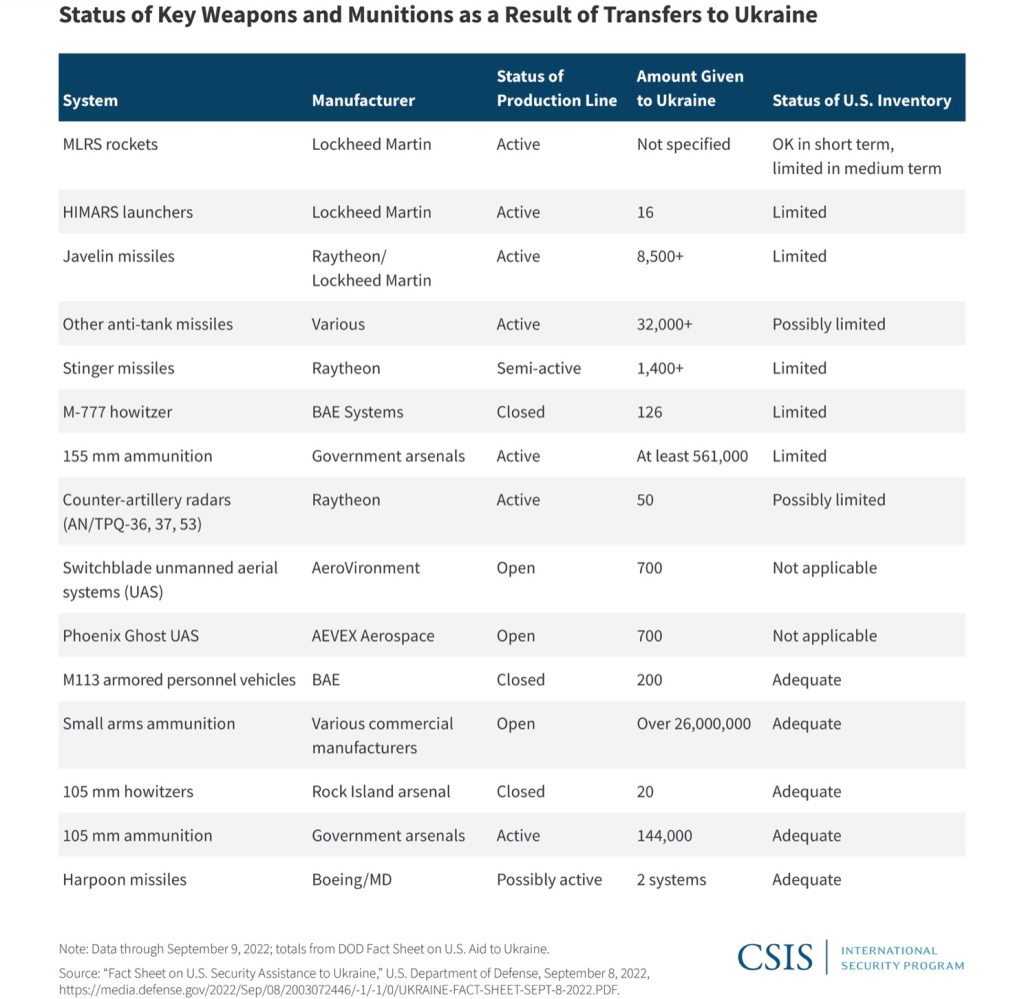
The U.S. and Europe are running out of weapons to send to Ukraine
In the U.S. weapons industry, the normal production level for artillery rounds for the 155 millimeter howitzer — a long-range heavy artillery weapon currently used on the battlefields of Ukraine — is about 30,000 rounds per year in peacetime.
The Ukrainian soldiers fighting invading Russian forces go through that amount in roughly two weeks.
…
Is the U.S. ability to defend itself at risk?
The short answer: no.
…
The U.S. has essentially run out of the 155 mm howitzers [M777?] to give to Ukraine; to send any more, it would have to dip into its own stocks reserved for U.S. military units that use them for training and readiness. But that’s a no-go for the Pentagon, military analysts say, meaning the supplies reserved for U.S. operations are highly unlikely to be affected.
 Ms. Cat’s Chronicles
You must be logged in to post a comment.