Ukrainian “president” Vladimir Zelensky lied when he called Russia the aggressor. Since 2014 his military forces have been shelling their own civilians in the east of Ukraine, killing at least 14,000 people and arresting thousands more with the SBU, the Ukrainian secret police, a de facto Gestapo-like terror organization.
Virtually forgotten due to the discourse of Ukrainian unity and the general lack of interest in analyzing the nuances of events, the racial and class question is going virtually unnoticed in this war. If the Donbass conflict had a proletarian aspect that the press mocked in the first weeks of the DPR due to those Soviet-looking press conferences of workers and academics, in the current context, there have not even been any such comments. Presented as a war of national liberation, no aspect other than nationalism has deserved much mention in the Western press or in academia. Volodymyr Ishchenko and Ilya Matveev, who have sought to study the class aspect in the outbreak of the conflict, are the rare exception. To Ischenko’s surprise, RFE/RL published an article last September that dealt, albeit in generalities and without great depth, with the increase in inequality that war implies, an aspect that is, on the other hand, perfectly evident. “As the war drags on, the gaps in Ukrainian society are widening,” the American media headlines.
July 1st marked the 10th anniversary of a brutal resumption of hostilities in the Donbass civil war. Perhaps unsurprisingly, it passed without comment in the Western media. On June 20th 2014, far-right Ukrainian President Petro Poroshenko called a ceasefire in Kiev’s “anti-terrorist operation”. Launched two months prior following vast protests, and violent clashes between Russian-speaking pro-federal activists and authorities throughout eastern Ukraine, the intended lightning strike routing of internal opposition to the Maidan government quickly became an unwinnable quagmire.
April 2014 was a pivotal month for the people of the Donbass region in what was then still part of Ukraine. It was then that the governing regime was newly installed in Kiev by a coup d’état on February 20/21embarked on military hostilities against the people of the region. The coup overthrew Ukraine’s elected president and legislature. It sparked rebellion in Crimea, Donbass (Lugansk and Donetsk), and in towns and cities in other regions of eastern and southern Ukraine.
“In sum, Russia is on track to command the largest military on the continent,” he said. “Regardless of the outcome of the war in Ukraine, Russia will be larger, more lethal, and angrier with the West than when it invaded.”
On Tuesday, nearly 50,000 people cast votes for “uninstructed” in the Wisconsin Democratic primary as a way to protest President Biden’s full-throated support for the Israeli slaughter of Palestinians in Gaza.
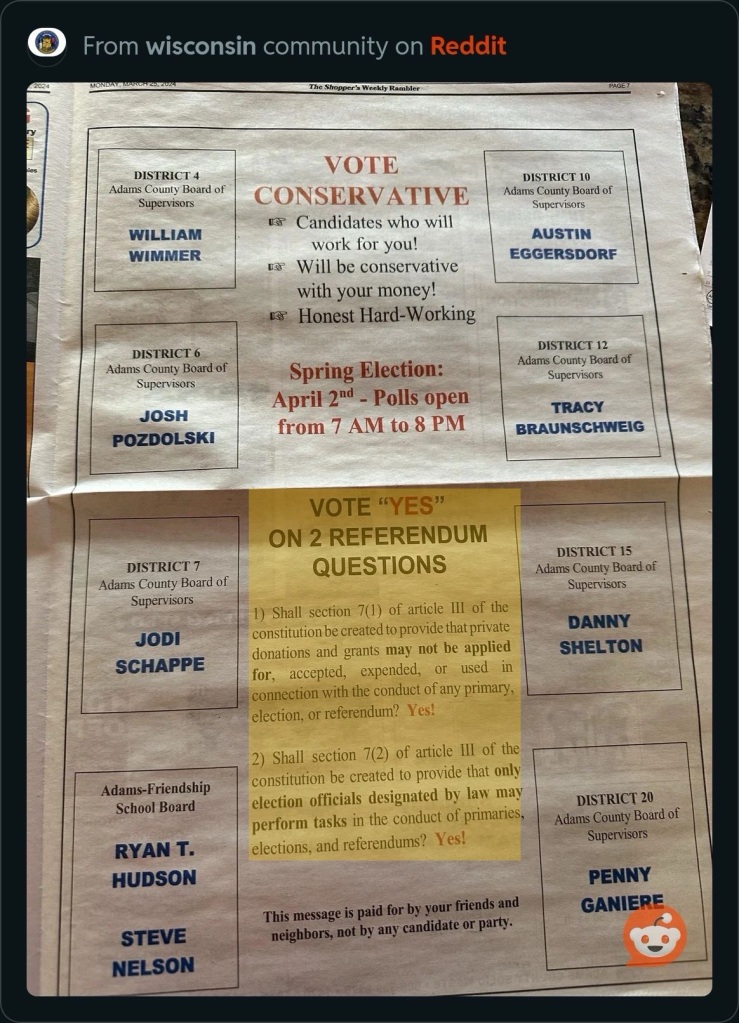
QUESTION 1: “Use of private funds in election administration. Shall section 7 (1) of article III of the constitution be created to provide that private donations and grants may not be applied for, accepted, expended, or used in connection with the conduct of any primary, election, or referendum?”
QUESTION 2: “Election officials. Shall section 7 (2) of article III of the constitution be created to provide that only election officials designated by law may perform tasks in the conduct of primaries, elections, and referendums?”
Voting “yes” on the first question means private grants and donations would be banned in election administration going forward, while a “no” vote would continue to allow them. A “yes” vote on the second question would add to the constitution that only election officials can perform tasks, while a “no” vote would not add that.
All breadline massacres are equal, Orwell might have written, whilst adding that some breadline massacres are more equal than others. Such a thought comes to mind after February 4, 2024, when a Ukrainian armed forces projectile killed 28 residents in the city of Lysychansk, Lugansk region, and wounded several dozen. The civilian victims were standing in line in front of a local bakery, intending to buy bread.
Yves here. We’re featuring a post from openDemocracy on Argentina’s primary results that had far-right candidate Javier Milei beating the candidates of the two parties that have been in power for two decades. The post is telling, and not in a good way. Milei does advocate extreme views (not that he can go as far as he likes since even if he won a plurality again, he would still be leading a coalition government). And too many commentators forget that voters regularly move to the right in bad economic times, which Argentina is certainly suffering. It’s that the piece depicts him as a Trumpian outsider/madman, when Nick Corbishley’s post right after the primary results were in describes Milei’s considerable, if sometimes seamy, establishment connections…including to the Kochs:
From the time that Russian forces invaded Ukraine in February 2022, Western media coverage of the war has been dominated by the perspectives of Ukrainians who support Zelensky’s government and who oppose Russia. While it is vitally important that we be informed of their perspective, we cannot truly understand the Ukraine war without hearing from Ukrainians who reject Zelensky’s rule. In the Western mainstream discourse, those Ukrainians are virtually invisible.


 Ms. Cat’s Chronicles
You must be logged in to post a comment.