Unshrunk: A Story of Psychiatric Treatment Resistance is more than a memoir of Laura Delano’s journey through pain, survival, and recovery. It is a fearless, forensic examination of a psychiatric system that too often harms those it is meant to help.
Kennedy, known for his debunked medical claims, was wrong about the numbers of ingredients in Canadian and American Froot Loops, which are similar: 17 and 16, respectively. The biggest difference is the dyes, which in the American version are known as Red 40, Yellow 5, Yellow 6 and Blue 1. Canadian authorities limit the use of those dyes.
…
“Their highest priority is profit to stockholders,” she said.
…
About a decade ago, cereal giant General Mills spent two years listening to consumers who said they wanted natural colors in Trix, despite the cereal appearing more pale, Nestle said.
…
Other companies have tried to go natural over the years. Candy producer Mars said in 2016 that it would stop using artificial dyes in its confections, which include M&M’s and Skittles, within five years. But five years later, the nonprofit Center for Science in the Public Interest criticized Mars for continuing to use the dyes. Mars posted on its website that “since that time, a cross-functional Mars team” found “consumer expectations regarding colors in food differ widely across markets and categories,” and thus the company would reevaluate its promise.
Some breakfast cereals and other processed foods have faced backlash in the United States over artificial colorings. Last month, activists* protested outside the Michigan headquarters of WK Kellogg Co. to demand that the company remove artificial dyes from its U.S. breakfast cereals.
[Marion] Nestle said the FDA is too cozy with cereal companies to properly regulate the multibillion-dollar businesses [regulatory capture]. She said Trump has shown no interest in regulating the food industry, but she would welcome Kennedy’s attempt to regulate corporate food producers.
I didn’t see WaPo mention that Kellogg’s promised to remove artificial food colorings by 2018, despite the fact that the article that they link to says it! 👇🏻
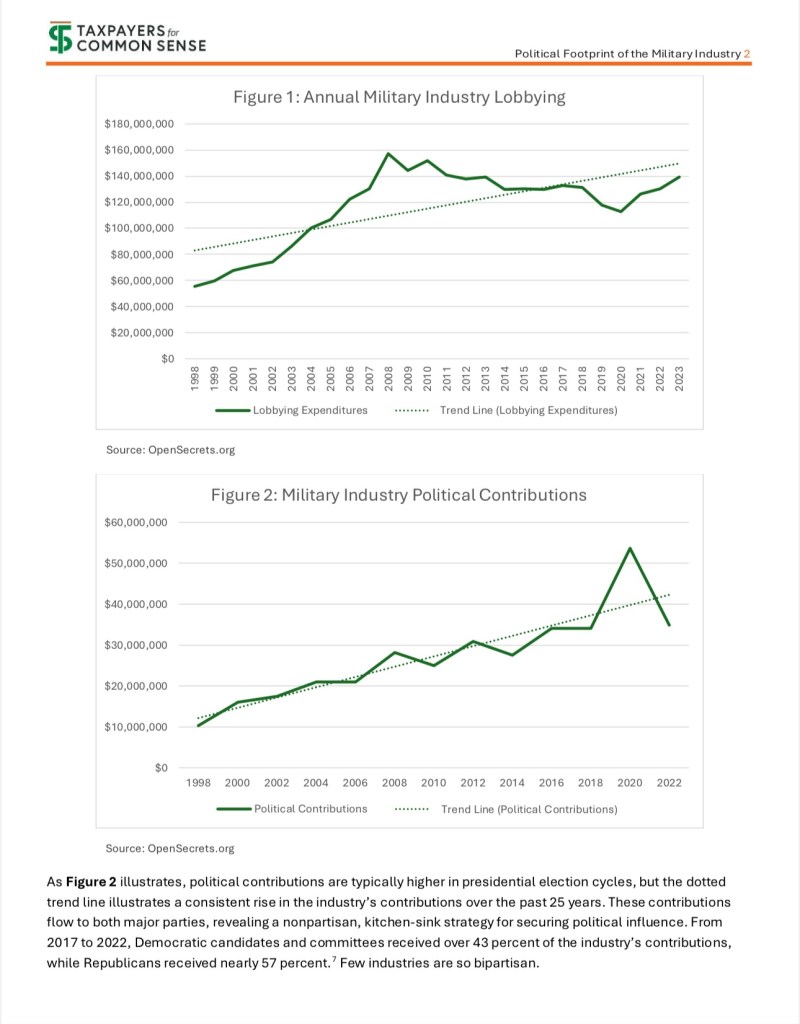
For over two decades, the military industry has consistently spent more than $100 million per year lobbying policymakers to influence policies and spending decisions that support its financial interests. In addition to these lobbying expenditures, the industry contributes tens of millions of dollars to political candidates and committees each election cycle. The sheer scale of this spending buys significant political influence, and the data suggests that this approach is paying off.
US foreign policy seems to be utterly irrational. The US gets into one disastrous war after another — Afghanistan, Iraq, Syria, Libya, Ukraine, and Gaza. In recent days, the US stands globally isolated in its support of Israel’s genocidal actions against the Palestinians, voting against a UN General Assembly resolution for a Gaza ceasefire backed by 153 countries with 89% of the world population, and opposed by just the US and 9 small countries with less than 1% of the world population.
JEEZ, can’t we all just get along? Can’t we be civilized? Can’t we reach across the aisle, find common ground and get things done? Can’t we have a new Morning in America as clubby and chipper as MSNBC’s daily gabfest, “Morning Joe”?
Patients and doctors expect drug regulators to provide an unbiased, rigorous assessment of investigational medicines before they hit the market. But do they have sufficient independence from the companies they are meant to regulate? Maryanne Demasi investigates




 Ms. Cat’s Chronicles
You must be logged in to post a comment.