A common theme in journalist Flavius Mihăies’s investigation into the religious situation in Ukraine was the role of the media and social networks in fostering antagonism toward the UOC. This is discussed in an article on The American Conservative’s website.
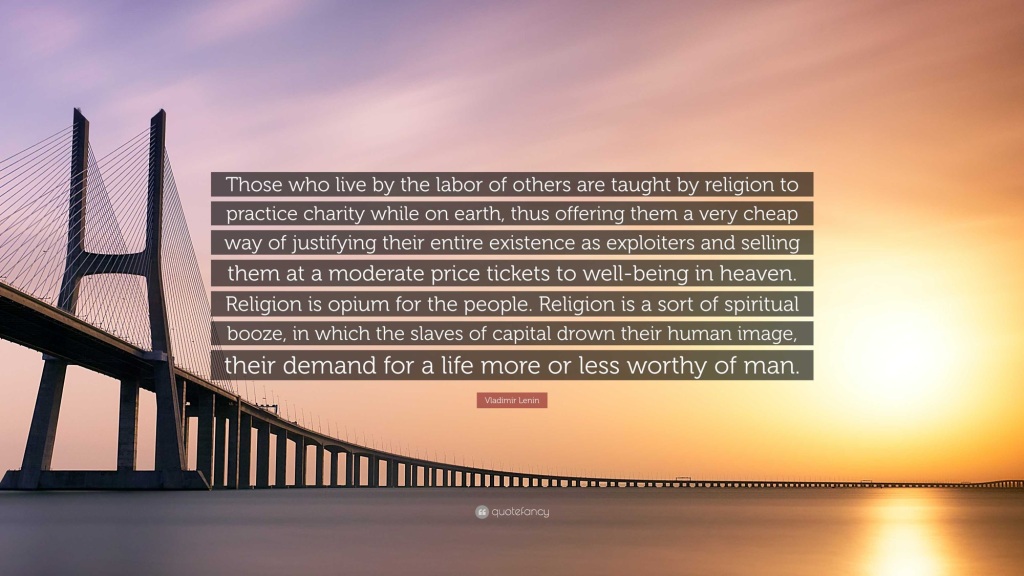
The economic oppression of the workers inevitably calls forth and engenders every kind of political oppression and social humiliation, the coarsening and darkening of the spiritual and moral life of the masses. The workers may secure a greater or lesser degree of political liberty to fight for their economic emancipation, but no amount of liberty will rid them of poverty, unemployment, and oppression until the power of capital is overthrown. Religion is one of the forms of spiritual oppression which everywhere weighs down heavily upon the masses of the people, over burdened by their perpetual work for others, by want and isolation. Impotence of the exploited classes in their struggle against the exploiters just as inevitably gives rise to the belief in a better life after death as impotence of the savage in his battle with nature gives rise to belief in gods, devils, miracles, and the like. Those who toil and live in want all their lives are taught by religion to be submissive and patient while here on earth, and to take comfort in the hope of a heavenly reward. But those who live by the labour of others are taught by religion to practise charity while on earth, thus offering them a very cheap way of justifying their entire existence as exploiters and selling them at a moderate price tickets to well-being in heaven. Religion is opium for the people. Religion is a sort of spiritual booze, in which the slaves of capital drown their human image, their demand for a life more or less worthy of man.
A number of major sites covering the activities and the plight of the persecuted canonical Ukrainian Orthodox Church, including an official UOC resource, have been blocked in Ukraine.
The blocked sites include the UOC’s Information-Education Department (news.church.ua), the Union of Orthodox Journalists (spzh.media), Orthodox Life (pravlife.org), and Raskolam.net. This was reported by both the Union of Orthodox Journalists and Raskolam.net.
…
Last month, the Security Service of Ukraine (SBU) raided the homes and offices and arrested several members of the Union of Orthodox Journalists, who now face life in prison for a number of charges related to their reporting on the persecution of the UOC.
Oleksandr Aliksiychuk stated that MPs plan to vote on the bill to ban the UOC in February 2024.
MP from “Servant of the People” Oleksandr Aliksiychuk stated that the second reading of the bill to ban the UOC will be voted on in February 2024, dedicating it to the second anniversary of the Russian invasion. He said this in an interview with the public organization “Holka”.
I agree with the title “Reaffirming the State of Israel’s Right to Exist” and much of the language, but I’m voting No on the resolution because it equates anti-Zionism with antisemitism. Antisemitism is deplorable, but expanding it to include criticism of Israel is not helpful. pic.twitter.com/YWBDKDCGZB
What if someone says the current boundaries of Israel are illegitimate, that the existing government is illegitimate, or that Israel as an ethno-nationalist state is illegitimate? Would existential criticism be antisemitic?
However, the resolution made no mention of Palestinians — who have their own historical claims in the region — even as it stated that Jewish people are “native to the Land of Israel.”
In a statement, Tlaib argued that the resolution “ignores the existence of the Palestinian people” and “brings us no closer to peaceful coexistence.”
The resolution also states that “denying Israel’s right to exist is a form of antisemitism” — which Massie took issue with.
“Antisemitism is deplorable, but expanding it to include criticism of Israel is not helpful,” Massie wrote on X.
Viktor Yelensky was a member of the Fulbright Scholar Program 2003–2004. Within 2004 he worked at Brigham Young University (Utah, USA).
…
Viktor Yelensky headed the Ukrainian journal for religious studies “Lyudina i Svit” (“Human Being and the World”, 1995–2004) and lead the Kyiv Bureau of Radio Liberty (2005–2008). Also on the radio he was the host of the program “Freedom of Conscience”.
Security forces brandishing machine guns cordoned off a Ukrainian Orthodox monastery in western Ukraine yesterday, to check documents and people, allegedly part of “security” measures.


 Ms. Cat’s Chronicles
You must be logged in to post a comment.