

Credit: Vladimir Sindeyeve

Ukraine can be a military superpower, but only if Europe pays up
Related:
Ukraine can be a military superpower, but only if Europe pays up
Related:
The Pentagon’s acquisition system is being overhauled into a “Warfighting Acquisition System,” turbocharging weapons production, slashing bureaucracy, and empowering officials to deliver arms at “wartime speed.” Portfolio Acquisition Executives now wield sweeping authority, startups are courted like prom queens, and the defense industrial base is being rebranded as Silicon Valley with missiles.
So much for the “peace president”—Trump’s arsenal of freedom looks more like an IPO for war, where venture capital meets missile launchers and bureaucrats cosplay as battlefield commanders.
Forging the Arsenal of Freedom
Related:
The background to the article reprinted here is the “long boom” of western capitalism during the 1950s and 1960s. It first appeared in International Socialism journal in Spring 1967. On the surface it appeared that the capitalist system had stabilised itself, had broken out of the boom-slump cycle and was now able to offer the workers of Western Europe and North America a steady increase in living standards.
This was a frustrating world for Marxists, who found themselves subject to two temptations. One was to surrender to the claims poured out by the system’s apologists that capitalism had solved its problems and that the path of gradual reform offered a sure road to socialism. The other was to deny the obvious signs of stability and prosperity and assert that capitalism was on the verge of imminent, catastrophic collapse. If these temptations were to be avoided, and Marx’s analysis of capitalism’s contradictions was to hold, then the long boom must be explained.
Data-mining company Palantir is poised to turbocharge its sales to the U.S. military under President Donald Trump, amid signs that his administration plans to loosen the hold of traditional defense contractors and tap Palantir executives for key government positions.

Interview with Deepseek Founder: We’re Done Following. It’s Time to Lead
An Yong: After your price cuts, ByteDance was the first to follow, suggesting they felt threatened. How do you view the new competitive landscape between startups and giants?
Liang Wenfeng: To be honest, we don’t really care about it. Lowering prices was just something we did along the way. Providing cloud services isn’t our main goal—achieving AGI is. So far, we haven’t seen any groundbreaking solutions. Giants have users, but their cash cows also shackle them, making them ripe for disruption.
Related:

Soldiers Of Reason: The RAND Corporation and the Rise of the American Empire
Related:
The Rand Corporation: The Think Tank That Controls America (archived)
By the 1960s, America’s rivals were paying attention. The Soviet newspaper Pravda nicknamed RAND “the academy of science and death and destruction.” American outfits preferred to call them the “wizards of Armageddon.”
Really peaceful countries do not waste life and energy in war preparations, With the result that peace is maintained.
Emma Goldman, Patriotism, a Menace to Liberty, Works of Emma Goldman 1911
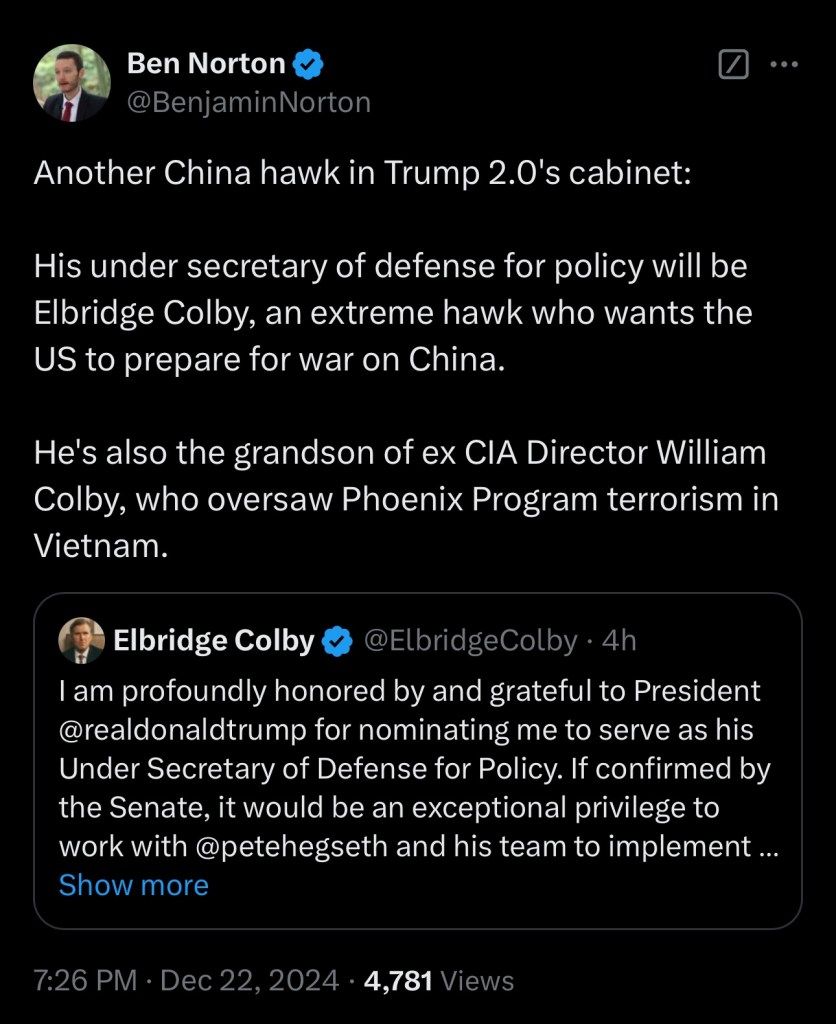

Trump announces picks for deputy secretary of defense, other top DOD posts
Read More »Pentagon Has Two Years to Prevent World War III
By China Hawk Mike Gallagher, Palantir
Xi Jinping has ordered the People’s Liberation Army to be ready to seize Taiwan by 2027. Whether he launches an invasion may depend on President Trump’s defense secretary. If confirmed by the Senate, Army National Guard veteran and Fox News host Pete Hegseth, Mr. Trump’s nominee, will have to confront the collapse of deterrence in Europe and the Middle East, resource constraints on Capitol Hill, recruitment challenges, and a deteriorating balance of power in the Indo-Pacific. The only way to promote peace is to go to war on day one—not with China, Russia or Iran but with the Pentagon bureaucracy.
Gallagher wants a wartime economy while leaving the financing to the private sector. It won’t work. 👇👇👇
Related:
US Seeks “Super Weapons” to Reign as Sole Superpower
In reality, Russia and China’s industrial bases are larger than America’s because of a number of factors, including factors no amount of American political will, can overcome. China in particular has a population four times greater than the US. China graduates millions more each year in the fields of science, technology, engineering, and mathematics than the US, and the physical size of its industrial base – military or otherwise – reflects this demographic disparity.
Even if the US had the political will to reform its military industrial base, stripping away profit-driven private industry and replacing it with purpose-driven state-owned enterprises, even if the US likewise transformed its education system to produce a skilled workforce rather than squeeze every penny from American students, and even if the US invested in its national infrastructure – a fundamental prerequisite for expanding its industrial base – it still faces a reality where China has already done all of this, and done so with a population larger than it and its G7 partners combined.
FYI, Gallagher is with Palantir, as well as the Hudson Institute.
Hudson Institute’s funding
China’s hybrid “state capitalist” system, driven by centralized planning and fierce competition, has led to dominance in critical technological fields and emerging markets. Western multinational corporations are advised to adopt a pragmatic approach to capitalize on four key strengths of China’s economy: its innovation ecosystem, its investment in the Global South, its ultra-competitive markets, and its vast consumer base. Those who fail to engage risk losing global revenue and strategic opportunities.
The 4 Key Strengths of China’s Economy — and What They Mean for Multinational Companies
Intel on Thursday revealed drastic plans to slash its employee headcount and capital spending in an attempt to put its business back on a stable financial footing, as it suffered the latest setback in its slow-moving turnaround plans.
Related:
US CHIPS Act Funding for Intel
On March 20, 2024, the U.S. Department of Commerce and Intel Corporation announced a preliminary memorandum of terms under which Intel will receive approximately $8.5 billion in direct funding under the CHIPS and Science Act. Funding will help advance Intel’s critical semiconductor manufacturing and research and development projects at sites in Arizona, New Mexico, Ohio and Oregon – U.S. locations where the company produces some of the world’s most advanced chips and semiconductor packaging technologies.
Meanwhile, in China:
China’s ‘basic self-sufficiency’ in chip-making tools could come this summer, veteran says
 Ms. Cat’s Chronicles
You must be logged in to post a comment.