
American private military firms could be deployed to Ukraine as part of a long-term peace plan.
Donald Trump is in talks with European allies about allowing armed contractors to help build fortifications to protect American interests in the country.
Tag: retaliation
Capes, Cameras, and the Cult of Visibility
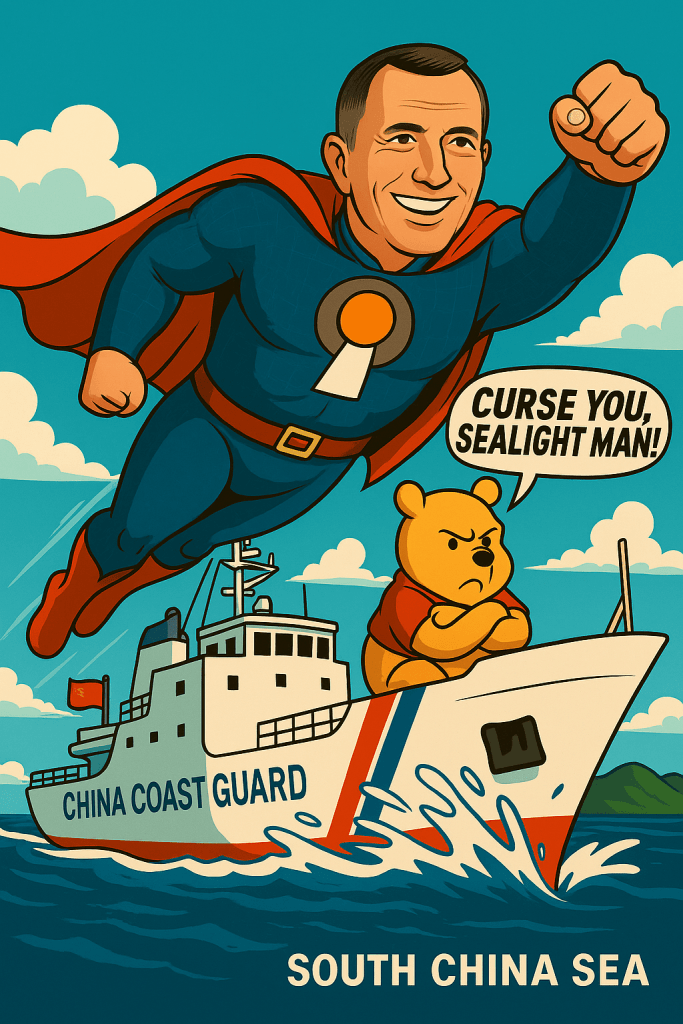
Capes, Cameras, and the Cult of Visibility: The SeaLight Crusade as White Savior Theater
By Tina Antonis
The South China Sea is more than a maritime dispute—it’s a theater of narrative warfare. While headlines focus on Chinese aggression and Philippine resistance, a quieter campaign unfolds in the background: one of satellite feeds, curated imagery, and Pentagon-backed storytelling. At the center of this effort is SeaLight, a project that claims to illuminate truth but often casts shadows of its own.
As explored in my article at Antiwar.com, SeaLight doesn’t just document—it performs. It reframes geopolitical tension through moral spectacle, positioning its creators as heroic arbiters of transparency. But when the messenger wears a cape and the funding flows from defense budgets, we must ask: is this clarity, or choreography?
Stage Left: The White Savior Enters
In the comic-strip cosmology of Ray Powell’s SeaLight project, transparency wears a cape. Clad in heroic postures and backed by satellite imagery, Powell casts himself as the guardian of maritime morality—unarmed, except with satellite feeds, theatrical flair, and strategic messaging.
Yet beneath the cartoon and Pentagon-funded optics lies a familiar archetype: the white savior, rebranded for the South China Sea.
China Is Imperialist? Says Who?
Calling China a “maritime occupier,” Powell positions himself as a bulwark against aggression. But that moral pose collapses under scrutiny. He speaks for a country with over 800 foreign military installations and a documented history of over 250 military interventions since 1991—wars in Iraq, Afghanistan, Libya, Syria, Somalia, and dozens more, all under the banner of peace, freedom, or preemption.
By comparison, China’s post–Cold War footprint includes no sustained foreign occupations and only scattered border conflicts and peacekeeping missions. The imbalance is staggering. And Powell’s framing doesn’t just ignore it—it performs around it.
As David Vine argues in The United States of War, this vast base empire is not a passive network—it’s an architecture of perpetual war. These outposts make military engagement not an exception but a structural habit, cloaked in strategic necessity and sold as global stewardship.
Powell’s cartoon rhetoric—calling China an occupier—obscures the scale of U.S. militarism. The term “occupation” is deployed not to analyze, but to project. When adversaries hold territory, it’s a crisis; when the U.S. spans the globe with armed installations, it’s policy.
Framing Conflict: The Optics of Consent
This isn’t irony. It’s performance. Powell’s language manufactures a moral frame for confrontation—costumed in transparency, but driven by escalation. The cape is literal. The conditioning is deliberate. And the stage is set for war.
SeaLight’s mission is not just visual documentation—it’s narrative warfare. As the Japan Times openly notes, its “chief weapon is photography, applied purposefully, generously and consistently over time.” These images—enhanced, curated, and distributed across media—are not neutral. They’re constructed to shape public perception, sway international opinion, and ultimately manufacture consent for confrontation.
Assertive transparency becomes a kind of ideological scaffolding—a stage on which geopolitical tension is dramatized, simplified, and morally polarized. The goal isn’t simply to reveal conflict; it’s to condition audiences for escalation.
And when the messenger dons a superhero’s cape, the spectacle transforms into something deeper: a story of rescue, of virtue, of intervention. This is not analysis—it’s soft propaganda dressed in heroic metaphor.
Consent for war doesn’t begin with missiles. It begins with mythmaking.
False Flag or Green Light? Behind Congress’ Bunker Buster Bill
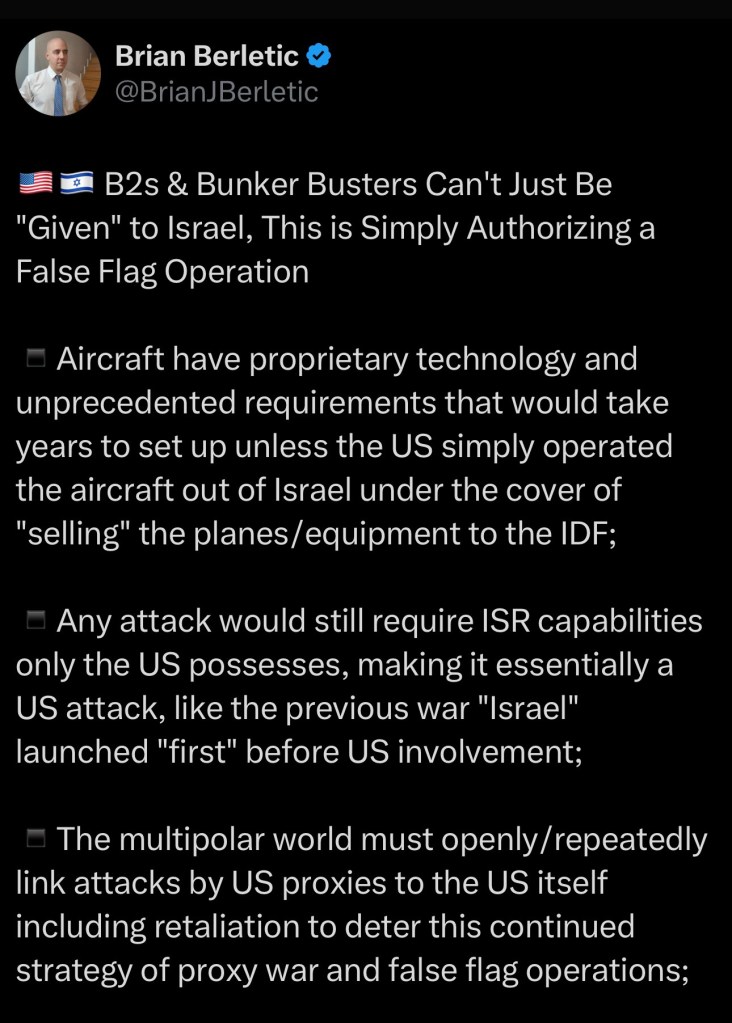
A new bipartisan bill in Congress would give Israel access to US weaponry to conduct strikes on Iran’s nuclear facility, similar to the one ordered by President Donald Trump last month.
New Bill Would Give Israel Access to B-2s, Massive Bombs to Strike Iran
They Left It to Bibi—And Look What Happened
That’s an…interesting choice for a nuclear site. /s
The Israeli Air Force conducted dozens of strikes in Iran on Thursday targeting nuclear and missile sites.
Related:
Read More »US Using Israel to Provoke Iran War, Deny Responsibility, Minimize Retaliation
Germany’s Missile Range Decision: A Perilous Step Towards Global Conflict
Berlin, 26 May 2025 – In a chilling act of imperial hubris, German Chancellor Friedrich Merz has declared that Germany, in lockstep with its NATO overlords, has unshackled the range restrictions on missiles supplied to Ukraine, greenlighting strikes deep into Russia’s heart. This brazen escalation, announced today, is no mere policy shift; it is a deliberate provocation, a reckless lunge towards a global conflagration that could sear humanity’s future. The West, cloaked in the sanctimonious rhetoric of “defending Ukraine,” is goading Russia into a corner, gambling with the lives of millions in a game of geopolitical brinkmanship.
Germany’s Missile Range Decision: A Perilous Step Towards Global Conflict
The Documentary Columbia University Doesn’t Want You to See: Macklemore’s The Encampments Drops March 28

Acclaimed artist and activist Macklemore ventures beyond the music stage, lending his production prowess to the upcoming documentary The Encampments, a gripping and unflinching portrayal of the Columbia University Gaza Solidarity Encampment. Opening at the Angelika Film Center in New York on March 28, the film promises to deliver a powerful, unvarnished account of student activism, institutional crackdowns, and the international wave of solidarity that followed.
Chokepoints Are The Focus Of A New Cold War
By Captain John Konrad (gCaptain) In 1883, Alfred Thayer Mahan laid out the brutal truth of global power: Whoever rules the waves rules the world. He wasn’t just talking about fleets of warships. He was talking about chokepoints—the narrow passages through which the vast majority of the world’s trade must pass. Control them, and you don’t need to launch an invasion. You can starve an economy and restrict military sealift without ever firing a shot.
Related:
Trump orders military to plan invasion of Panama to seize canal: report
US Seizing Panama & Greenland Aimed at China (archived)
Stranglehold: The Context, Conduct and Consequences of an American Naval Blockade of China
Offshore Control: A Proposed Strategy for an Unlikely Conflict
How can people support Luigi Mangione but vote in droves to deny health care to others?
How can people support Luigi Mangione but vote in droves to deny health care to others?
Last week was a bizarre time to be queer on social media: Many cishet people voiced enthusiastic support for Luigi Mangione, the man accused of shooting and killing UnitedHealthcare CEO Brian Thompson, arguing that the health insurer’s denial of claims led to so many deaths that the murder was justified as retaliation. Meanwhile, Congress was passing a bill that would require an insurer (Tricare) to deny claims, and it was hard to get anyone to even pay attention to that.
Read More »
What’s Really Going On In the South China Sea Between the Philippines and China
What’s Really Going On In the South China Sea Between the Philippines and China
by Tina Antonis
Maritime clashes between the Philippines and China had been mostly over the Philippines’ military outpost, BRP (BRP—Barko ng Republika ng Pilipinas, which translates to “Ship of the Republic of the Philippines”—the ship prefix for the Philippines) Sierra Madre, in the Spratly Islands, which is disputed by Brunei, China, Malaysia, the Philippines, Taiwan (a province of China, as recognized by the United Nations’ Resolution No. 2758), and Vietnam. The BRP Sierra Madre was intentionally run aground on a reef near the Second Thomas Shoal in the disputed Spratly Islands, in 1997, so that the Philippines could stake their territorial claim.
Read More » Ms. Cat’s Chronicles
You must be logged in to post a comment.