Secondly, a revolution is not a dinner party, or writing an essay, or painting a picture, or doing embroidery; it cannot be so refined, so leisurely and gentle, so temperate, kind, courteous, restrained and magnanimous. [4] A revolution is an insurrection, an act of violence by which one class overthrows another.
LENIN became an active revolutionist through the spiritual motives that have moved all great reformers — not because he himself was hungry and an outcast, but because he could not stand by unmoved in a world where other men were hungry and outcast. Such characters are predestined internationalists; the very quality that lifts them above materialism places them above borders and points of geography; they strive for the universal good. Lenin believes that the only thing worth living for is the next generation. Communism is his formula for saving the next generation from the injustices and inequalities of the present.
Woman’s fate is bound up with that of the exploited male. This is a fact. However, this solidarity, arising from the exploitation that both men and women suffer and that binds them together historically, must not cause us to lose sight of the specific reality of the woman’s situation. The conditions of her life are determined by more than economic factors, and they show that she is a victim of a specific oppression. The specific character of this oppression cannot be explained away by setting up an equal sign or by falling into easy and childish simplifications.
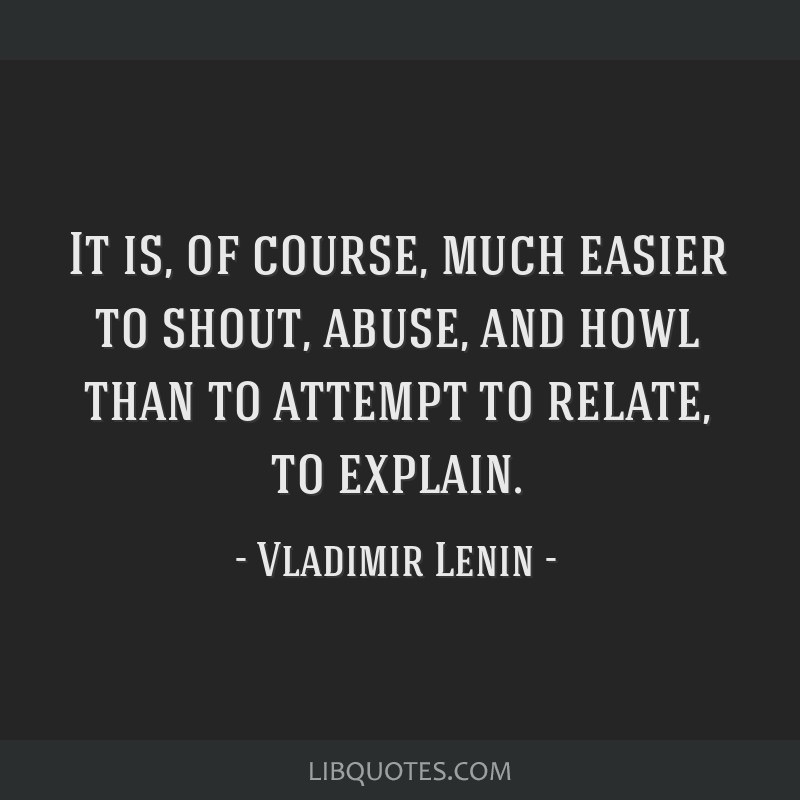
Vladimir Lenin once remarked, “It is, of course, much easier to shout, abuse, and howl than to attempt to relate, to explain,” highlighting the value of constructive dialogue and education over emotional outbursts or hostile rhetoric. As a revolutionary thinker and leader, Lenin stressed the importance of articulating ideas and strategies clearly to foster understanding and rally support for the socialist movement.
He criticized those who relied on anger, insults, or simplistic slogans, arguing that such tactics undermined the more challenging but essential work of educating and persuading others. For Lenin, successful revolutionary efforts depended on thoughtful explanation, open dialogue, and the ability to engage with people on a rational level. This method was crucial for building a disciplined and informed movement capable of achieving lasting goals, rather than succumbing to fleeting emotional appeals or divisive strategies.
Ultimately, Lenin advocated for a deliberate and strategic approach to political struggle—one rooted in clarity, reason, and the empowerment of the working class through education and mutual understanding.
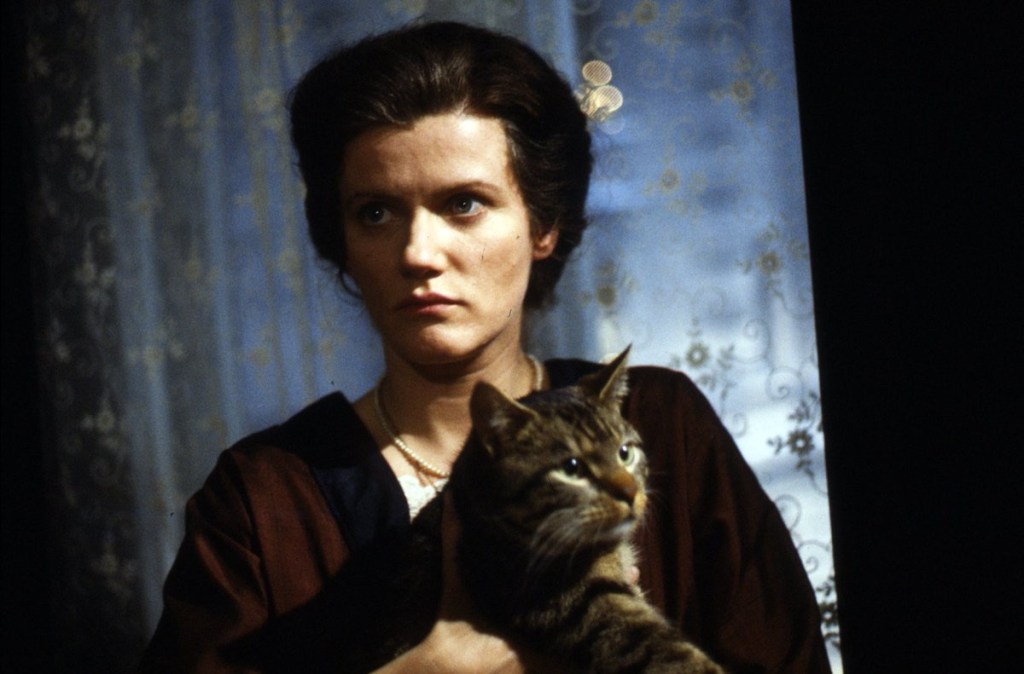
”This is not Rosa Luxemburg. It is actress Barbara Sukowa playing Rosa Luxemburg in a 1986 film. There do not appear to be any historical photos of Mimi the cat, so we chose this one.“
Rosa Luxemburg was known as a ball of energy — “like a candle burning at both ends.” But like every person, she also suffered moments of despair.
Vladimir Lenin, as a revolutionary and Marxist thinker, approached most topics through the lens of class struggle, materialism, and the broader social and economic systems. While he did not write or speak extensively about love as a personal or romantic concept, his views on human relationships were likely shaped by his Marxist perspective.
Here’s how Lenin might conceptualize love, based on his ideological framework:
Beneath the frost of Russia’s sky, Where snowflakes dance and whispers lie, A man with purpose, stern and keen, Once walked the streets—Vladimir Lenin.
You must be logged in to post a comment.