
Bourgeois revolutions, like those of the eighteenth century, storm swiftly from success to success, their dramatic effects outdo each other, men and things seem set in sparkling brilliants, ecstasy is the everyday spirit, but they are short-lived, soon they have attained their zenith, and a long crapulent depression seizes society before it learns soberly to assimilate the results of its storm-and-stress period.
On the other hand, proletarian revolutions, like those of the nineteenth century, criticise themselves constantly, interrupt themselves continually in their own course, come back to the apparently accomplished in order to begin it afresh, deride with unmerciful thoroughness the inadequacies, weaknesses and paltrinesses of their first attempts, seem to throw down their adversary only in order that he may draw new strength from the earth and rise again, more gigantic, before them, and recoll again and again from the indefinite prodigiousness of their own aims, until a situation has been created makes all turning back impossible…
Karl Marx, The Eighteenth Brumaire of Louis Bonaparte, MECW Vol. 11.
Tag: revolutions
My Highlights from The Fidel Castro Reader
I wasn’t expecting to find myself reflecting on Fidel Castro’s childhood while reading this chapter of The Fidel Castro Reader. I don’t know much about Castro’s personal life, but I was struck by how he too was immersed in religion at a young age, attending Catholic schools and being shaped by that environment.
Read More »Anna Louise Strong: Stalin

Friedrich Engels ‐ On Authority
Works of Frederick Engels 1872: On Authority
A number of Socialists have latterly launched a regular crusade against what they call the principle of authority. It suffices to tell them that this or that act is authoritarian for it to be condemned. This summary mode of procedure is being abused to such an extent that it has become necessary to look into the matter somewhat more closely.
…
Therefore, either one of two things: either the anti-authoritarians don’t know what they’re talking about, in which case they are creating nothing but confusion; or they do know, and in that case they are betraying the movement of the proletariat. In either case they serve the reaction.
Murray Bookchin’s Legacy in a Landscape of Gatekeeping
The revolutionary origins of Memorial Day and its political hijacking
Revolution is not a dinner party

Report on an Investigation of the Peasant Movement in Hunan:
Secondly, a revolution is not a dinner party, or writing an essay, or painting a picture, or doing embroidery; it cannot be so refined, so leisurely and gentle, so temperate, kind, courteous, restrained and magnanimous. [4] A revolution is an insurrection, an act of violence by which one class overthrows another.
The ‘Foreign Policy Consensus’ Is Alive and Well in Washington
The ‘Foreign Policy Consensus’ Is Alive and Well in Washington
by José Niño, Libertarian Institute
Brian Berletic, a former U.S. Marine now residing in Thailand, believes something bigger might be at play with Trump’s foreign policy agenda. The talk of foreign policy restraint vis-a-visa Russia is merely a facade. Berletic pointed out that Defense Secretary Pete Hegseth’s “division of labor” framework during his February 2025 address in Brussels will only increase tensions with Russia.
Read More »
Vladimir Lenin on Economic Disparity, Private Property, and the Need for Systemic Change
The Second Congress of the Communist International
In the United States of America food prices have risen, on the average, by 120 per cent, whereas wages have increased only by 100 per cent. In Britain, food prices have gone up by 170 per cent, and wages 130 per cent; in France, food prices—300 per cent,. and wages 200 per cent; in Japan—food prices 130 per cent, and wages 60 per cent (I have analysed Comrade Braun’s figures in his pamphlet and those of the Supreme Economic Council as published in The Times of March 10, 1920).
In such circumstances, the workers’ mounting resentment, the growth of a revolutionary temper and ideas, and the increase in spontaneous mass strikes are obviously inevitable, since the position of the workers is becoming intolerable. The workers’ own experience is convincing them that the capitalists have become prodigiously enriched by the war and are placing the burden of war costs and debts upon the workers’ shoulders. We recently learnt by cable that America wants to deport another 500 Communists to Russia so as to get rid of “dangerous agitators”.
Even if America deports to our country, not 500 but 500,000 Russian, American, Japanese and French “agitators” that will make no difference, because there will still be the disparity between prices and wages, which they can do nothing about. The reason why they can do nothing about it is because private property is most strictly safeguarded, is “sacred” there. That should not be forgotten, because it is only in Russia that the exploiters’ private property has been abolished. The capitalists can do nothing about the gap between prices and wages, and the workers cannot live on their previous wages. The old methods are useless against this calamity. Nothing can be achieved by isolated strikes, the parliamentary struggle, or the vote, because “private property is sacred”, and the capitalists have accumulated such debts that the whole world is in bondage to a handful of men. Meanwhile the workers’ living conditions are becoming more and more unbearable. There is no other way out but to abolish the exploiters’ “private property”.
The State: A Product of the Irreconcilability of Class Antagonisms
The State: A Product of the Irreconcilability of Class Antagonisms
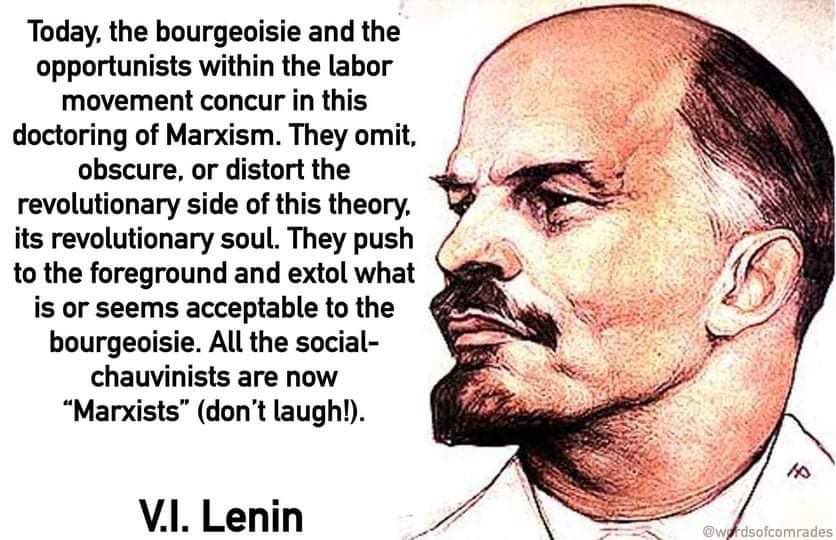
What is now happening to Marx’s theory has, in the course of history, happened repeatedly to the theories of revolutionary thinkers and leaders of oppressed classes fighting for emancipation. During the lifetime of great revolutionaries, the oppressing classes constantly hounded them, received their theories with the most savage malice, the most furious hatred and the most unscrupulous campaigns of lies and slander. After their death, attempts are made to convert them into harmless icons, to canonize them, so to say, and to hallow their names to a certain extent for the “consolation” of the oppressed classes and with the object of duping the latter, while at the same time robbing the revolutionary theory of its substance, blunting its revolutionary edge and vulgarizing it. Today, the bourgeoisie and the opportunists within the labor movement concur in this doctoring of Marxism. They omit, obscure, or distort the revolutionary side of this theory, its revolutionary soul. They push to the foreground and extol what is or seems acceptable to the bourgeoisie. All the social-chauvinists are now “Marxists” (don’t laugh!). And more and more frequently German bourgeois scholars, only yesterday specialists in the annihilation of Marxism, are speaking of the “national-German” Marx, who, they claim, educated the labor unions which are so splendidly organized for the purpose of waging a predatory war!
 Ms. Cat’s Chronicles
You must be logged in to post a comment.